Current bull markets in the S&P 500 and Nasdaq Composite may seem like cause for celebration, yet a deeper dive reveals an unorthodox trajectory that poses significant implications for future market performance. Understanding this anomaly is crucial for investors to safeguard their portfolios.
Deciphering Market Behavior
Commonly, the S&P 500’s performance is equated with the broader stock market’s health. On the other hand, assessing indexes like the Dow Jones Industrial grants insight based on sectoral and industrial metrics.
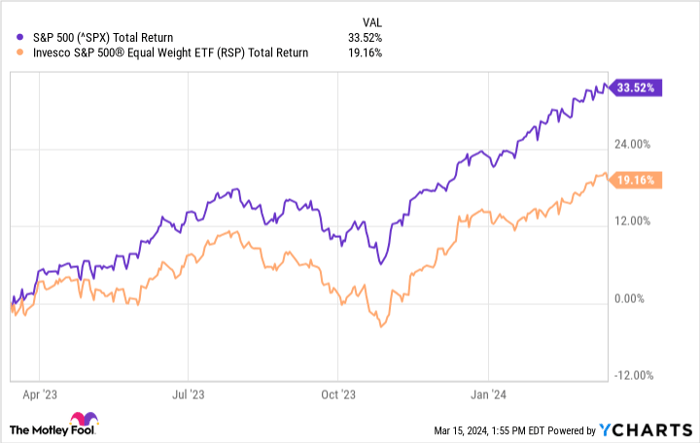
In periods of market upswings, it is generally assumed that most stocks are faring well, despite some facing challenges. Over the last year, the S&P 500 has surged by 33.5%, with the Nasdaq following suit at 42.3%. At first glance, these figures signal robust corporate financial performance and optimistic investor sentiments. While this is true to a large extent, there is a unique trend lurking beneath the surface that investors cannot afford to overlook.
A Rising Tide Doesn’t Lift All Boats
Market indexes are usually governed by market capitalization, meaning that stocks with higher valuations hold more considerable weight within an index. While this rationale aligns with the substantial impact that large corporations have on economic activity and shareholder returns, it also leads to considerable index concentration. In fact, the top 50 companies in the S&P account for nearly 60% of the index, with Microsoft alone representing 7%.
Conversely, some exchange-traded funds (ETFs) adopt an equal-weighting approach, disregarding company size and valuation in the portfolio allocation. Monitoring the performance of these equal-weighted funds against market-weighted indexes provides valuable insights, especially during atypical market trends, such as the one currently unfolding.
The Invesco S&P 500 Equal Weight ETF (NYSEMKT: RSP) has trailed the S&P 500 index by almost 14 percentage points over the past year, mirroring a similar trend between the Direxion NASDAQ-100 Equal Weighted ETF (NYSEMKT: QQQE) and the Nasdaq.
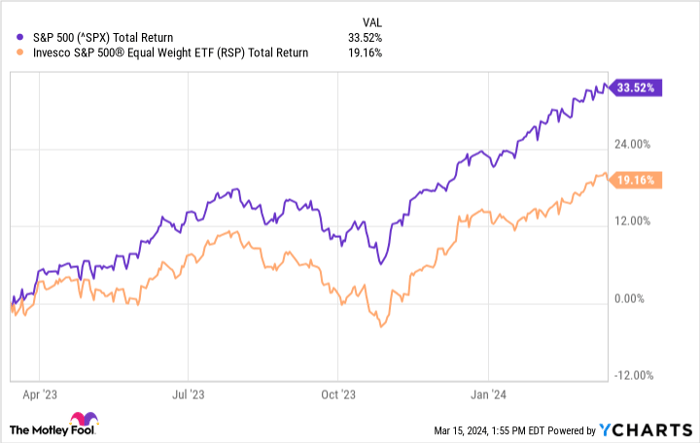
^SPX data by YCharts.
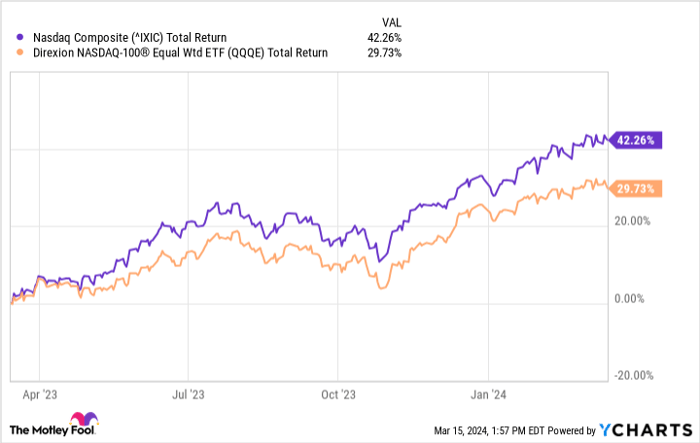
^IXIC data by YCharts.
Although these equal-weighted funds have shown above-average returns, it is evident that not all stocks are experiencing the same degree of prosperity as the largest players. This nuance is imperceptible when solely considering index performance, indicating a potential pitfall for uninformed investors.
Unraveling the “Magnificent Seven”
Historically, major stocks tend to align closely with the broader market over the long run. While tech giants have shown impressive momentum in recent bullish phases, equal-weight ETFs have usually kept pace with their cap-weighted counterparts.
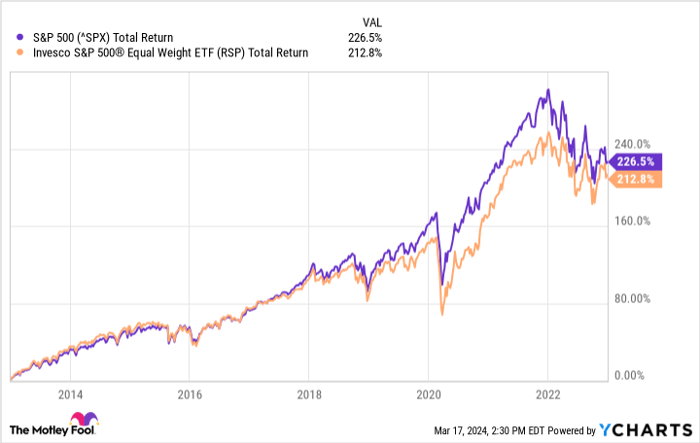
^SPX data by YCharts.
However, a shift has occurred in the past year, with the emergence of the “Magnificent Seven” – a group of tech stocks that have reigned supreme in the market sphere.
These companies, hailed as leaders in high-growth industries, captivated investors by trimming costs during uncertain economic climates in the previous year. Apprehensions surrounding consumer resilience and high interest rates restrained investors from fully embracing riskier growth stocks. Yet, the prospect of forthcoming rate cuts by the Federal Reserve deterred asset managers from overly conservative allocations, with the Magnificent Seven offering reliability alongside elevated growth potential.
Despite posting stellar financial results, the soaring prices of these stocks, partly fueled by inflated valuations, remain a point of concern. Most within this elite group now trade at premium valuations that may revert to a more sustainable equilibrium based on future cash flows without a sustained outperformance relative to the market at large. In such a scenario, these tech behemoths risk enduring substantial losses during the next market downturn, or the broader index may narrow the performance gap through the ongoing bull phase.
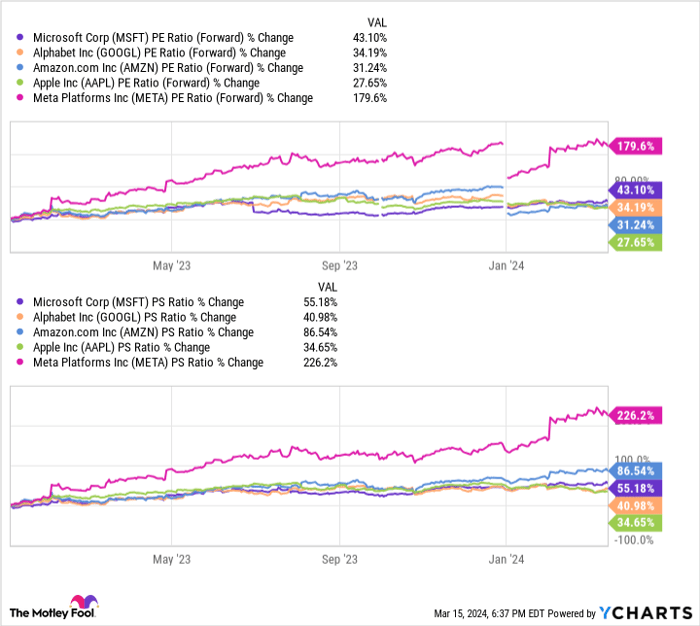
MSFT PE Ratio (Forward) data by YCharts.
Therefore, vigilance in assessing portfolio concentration and avoiding excessive risk-taking is paramount for investors. While high-conviction stocks can form a part of your investment strategy, periodic rebalancing in response to fluctuating relative valuations is a prudent approach. Remember, yesterday’s winners might not be tomorrow’s champions.
Whether you lean towards index investing or prefer individual stocks, align your expectations with the current performance landscape to make informed decisions.
Is it Time to Invest in Invesco Exchange-Traded Fund Trust – Invesco S&P 500 Equal Weight ETF?
Prior to investing in Invesco Exchange-Traded Fund Trust – Invesco S&P 500 Equal Weight ETF, consider this:
The Motley Fool Stock Advisor analyst team recently unveiled their selection of what they believe are the 10 best stocks for investors to acquire presently…and Invesco Exchange-Traded Fund Trust – Invesco S&P 500 Equal Weight ETF didn’t make the cut. These chosen 10 stocks hold the potential to yield exceptional returns in the years to come.
Stock Advisor offers investors a comprehensive roadmap for success, providing portfolio-building guidance, regular analyst updates, and two new stock recommendations each month. The Stock Advisor service has surpassed the S&P 500’s returns by over threefold since 2002*.
Discover the 10 stock picks
*Stock Advisor returns as of March 21, 2024
John Mackey, former CEO of Whole Foods Market, an Amazon subsidiary, serves on The Motley Fool’s board of directors. Randi Zuckerberg, ex-director of market development and spokesperson for Facebook and sister to Meta Platforms CEO Mark Zuckerberg, is a member of The Motley Fool’s board of directors. Suzanne Frey, an executive at Alphabet, also sits on The Motley Fool’s board of directors. Ryan Downie has holdings in Alphabet, Amazon, Microsoft, and Nvidia. The Motley Fool holds positions in and recommends Alphabet, Amazon, Apple, Meta Platforms, Microsoft, Nvidia, and Tesla. The Motley Fool suggests the following options: long January 2026 $395 calls on Microsoft and short January 2026 $405 calls on Microsoft. The Motley Fool abides by a disclosure policy.
The viewpoints expressed here represent the author’s perspective and not necessarily those of Nasdaq, Inc.