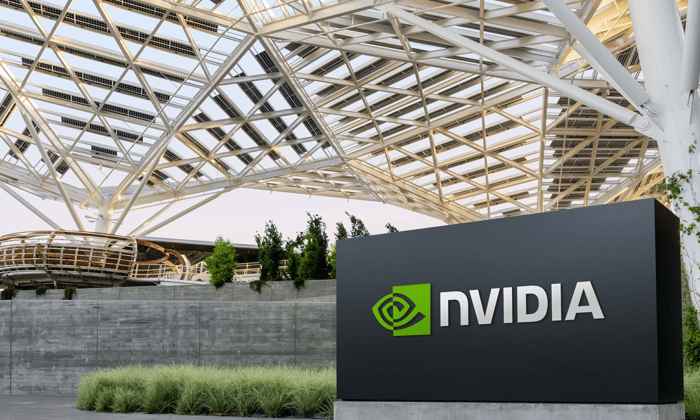
Securing a spot in the elite $1 trillion valuation arena is no small feat, with only a handful of companies making the cut after years of unwavering operational supremacy. At present, a mere six U.S. companies boast valuations exceeding $1 trillion, with the likes of Microsoft, Apple, Nvidia, Alphabet, Amazon, and Meta Platforms leading the charge. However, the true leaders of the pack, Apple and Microsoft, stand tall with valuations surpassing the $2 trillion mark, a figure recently tempered by a slight stock market retreat. Nvidia, on the other hand, surged past the $2 trillion milestone during Friday’s market opening, closing just shy of the significant sum. Currently valued at $1.97 trillion, with $1 trillion added within the last year alone, Nvidia stands on the precipice of the $2 trillion threshold, poised to carve a permanent niche amongst the industry titans.
The Seeds of Innovation: Nvidia’s Storied Legacy
Seedlings of visionary innovation planted back in 1993 have blossomed into Nvidia’s modern tale of triumph. Originally created to revolutionize 3D graphics within gaming and multimedia, the company unveiled the world’s premier graphics processing unit (GPU) in 1999, heralding the inception of the GeForce brand that continues to reign supreme in the gaming realm. However, the metamorphosis of GPUs now extends beyond gaming, permeating the data center landscape. Powered by hundreds of cores, GPUs, notably the H100, excel in processing voluminous data at lightning speeds, making them indispensable for artificial intelligence (AI) workloads. The advent of the H100 has been the linchpin propelling Nvidia’s exponential growth over the past year. Yet, innovation knows no bounds as Nvidia forges ahead with crafting the transcendent H200. Doubling the inferencing speeds of its predecessor while consuming half the energy, the H200 emerges as a cost-effective data center juggernaut. With shipments on the brink of scaling to new heights, Nvidia stands at the vanguard, poised to satiate an insatiable market demand.
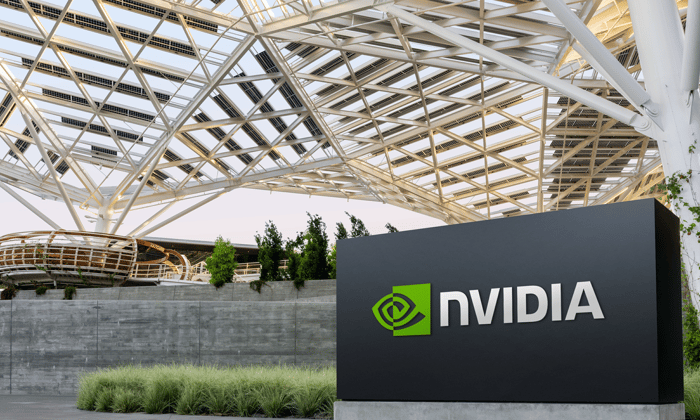
Image source: Nvidia.
Beyond Hardware: The Software Nexus
Nvidia’s ascent is not solely scripted by hardware dominion but is also propelled by a burgeoning software ecosystem. The CUDA platform, a cornerstone of this ecosystem, empowers developers to optimize GPUs, expediting application development processes. A trump card in Nvidia’s hand is that CUDA remains exclusive to Nvidia’s GPUs, foiling any competitor’s bid to usurp its domain. But the plot thickens as CEO Jensen Huang unveils Nvidia’s foray into AI Enterprise, an artificial intelligence operating system that arms businesses with development tools and pre-trained models to hasten the AI application development cycle. Embedding its roots in major cloud platforms like Amazon Web Services, Microsoft Azure, and Google Cloud, Nvidia seamlessly segues into the echelons of millions of potential clients.
Exponential Growth Trajectory: Nvidia’s Revenue Odyssey
The crescendo of Nvidia’s revenue symphony crescendoed with the close of fiscal 2024, tallying a monumental $60.9 billion, a staggering 126% surge from the preceding fiscal year. Mirroring this surge, Nvidia’s revenue has embarked on a tenfold journey over the past eight years, underscoring the company’s meteoric ascent. The data center arm emerged as the vanguard of Nvidia’s fiscal zenith, spearheaded by the AI-driven H100 GPU. Commandeering $47.5 billion or 78% of the company’s total revenue, the data center segment skyrocketed by 217% from fiscal 2023. Prognostications for the maiden voyage of fiscal 2025 echo a robust forecast of $24 billion in total revenue, translating to a formidable 233% upswing vis-a-vis the initial quarter of fiscal 2024. Nvidia’s visionary helm, Jensen Huang, foresees the generative AI revolution unfurling new vistas, catalyzing an imminent doubling of the world’s data center infrastructure base. This monumental shift heralds an opportunity worth hundreds of billions over the next quinquennium.
The Final Sprint: Nvidia’s Tryst with the $2 Trillion Pedestal
Precariously perched at $1.97 trillion, Nvidia is on the cusp of ascending to the empyrean $2 trillion enclave. Having eclipsed tech stalwarts like Amazon and Alphabet in valuation, a mere 1.5% stock uptick will catapult Nvidia into the exclusive echelon graced by Apple and Microsoft. The present price-to-earnings (P/E) ratio of 60.6 may raise eyebrows as being exorbitant, almost double the 32.1 P/E ratio of the Nasdaq-100 index, warranting cautious optimism. Yet, Wall Street’s crystal ball forecasts a fiscal 2025 earnings of $20.44 for Nvidia, which could potentially whittle down the P/E ratio to 37.9, still a premium relative to the Nasdaq-100. Riding this wave of optimism, Loop Capital’s analyst envisions a 53% spike in Nvidia’s stock, sending valuation soaring to nearly $3 trillion. While the short-term realism of this projection may be contested, the long-term horizon paints a compelling narrative, echoing Jensen Huang’s prognostications of a data center revolution galvanizing Nvidia’s journey into unfathomed realms of prosperity.
Should you invest $1,000 in Nvidia right now?
Before diving headlong into Nvidia stock, weigh this in mind:
The Motley Fool Stock Advisor analyst cohort has spotlighted the 10 best stocks for investor portfolios, with Nvidia not featuring on the esteemed roster. These ten stocks are poised to unleash ferocious growth in the ensuing years.
Stock Advisor disseminates a roadmap to success, proffering guidance on portfolio construction, analyst insights, and bi-monthly stock picks. Since 2002*, Stock Advisor has eclipsed S&P 500 returns thrice over.
Delve into the 10 stocks
*Stock Advisor returns as of February 20, 2024
Suzanne Frey, an Alphabet luminary, sits on The Motley Fool’s board of directors. Randi Zuckerberg, erstwhile market development director and Meta Platforms CEO Mark Zuckerberg’s sibling, is also on The Motley Fool’s board of directors. John Mackey, former Whole Foods Market CEO under Amazon’s aegis, is yet another notable on The Motley Fool’s board. Anthony Di Pizio has no holdings in the companies discussed. The Motley Fool boasts positions in and recommends Apple, Amazon, Alphabet, Meta Platforms, Microsoft, and Nvidia. The Motley Fool advocates for long January 2026 $395 calls on Microsoft and short January 2026 $405 calls on Microsoft. The Motley Fool adheres to a strict disclosure policy.
Opinions expressed in this article are solely those of the author and do not necessarily reflect Nasdaq, Inc.’s viewpoints.