February brought a ray of hope for retailers, with a 0.6% increase in retail sales, despite higher consumer prices. The economic scene is further brightened by the Federal Reserve’s hints at cutting interest rates thrice in 2024. Yet, amidst this landscape of optimism, some retail stocks appear to be on shaky ground, presenting a dilemma for investors.
While this era seems ripe for retail growth, clinging to certain stocks may prove costly. This is a poignant reality as signs point to a conducive environment for some retailers to soar ahead, leaving laggards behind in their shadow.
Here are three retail stocks that are flashing caution signals and perhaps should be ushered towards the exit door.
The Love-Hate Saga of Lovesac (LOVE)

Source: JHVEPhoto / Shutterstock.com
Lovesac (NASDAQ:LOVE) stands out with its innovative modular furniture and commitment to environmental, social, and governance (ESG) principles.
Despite a robust 30.8% surge in net sales for fiscal 2023, LOVE faces a conundrum. While revenue channels expanded across the board, the erosion in gross margins, sliding to 53.1% from 54.9% in fiscal 2022, raises red flags. The culprits? Soaring freight costs including tariffs and warehousing expenses.
Although LOVE’s revenue trajectory sparkles, the darker side prevails in its inability to boost margins. The dismal free cash flow trend alongside negative return on equity spanning the last five financial years paints a precarious picture.
The narrow path ahead hints at a gloomy FCF outlook due to its meager operating margin, hovering consistently near 5%. As revenue swells, losses widen, with an alarming average FCF margin of approximately negative 7%.
Etsy’s (ETSY) Quandary in the E-Commerce Maze

Source: quietbits / Shutterstock.com
Etsy (NASDAQ:ETSY) has made a significant mark with its array of unique handmade and vintage offerings in the online retail realm.
ETSY appears to be caught in a persistent loop as with other e-commerce peers. Peaking during the COVID era, it now navigates a plateau of growth over the past three years. Fluctuations and stumbles in its earnings per share (EPS) trajectory have been a recurring motif, portraying a struggle to maintain consistency.
Case in point: ETSY posted a negative EPS of -5.48 in 2022, a stark contrast to the 2.24 from the preceding year. The EPS landscape pre-COVID hovered around 0.68 on average, hinting that the pandemic may have skewed the company’s performance yardstick.
Additionally, ETSY’s valuation appears lofty relative to its tepid top-line growth forecast, with a trading multiple of 30 times earnings against an anticipated revenue uptick of only 5%. In the vast expanse of e-commerce dominion, more fruitful pastures might beckon, such as the illustrious AMZN.
Express (EXPR) on the Brink of Retail Abyss
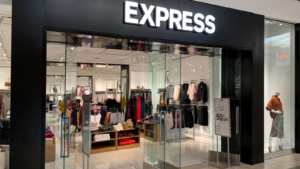
Source: damann / Shutterstock.com
Express (OTCMKTS:EXPR) is a fashion retailer teetering on the edge of a precipice, as previously reported by Investorplace.
The company is a shadow of its former self, with its market valuation plummeting over 90% in the past 52 weeks and a formidable 19.11% of its float held short. The market’s resounding sentiment of a downward spiral is further reflected in its mere $1.4 per share price tag at present.
EXPR’s woes stem from a towering debt burden and a distressing negative free cash flow scenario. The liquidity quagmire, indicated by a negative $226.07 per share when scrutinizing total debt and cash equivalents, paints a somber liquidity portrait.
The lights are dimming on EXPR, with year-to-date cash burn spewing over $238.90 million, leaving a scant $34 million in the coffers. Clinging onto EXPR shares might not be for the faint-hearted, as a palpable bankruptcy risk looms large, potentially erasing any remnant of investment value.
On the date of publication, Matthew Farley did not have (either directly or indirectly) any positions in the securities mentioned in this article. The opinions expressed are those of the author, adhering to the InvestorPlace.com Publishing Guidelines.