How much does it take to be wealthy? A recent survey by Charles Schwab found that the average American believes a net worth of $2.2 million is the ticket. However, to enter the exclusive realm of the ultra-wealthy, one needs a hefty $30 million in hand. Quite the discrepancy, isn’t it?
The lifestyles of the super-rich reflect their hefty bank accounts: different from the average American in both spending habits and investment decisions. Here, we delve into three intriguing ways the ultra-wealthy choose to invest their fortunes.

Image source: Getty Images.
Private Equity: A Not-So-Public Option
While the affluent invest a portion of their wealth in stocks, they also allocate roughly half of their assets to alternative investments, a stark contrast to the meager 5% adopted by the average investor. The premier alternative investment choice among the ultra-rich? Private equity.
Unlike publicly traded companies that list their shares on exchanges like the New York Stock Exchange and Nasdaq, private equity investments are reserved for institutional and accredited investors. These exclusive offerings are accessible only to those with hefty annual incomes, substantial net worth, or certain professional licenses.
According to a survey by KKR, high-net-worth families have allocated 27% of their portfolios to private equity, a close second to the 31% allocated to publicly listed equities. Over time, private equity has consistently outperformed the S&P 500, with a few exceptions here and there.
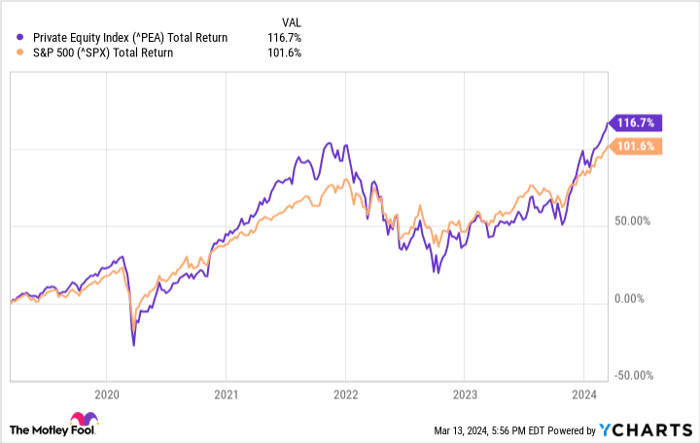
^PEA data by YCharts
Investor interest in private equity continues to surge, with a substantial 79% of institutional investors planning to boost their allocations significantly by 2025, as per a Prequin survey.
Private Credit: The Silent Wealth Builder
A mere 4% of high-net-worth family portfolios find their way into private credit, as identified by the KKR survey. What exactly is private credit? This involves lending funds to private companies in exchange for interest payments and the eventual repayment of the principal amount.
Comparatively less risky than private equity, private credit provides an added layer of security for investors, as debt holders are typically prioritized in case of bankruptcy. However, like any investment, it’s not entirely devoid of risks.
Following the trend of its alternative investment sibling, private credit is gaining favor among investors, with 67% of institutional investors slated to ramp up their private debt allocation by 2025, according to Prequin.
Luxury Goods: The Glitzy Investment
For some ultra-wealthy individuals, investment doesn’t stop at traditional avenues; luxury goods also make the cut. From designer handbags to rare wines, classic cars to elegant jewelry, these opulent possessions offer a different kind of investment allure.
Are luxury goods a sound investment? It’s a mixed bag. While the Knight Frank Luxury Investment Index saw a soaring 137% increase over a decade, the S&P 500 yielded an impressive return of almost 237% during the same period.
Certain luxury goods—like rare whiskies, which recorded a staggering 373% surge in prices—have managed to outpace the stock market. However, factors like illiquidity, maintenance costs, and minimal regulatory oversight make luxury goods a diversification, rather than a foundation, for an investment portfolio.
A Common-Sense Approach
For those who don’t boast a $30 million net worth, fret not about not mirroring the investment choices of the ultra-rich. Notably, most alternative investments fail to outperform the reliable S&P 500 over the long term.
Consider the approach of Warren Buffett, a fixture in the ultra-high-net-worth echelon, who has designated the bulk of his family’s inheritance to low-cost S&P 500 index funds. For most investors, irrespective of their wealth, Buffett’s pragmatic strategy offers a safer bet than more esoteric investment options.
5 Stocks Our Experts Predict Could Double In the Next Year
By submitting your email, you'll also get a free pivot & flow membership. A free daily market overview. You can unsubscribe at any time.