Every investor worth their salt is on the eternal quest for the next trillion-dollar stock, the pot of gold at the end of the rainbow. And in this high-stakes game of financial bingo, Visa ((NYSE: V)) emerges as a serious contender. The reason? A competitive moat so wide, so deep, it’s practically a financial Mariana Trench. Visa’s meteoric rise owes everything to this formidable advantage, one that continues to fortify its foothold in the market with all the tenacity of a well-fed bull in a china shop.
The Thunderous Impact of Network Effects
When the goal is to unearth stocks with infinite growth potential that defies conventional wisdom, look no further than companies basking in the halo of network effects. These dynamic forces give rise to an ecosystem where the more, the merrier — think of it as throwing a party that everyone clamors to attend. Social media titans like Meta Platforms are prime exemplars of this phenomenon, drawing strength from their mammoth user base. It’s the classic case of success breeding further success, a snowball effect that propels growth to uncharted territories. In this landscape, Visa stands its ground as the paragon of a stock benefitted by the most potent of network effects.
The Apex Predator of Network Effect Stocks
Visa needs no introduction; its ubiquitous presence is as familiar as your go-to snack stash. The reason? An assurance that your trusty Visa card is the golden ticket universally adored by merchants far and wide. Consumers gravitate towards Visa-endorsed payment methods, while merchants are quick to tap into the world’s collective wallets, forming an intricate web of interdependence. Stats don’t lie; an iron grip on 61% of the U.S. credit and debit card market speaks volumes. And in the realm of network effects, where winners take all, Visa reigns supreme with a crown of thorns for any hopeful contender who dares to challenge its dominion.
While insurgents like PayPal and Block have cunningly slipped through the crevices to carve their niche in the payment domain, Visa’s gravitational pull remains unassailable. A recent revelation saw PayPal and Venmo cozy up to Visa’s interoperability network, Visa+, a spectacle that underscores the symbiosis where David extends an olive branch to Goliath. The rationale is crystal clear — in the realm of payment networks, size does matter, and Visa’s allure proves irresistible even to its adversaries. Harnessing a profit margin averaging 47% over the past decade, Visa emerges not just as a contender but as a colossus that towers above the likes of Amazon, Alphabet, and even Meta Platforms.
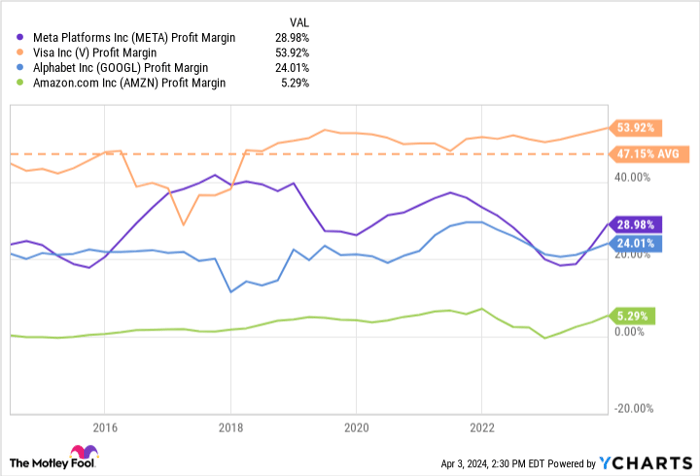
META Profit Margin data by YCharts.
A Trillion-Dollar Odyssey by 2035?
Visa’s roadmap to greatness isn’t paved with revolutionary business models or exclusive patents. Instead, it rides the untamed colossus of network effects, a lifeline for businesses destined for greatness. The prospect of Visa breaching the $1 trillion market cap well before 2035 isn’t just wishful thinking; it’s a prophecy waiting to be fulfilled. Transcending milestones from a $250 billion valuation to a $500 billion juggernaut happened in the blink of an eye. The payments arena, a cosmic expanse of infinite possibilities, beckons Visa to soar from its $560 billion perch today to the coveted $1 trillion summit by 2035 — a feat that might very well be achieved even earlier.
While Visa’s stock valuation may seem steep at 31 times earnings, juxtapose it with the S&P 500 trading at 28 times earnings. In this light, shelling out a tad extra for a blue-chip darling like Visa seems a negligible gamble for investors in it for the long haul.
Is Investing in Visa the Right Move?
Before diving headlong into Visa’s stock, ponder this:
The savants over at the Motley Fool Stock Advisor have cherry-picked what they deem the 10 best stocks for the savvy investor’s arsenal, and Visa didn’t make the cut. These chosen few are poised to unfurl monstrous returns in the foreseeable future.
Stock Advisor isn’t just a hand-holding guide through the volatility of financial markets; it’s an architect mapping a route to prosperity. Regular insights, bimonthly stock picks, and a track record that’s trounced the S&P 500 thrice over since 2002* — the allure of the 10 chosen knights is undeniable.
Witness the 10 contenders
*Stock Advisor returns as of April 4, 2024
Randi Zuckerberg, the strategist extraordinaire and sister to Meta Platforms’ maestro Mark Zuckerberg, graciously sits on The Motley Fool’s advisory board. American Express and Discover Financial Services have generously lent their promotional patronage to The Ascent, a Motley Fool enterprise. Suzanne Frey of Alphabet fame also graces The Motley Fool’s board of directors. John Mackey, the luminary behind Amazon’s acquisition saga, is a sage voice on The Motley Fool’s board. Ryan Vanzo, ever the silent observer, claims no stake in the stocks discussed. The Motley Fool, champion of the investment realm, champions Alphabet, Amazon, Block, Mastercard, Meta Platforms, PayPal, and Visa. Discover Financial Services seeks to catch your eye, oh reader, as an advertiser extraordinaire on The Ascent. The Motley Fool winks and nudges towards Discover Financial Services and advocates options that ride the wave: long calls on Mastercard into 2025, short calls on Mastercard into 2025, and short calls on PayPal into March 2024. And in the spirit of transparency, The Motley Fool proclaims its doctrine for all to hear.
The viewpoints and proclamations herein belong to the author and do not necessarily mirror the musings of Nasdaq, Inc.
5 Stocks Our Experts Predict Could Double In the Next Year
By submitting your email, you'll also get a free pivot & flow membership. A free daily market overview. You can unsubscribe at any time.