Despite global efforts to curb emissions, the three primary greenhouse gases responsible for trapping heat showed no sign of abating in the past year. This concerning trend highlights the imperative for urgent action to reduce emissions and move towards a net-zero future. Regulated carbon allowance markets have emerged as a pivotal tool in the fight against climate change, offering investors significant opportunities amidst this pressing environmental challenge.
The National Oceanic and Atmospheric Administration (NOAA) reported that the levels of carbon dioxide, methane, and nitrous oxide all experienced an alarming increase in 2023. This rise is in line with the significant uptrend in greenhouse gas emissions witnessed over the last decade.
“The 2023 increase marks the third-largest surge in the past ten years,” noted Xin Lan, a CIRES scientist at NOAA’s Global Monitoring Laboratory (GML). He attributed this spike to the continuing escalation of fossil fuel CO2 emissions, compounded by heightened fire emissions possibly triggered by the shift from La Nina to El Nino weather patterns.
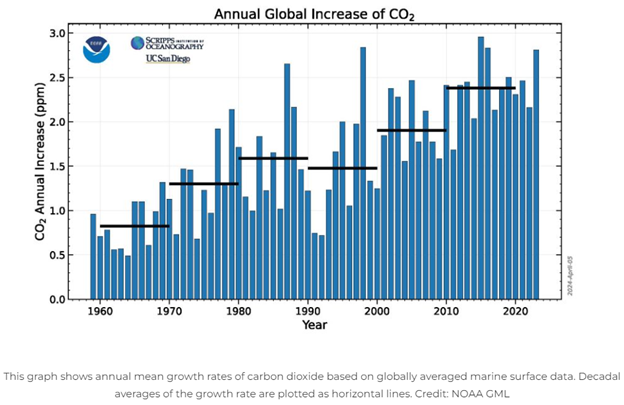
Image source: NOAA
The relentless increase in carbon dioxide emissions remains a cause for concern, with CO2 levels soaring to 36.6 billion tons annually in 2023, a stark contrast from the mere 10.9 billion tons recorded in the 1960s when measurements commenced.
Vanda Grubišić, director of GML, emphasized, “These figures underscore the substantial efforts needed to make tangible strides in reducing the accumulation of greenhouse gases in the atmosphere.”
Nitrous oxide surged by 1 part-per-billion last year, peaking at 336.7 ppb. Since 2000, the highest annual increments were observed in 2020 and 2021, each at 1.3 ppb per year, surpassing pre-industrial levels of just 270 ppb.
Meanwhile, atmospheric methane levels reached the 5th highest point since 2007 in 2023, climbing to 1922.6 ppb with an annual gain of 10.9 ppb. Although slightly lower than the 18 ppb and 15.2 ppb increases in 2021 and 2020, respectively, methane is deemed particularly harmful due to its high heat-trapping efficiency.
The Role of Carbon Markets in Greenhouse Gas Reduction
Amidst the escalating greenhouse gas emissions, portfolios can potentially reap benefits by aligning with the global shift towards climate-conscious practices. An effective method of participating in this transition is through investments in carbon allowance markets.
Carbon allowance markets, characterized by stringent regulations, exert increasing pressure on polluting entities by restricting supply annually or along a predetermined trajectory, thereby escalating prices over time. KraneShares presents a range of ETFs offering exposure to major global carbon markets.
The KraneShares Global Carbon ETF (NYSE: KRBN) pioneered an investment avenue focused on trading carbon credits, offering diversified exposure to key carbon markets worldwide and specifically targeting RGGI.
The KraneShares European Carbon Allowance ETF (KEUA) delivers focused exposure to the EU carbon allowances market and operates through active management. The fund’s benchmark is linked to the most actively traded EUA futures contracts within the oldest and most liquid carbon allowances market.
The KraneShares California Carbon Allowance ETF (KCCA) provides targeted exposure to the joint carbon allowance market of California and Quebec, including California’s cap-and-trade carbon allowance program, recognized as one of the fastest-growing initiatives globally.
For more news, information, and analysis, explore the Climate Insights Channel.
Read more on ETFTrends.com.
The opinions expressed herein belong to the author and not Nasdaq, Inc.