Boost Your Income: Explore Covered Calls with CME Group
Maximize Your Earnings with Strategic Options
Shareholders of CME Group (Symbol: CME) seeking ways to enhance their income beyond the stock’s current 2.4% annual dividend yield might consider selling the January 2026 covered call at the $250 strike. By doing so, investors can collect a premium based on the $13.30 bid, which equates to an additional annualized return of 5.3% calculated from today’s stock price. This strategy potentially brings the total annual yield to 7.7% if the stock is not called away. However, if CME shares do appreciate past the $250 mark, shareholders forfeit any gains above that strike, which means the stock must increase by 4.6% for the call to take effect. In such a scenario, shareholders could still achieve a 10.2% return, combined with dividends earned up to that point.
Dividends can be less predictable, often fluctuating with a company’s profitability. Monitoring CME Group’s dividend history might provide insights into whether the recent payout is sustainable, and help assess the reliability of the 2.4% annual dividend yield.

A Glimpse at CME’s Trading History
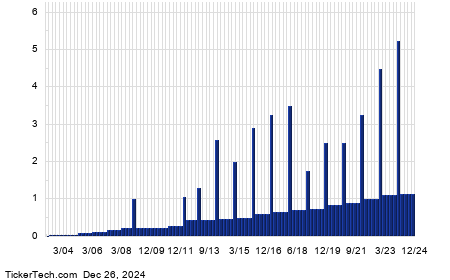
A chart displaying CME’s trading history over the past twelve months reveals the $250 strike highlighted in red:

The analysis of stock volatility, used alongside fundamental metrics, can assist in determining if selling the January 2026 covered call at the $250 strike offers a favorable risk-reward ratio. Most options typically expire worthless, but understanding option myths can clarify the complexities of trading. CME Group’s trailing twelve-month volatility stands at 17%, calculated from the last 251 trading days and today’s closing price of $238.97. For additional options ideas across various expiration dates, check out the CME Stock Options page on StockOptionsChannel.com.
Current Market Activity Indicates High Call Demand
As of mid-afternoon trading on Thursday, the volume of puts among S&P 500 components reached 709,347 contracts, while calls hit 1.43 million. This results in a put:call ratio of 0.50, indicating significantly higher call volume compared to puts. Historically, the median put:call ratio sits at 0.65, suggesting that traders are currently favoring calls.
Discover which call and put options are trending today.
 Top YieldBoost Calls of the S&P 500 »
Also see:
- ABNY Options Chain
- IGR Historical Stock Prices
- VINP Market Cap History
The views and opinions expressed herein are those of the author and do not necessarily reflect those of Nasdaq, Inc.