Amazon’s Growth Waning: Three Alternative Stocks for Investors
There’s no denying it: Amazon (NASDAQ: AMZN) has been one of this century’s most rewarding stock picks, and it stands out as one of the market’s biggest-ever winners. Shares are up by more than 250,000% since their public offering in 1997, even after a significant pullback from January’s peak.
However, it’s evident that Amazon’s days of the highest growth are behind it. Comparisons to its past performance set an exceptionally high bar. While the company remains a solid investment, those seeking above-average growth going forward may need to consider other options.
Where to invest $1,000 right now? Our analyst team revealed what they believe are the 10 best stocks to buy right now. Learn More »
Here’s a rundown of three promising growth stocks to consider in place of Amazon.
1. Shopify
Amazon may dominate the e-commerce space in the Western Hemisphere, but it paved the way for a range of competitors to emerge. New brands and sellers are now exploring various online selling platforms, as consumers increasingly seek alternatives to massive online marketplaces like Amazon.
One such competitor is Shopify (NASDAQ: SHOP). Shopify enables manufacturers and brands to establish their own online presence, allowing them to sell directly to customers. Its platform provides everything from digital shopping carts to payment processing, inventory management, and marketing tools. Notable clients include FragranceNet, Skullcandy, Carrier, and Daily Harvest.
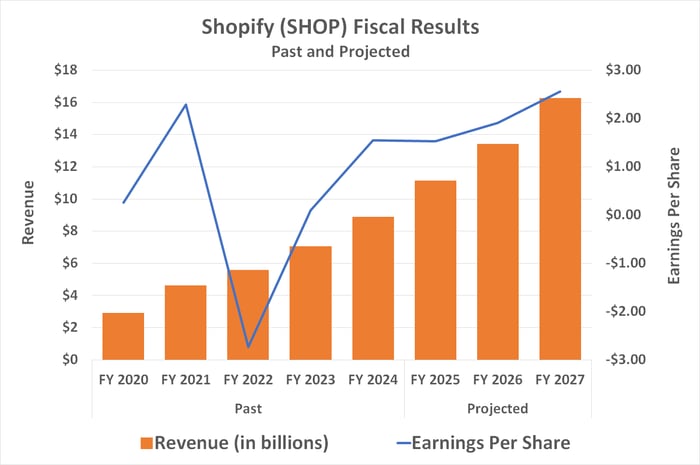
Estimates suggest that there are about 5 million Shopify-powered online stores currently in operation. While Shopify no longer discloses exact figures, the platform collectively processed $292.3 billion in sales during 2024, resulting in nearly $8.9 billion in revenue and $1.1 billion in operating income. Both figures reflect substantial year-over-year growth, continuing a streak that many thought was unachievable just a few years ago.

Data source: StockAnalysis.com. Chart by author.
What drives this growth? While consumers appreciate the convenience of shopping on Amazon, they increasingly yearn for authenticity and want to support responsible brands with compelling narratives. A recent poll by Upworthy and Alter Agents found that 76% of North American consumers seek out “feel good” content from brands they might buy from. Shopify equips sellers with the tools to create these narratives successfully.
This trend is expected to grow. Analysts anticipate Shopify’s revenue will increase by more than 20% annually at least through 2027.
2. SoFi Technologies
The banking sector has transformed just as significantly as e-commerce thanks to the internet. A survey from the American Bankers Association reveals that 55% of U.S. consumers prefer using a mobile app for their banking needs. Conventional computers come in second, used by 22% of customers, while only 11% prefer visiting a bank branch.
However, many online banking platforms established by traditional banks struggle to connect with today’s tech-savvy consumers. Users increasingly favor services designed from the ground up for online banking, such as SoFi Technologies (NASDAQ: SOFI).
SoFi provides various banking services, including checking accounts, credit cards, investing, lending, and insurance—all without physical branches.
With over 10.1 million customers and continuous growth since 2020, SoFi showcases the demand for digital banking solutions. Each customer increasingly engages with a wider array of banking services.

Image source: SoFi Technologies year-end earnings conference call presentation.
The future looks bright for SoFi, as the global online banking market is projected to grow by 14% annually through 2030, according to Straits Research. While Europe is expected to lead this expansion, North America’s already significant market will play a crucial role, especially as SoFi continues to target this region.
3. Uber Technologies
Lastly, consider Uber Technologies (NYSE: UBER) as a compelling alternative investment. The company is currently trading at a level similar to where it was a year ago, despite ongoing growth that leaves it about 25% below analysts’ consensus price target of over $90 per share.
Uber thrives on technological advancements, particularly the internet and mobile connectivity that allow consumers to easily request rides. This model was unimaginable 25 years ago when hailing a cab or taking public transit were the only real options for third-party mobility.
Additionally, Uber experienced a 19% growth in total trips and revenue last year, driven by various factors, including rising consumer demand. As the company continues to innovate, it could present significant growth opportunities for investors.
Declining Interest in Car Ownership Signals Shift in Transportation Trends
Rising costs and decreased convenience are causing a notable shift in attitudes towards car ownership. A recent poll by Deloitte shows that only 11% of U.S. residents aged 55 and older would consider giving up their vehicles for ride-hailing services like Uber. In stark contrast, a significant 44% of those under 35 are open to abandoning traditional car ownership for these convenient alternatives.
Trend of Delayed Driver’s Licenses Among Youth
Additionally, many young people seem to be postponing the acquisition of their driver’s licenses. Data from the Federal Highway Administration reveals that the percentage of 19-year-olds with a license has declined from over 87% in 1983 to below 69% in 2022. This trend reflects a broader shift among the younger demographic who find little necessity in driving themselves when cost-effective and convenient options are available.
The Future of Uber’s Market Performance
Uber’s stock performance has fluctuated recently, influenced by some disappointing quarterly results. However, it’s essential to view the bigger picture. Historically, Uber’s growth has averaged in the mid-teens, and analysts predict that this momentum will continue for several more years as ride-hailing increasingly replaces traditional car ownership.
Most analysts currently view Uber’s stock as a strong buy, despite mixed investor sentiment.
Investment Considerations for Shopify
If you’re contemplating an investment in Shopify, take a closer look at the current market analysis:
The Motley Fool Stock Advisor analyst team has identified what they consider to be the 10 best stocks for investors to buy now, and Shopify does not feature on this list. The stocks that have made the cut are expected to yield substantial returns in the years ahead.
Consider the example of Nvidia, which was highlighted on April 15, 2005. If you had invested $1,000 at that time, your investment would now be worth $578,035!*
The Stock Advisor program offers an accessible strategy for investment success, featuring guidance on portfolio building, consistent analyst updates, and two new stock picks each month. Since its inception in 2002, the service has outperformed the S&P 500 by more than four times.*
*Stock Advisor returns as of April 1, 2025
John Mackey, former CEO of Whole Foods Market, an Amazon subsidiary, serves on The Motley Fool’s board of directors. James Brumley has no positions in any of the mentioned stocks. The Motley Fool has positions in and recommends Amazon, Shopify, and Uber Technologies. Full disclosure available.
The views and opinions expressed herein are those of the author and do not necessarily reflect those of Nasdaq, Inc.