Amazon Faces Bear Market Challenges Amid Investment Opportunities
While neither the Dow Jones Industrial Average nor the S&P 500 has entered bear market territory, shares of Amazon (NASDAQ: AMZN) have fallen more than 20% from its previous high set in February, even with a recent attempt at recovery.
Some investors might contemplate abandoning Amazon. However, historical patterns indicate that now may be an opportune moment to consider investing in Amazon Stock.
Where to invest $1,000 right now? Our analyst team just revealed what they believe are the 10 best stocks to buy now. Learn More »
Pullbacks: A Chance for Investors
Many might be surprised at how frequently Amazon’s share price has dipped by 20% or more since its initial public offering in May 1997. According to calculations, the Stock has entered bear market territory 21 times, averaging a decline of over 20% approximately every 16 months.
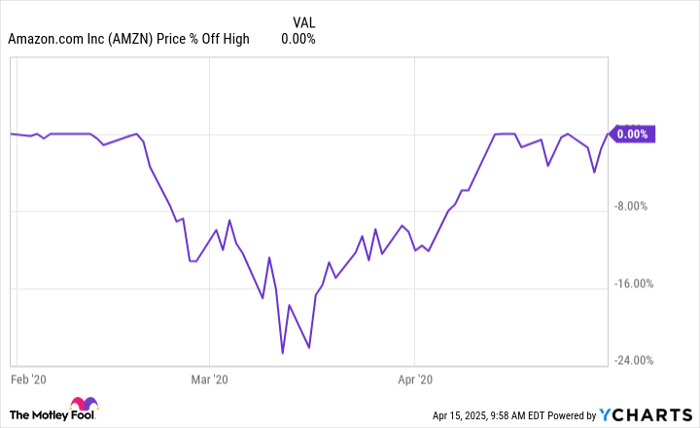
Some declines have been brief, like the significant drop in February 2020, correlating with the onset of COVID-19. Notably, the Stock regained its previous high within just two months.

AMZN data by YCharts
Yet, in other instances, Amazon has remained in bear territory for extended periods. A major downturn occurred following the dot-com bubble burst in late 1999, leading to a nearly nine-year recovery for Amazon’s shares.

AMZN data by YCharts
Regardless of the duration of these declines, each price pullback represented a valuable buying opportunity for long-term investors. For instance, had you invested $10,000 in Amazon on December 10, 1999, a seeming poor decision at the time, it would now be worth nearly $340,000.
A Historically Low Valuation
Currently, Amazon’s stock is trading at a historically low valuation. While this is partly due to the recent sell-off, it also stems from the company’s intensified focus on enhancing profitability.
The shares presently trade for under 33 times trailing 12-month earnings. This pricing was similarly observed during the 2008 market crash, which marked the beginning of the Great Recession.

AMZN PE Ratio data by YCharts
If you had invested $10,000 in Amazon during the last instance of such low valuation, your investment would now exceed $760,000. Historical trends suggest that purchasing Amazon when its price-to-earnings ratio is below 33 is typically a lucrative opportunity.
Furthermore, Amazon’s forward price-to-earnings ratio is even lower at 27.55, indicating robust growth expectations from Wall Street for the company’s earnings in the coming year.
Will Amazon’s History Repeat Itself?
Before investing significantly in Amazon Stock, it’s essential to recognize that Amazon has evolved substantially since its past declines of 20% or more. Notably, the cloud computing segment has seen a shift; it’s no longer the exciting new frontier it was when Amazon Web Services debuted in 2006.
However, previous performance trends suggest that Amazon’s history may provide valuable insights today. I also believe the Stock’s historically low valuation merits consideration.
While it may be unlikely for Amazon to replicate the extraordinary returns of its past 28 years, that doesn’t preclude the stock from being a rewarding investment moving forward.
The anticipated growth of artificial intelligence may drive increased adoption of cloud services over the next decade. Additionally, I foresee expansions in the e-commerce realm and successful outcomes from Amazon’s initiatives in healthcare, satellite broadband, and self-driving vehicles. As Mark Twain famously said, “History doesn’t repeat itself, but it often rhymes.”
Should You Invest $1,000 in Amazon Right Now?
Before purchasing Stock in Amazon, consider this:
The Motley Fool Stock Advisor analyst team has identified what they believe are the 10 best stocks to invest in at the moment… and Amazon is not on this list. The selected stocks could potentially yield significant returns in the coming years.
For example, when Netflix made this list on December 17, 2004… if you had invested $1,000 at that time, you’d have $526,499!* Similarly, Nvidia was included on April 15, 2005… and if you had invested $1,000 back then, you’d have $687,684!*
It’s also important to note that Stock Advisor has an impressive total average return of 818% — significantly outperforming 156 for the S&P 500. Stay updated with the latest top 10 list by joining Stock Advisor.
See the 10 stocks »
*Stock Advisor returns as of April 14, 2025
John Mackey, former CEO of Whole Foods Market, an Amazon subsidiary, is a member of The Motley Fool’s board of directors. Keith Speights has positions in Amazon. The Motley Fool has positions in and recommends Amazon. The Motley Fool has a disclosure policy.
The views and opinions expressed herein are solely those of the author and do not necessarily reflect those of Nasdaq, Inc.