Disney to Launch Streaming ESPN, Challenging Cable Industry
It’s official. As widely anticipated, The Walt Disney Company (NYSE: DIS) will introduce a standalone streaming version of ESPN later this year, priced at $29.99 per month. Consumers who also subscribe to Disney+ and Hulu will enjoy an even lower effective monthly price.
This service launch likely signals a significant shift in the cable television landscape, although it may not lead to an immediate collapse.

Image source: Getty Images.
Disney Faces Strong Competition
The launch of this service was anticipated following CEO Bob Iger’s confirmation in early 2024. The crucial details were the timing, pricing, and potential impact of a sports-focused collaboration among Disney, Fox, and Warner Bros. Discovery. Although a federal court has blocked this joint venture, Disney is moving ahead with its plans to provide an affordable ESPN streaming option without requiring a cable subscription.
This decision poses a significant challenge for cable companies like Comcast‘s (NASDAQ: CMCSA) Xfinity and Charter Communications‘ (NASDAQ: CHTR) Spectrum, both of which are already losing customers.
Last quarter, Xfinity lost 427,000 cable subscribers, bringing its total to just under 12.1 million. This decline continues from a peak of nearly 23 million in 2013. Meanwhile, Spectrum’s customer base fell by 127,000 to 12.7 million, significantly down from its peak over a decade ago.
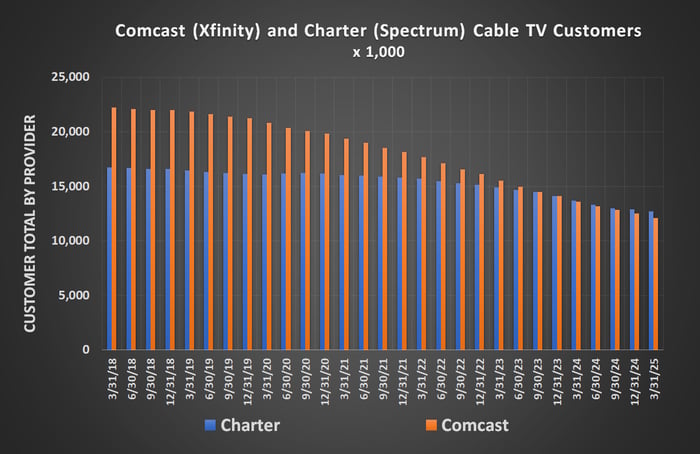
Data source: Comcast Corp. and Charter Communications Inc. Chart by author.
This trend is not isolated to these major players. According to consumer research firm eMarketer, the total number of cable subscribers in the U.S. has dropped by a third since 2013, with non-cable households now outnumbering cable TV customers.
The introduction of a streaming ESPN may exacerbate these issues for cable companies for several reasons.
Potential Major Disruption Ahead
The cable TV industry, already struggling, makes an appealing target for innovative newcomers.
If there were any remaining hopes for a turnaround, the arrival of ESPN streaming has effectively dashed them.
Disney’s ESPN is not just a recognizable brand; it leads the sports-television market, accounting for nearly 30% of total sports viewership, according to Nielsen ratings. Including Disney’s ABC sports programming boosts that figure to over 40%.
Disney’s significant market share grants it considerable leverage for various entrepreneurial strategies. Other studios may soon follow suit, albeit on a smaller scale.
Fox and Warner Bros. Discovery are already exploring alternatives beyond traditional cable to distribute their sports content, while streaming platforms like Paramount‘s Paramount+, Warner’s Max, and Amazon‘s Prime also air exclusive sporting events. Many professional sports leagues and some individual teams have even begun offering their own streaming packages.
Once Disney paves the way, it wouldn’t be surprising to see other major studios launch their own sports-focused streaming services.
This development poses a significant threat to the cable television industry. Live sports are the primary reason many consumers still maintain cable subscriptions. A recent CableTV.com survey reported that 27% of cable subscribers still pay high fees mainly for sports programming, while comfort with traditional cable ranks second. However, many subscribers may be more open to alternatives by now.
A Critical Crossroads for Cable and Disney
Historically, content producers like Disney and distributors have maintained a symbiotic relationship; however, this dynamic has changed into direct competition. Disney’s entry into streaming reflects how studios no longer require intermediaries for distribution.
For investors, what is detrimental to the cable television industry could be advantageous for Disney, potentially in a disproportionate manner.
Cable companies traditionally pay Disney around $10 per subscriber to air ESPN’s programming. In contrast, Disney will collect three times that amount by selling the same content directly to subscribers. Currently, sports represent less than 20% of Disney’s revenue, and about 10% of its operating income, but both metrics could increase significantly if ESPN’s streaming service succeeds.
In conclusion, cable stocks like Charter and Comcast are becoming less favorable investment options. Conversely, The Walt Disney Company is addressing its declining cable segment with a business model it excels in, combined with substantial marketing capabilities. This move could be the catalyst needed for a turnaround for Disney’s stock.
Should You Invest $1,000 in Walt Disney Right Now?
Before making a decision on investing in Walt Disney’s stock, consider the following:
New Top 10 Stocks Identified, But Walt Disney Misses Out
The Stock Advisor analyst team has recently unveiled its list of the 10 best stocks for investors right now. Notably, Walt Disney did not make the selection. The companies that are included have the potential to deliver significant returns in the upcoming years.
Reflecting on Past Recommendations
For context, consider the case of Netflix, which was featured on December 17, 2004. If an investor had put $1,000 into Netflix at that time, it would now be valued at an impressive $635,275! Similarly, Nvidia was listed on April 15, 2005; an investment of $1,000 would now be worth about $826,385.
Performance Comparison
The Stock Advisor‘s total average return stands at 967%, which significantly outperforms the S&P 500‘s average return of 171%. This demonstrates a considerable advantage for investors who have followed these recommendations. To view the latest top 10 list, consider joining Stock Advisor.
*Returns as of May 12, 2025
John Mackey, former CEO of Whole Foods Market, an Amazon subsidiary, serves on The Motley Fool’s board of directors. James Brumley holds no position in any mentioned stocks. The Motley Fool has investments in and recommends Amazon, Walt Disney, and Warner Bros. Discovery, and also recommends Comcast. The Motley Fool adheres to a strict disclosure policy.
The opinions expressed here belong to the author and do not necessarily reflect those of Nasdaq, Inc.
5 Stocks Our Experts Predict Could Double In the Next Year
By submitting your email, you'll also get a free pivot & flow membership. A free daily market overview. You can unsubscribe at any time.