In the recent Bureau of Labor Statistics (BLS) employment report, the indicators suggested a significant decline in the percentage of full-time jobs relative to the population. This development has raised concerns about the likelihood of an oncoming recession, contrary to the prevailing narrative of a soft landing.
To fully appreciate the current economic environment, we should reflect on the unprecedented monetary support that has propped up economic activities since mid-2023. During that time, experts discussed the distinct manufacturing setback without a full-blown economic downturn.
During 2011, the world witnessed a manufacturing slowdown triggered by a natural disaster in Japan and concurrent economic upheaval in the U.S. Despite bleak predictions, the anticipated recession did not materialize.
The economy’s manufacturing sector has been in decline for over a year, as evidenced by the ISM Manufacturing Index, mirroring the situation in 2011-2012. Nonetheless, the service sector has stepped in to shelter the economy from the blows of manufacturing contraction. Unlike the past, where manufacturing played a pivotal role in economic activities,
services currently account for nearly 80% of every dollar spent.
Historically, the economy has weathered manufacturing contractions while the service sector remained robust enough to stave off recession. Similar scenarios unfolded in 1998, 2011, and 2015, signifying the resilience of the U.S. economy in the face of manufacturing headwinds.
Given these historical parallels, a comparison of services and manufacturing in the current environment better elucidates why the economy has sidestepped recessionary threats. It is imperative to understand the economic weight of both sectors in the prevailing climate.
So, what impact does this have on the realm of full-time jobs?
The Crucial Role of Full-Time Jobs in the Economy
The resilience of the services side despite surging inflation and interest rates can be partly attributed to the substantial fiscal aid injected into the economy. However, the slowing growth in services, as a consequence of diminishing excess savings, constrains the economic outlook. Wage growth and employment will now play pivotal roles in sustaining economic momentum.
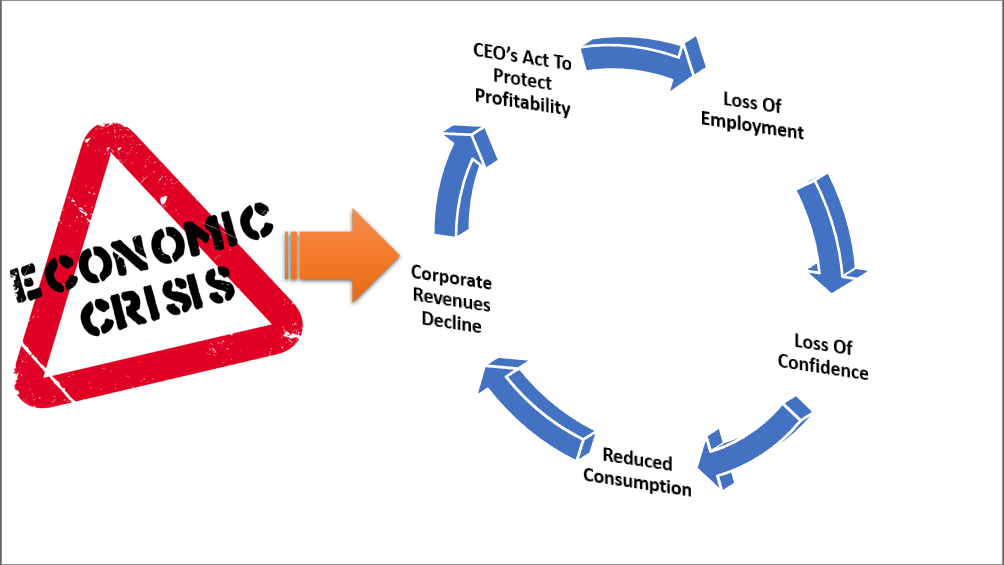
The U.S. economy relies heavily on consumption. However, without prior production, consumers have nothing to consume. The production phase is the precursor to generating the income necessary for consumption, as depicted in the economic cycle below.
Notably, when direct fiscal aid to households bypasses the production phase, a marked surge in economic growth is inevitable. The second quarter of 2021 witnessed a massive uptick in economic activity owing to these fiscal policies.
However, once the stimulus funds were exhausted, economic activity waned as the production side lagged behind. This underscores the vital significance of full-time jobs in the economy.
For households to sustain consumption at an economically viable rate, full-time employment is indispensable. These jobs offer higher wages, benefits, and health insurance to support families, which part-time jobs cannot replicate.
Despite media reports touting strong employment figures, the recovery largely represents the regaining of lost jobs during the economic standstill. In actuality, full-time employment as a proportion of the working-age population failed to rebound to pre-pandemic levels.
Two critical points emerge from this data. Firstly, the economy has not engendered millions of “new” jobs as propagated by the current administration. Secondly, in relation to the working-age population, full-time jobs have witnessed a significant drop, a recurring harbinger of impending recessions. When combined with the retreat in wage growth, the strain on the service sector becomes increasingly apparent.
The signs are undeniably ominous, and investors should carefully reassess their positions in light of this disconcerting data.
Grave Concerns Arise as Full-Time Jobs Decline Amidst Economic Slowdown
As the economy slows down, it should not be surprising that full-time jobs are declining.
CEOs Respond to Economic Pressures
In an effort to safeguard earnings and profitability, CEOs have resorted to cutting full-time jobs, a move considered the most impactful cost reduction strategy for any business. While employers typically hold onto their employees as long as possible, they eventually face the grim necessity of sacrificing personnel in the name of preserving profits. This unfortunate cycle unfolds predictably until it reaches a point of depletion.
Currently, with CEO confidence levels mirroring those usually indicative of a recession, the reduction in full-time jobs comes as no surprise.
Impact of Foreign-Born Workers
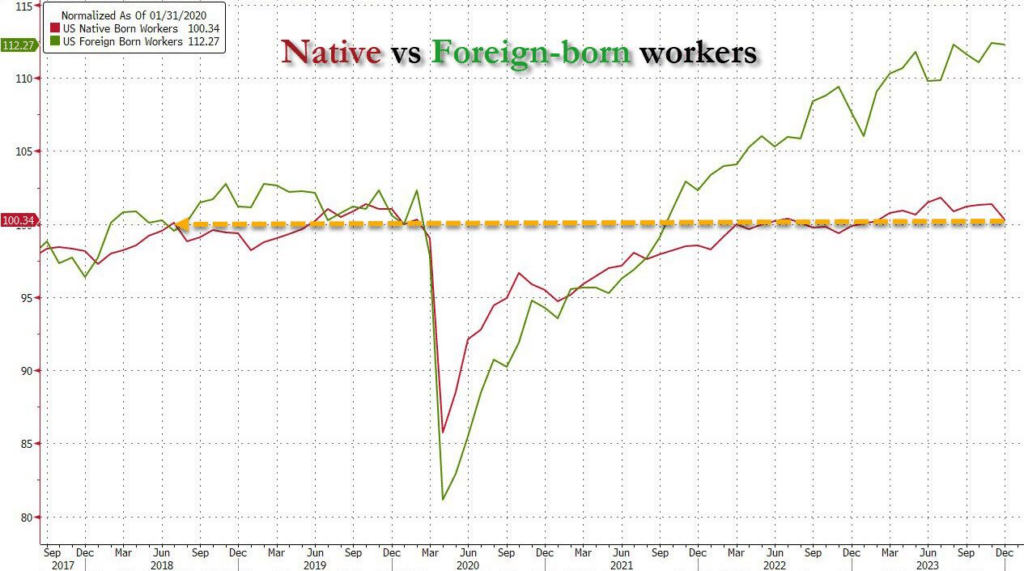
The surge of foreign-born workers entering the U.S. has exacerbated the situation, providing companies with an alternative pool of workers willing to labor for extended hours at diminished pay in comparison to native-born workers. This influx has enabled companies to replace full-time employees with part-time workers.
Moreover, for higher-skilled workers, companies have turned to technological advancements, artificial intelligence, and robotics to curtail expenses by substituting full-time employees.
As discussed in a previous report, “Minimum Wage Increases Hurt,” when faced with profitability threats, companies are inclined to downsize their workforce. The Congressional Budget Office emphasized how heightened minimum wage expenses usually prompt employers to reduce their workforce, presenting a domino effect on prices, labor types, and capital usage.
While some families benefit from an increased minimum wage, others experience real income declines due to job losses, reduced business income, and heightened consumer prices. All things considered, a minimum wage hike generally results in reduced average real family income.
It is essential to contemplate the recent downturn in full-time jobs as a critical data point worth monitoring closely. If the decline persists, it could signal an oncoming recession, a possibility already hinted at by the CEO confidence survey.
While this time could be different, historical evidence tells us otherwise. Despite considerations of a “soft landing,” prevailing indicators lean toward a less optimistic outlook.
The diminishing number of full-time jobs is an integral indicator deserving meticulous attention.
Original Post
Editor’s Note: The summary bullets for this article were chosen by Seeking Alpha editors.
5 Stocks Our Experts Predict Could Double In the Next Year
By submitting your email, you'll also get a free pivot & flow membership. A free daily market overview. You can unsubscribe at any time.