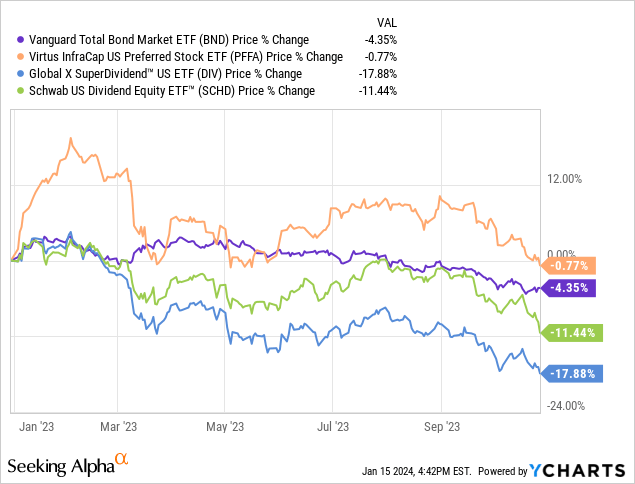
In 2023, the financial landscape was tumultuous, marked by the dominance of the “higher rates for longer” narrative and artificial intelligence hype. This turbulent environment led to a challenging period for bonds (BND), preferreds (PFFA), and high-yield stocks (DIV) in the initial ten months of the year. Meanwhile, AI-focused giants such as the “magnificent seven” – including Apple (AAPL), Meta (META), Amazon (AMZN), Alphabet (GOOG) (GOOGL), Tesla (TSLA), NVIDIA (NVDA), and Microsoft (MSFT) – experienced considerable growth.
However, this sharp dichotomy resulted in a premium valuation of the S&P 500 (SPY), led by the magnificent seven, while numerous quality dividend stocks, especially in interest rate-sensitive small-cap (IWM), REIT (VNQ), and utility (XLU) sectors, became significantly undervalued. Even famed investor Peter Lynch noticed this stark contrast, deeming it an intriguing investment opportunity.
Since then, concerns about persistently high interest rates have somewhat subsided, leading to a resurgence in dividend stocks, although utilities, in particular, have continued to lag behind SPY’s performance.
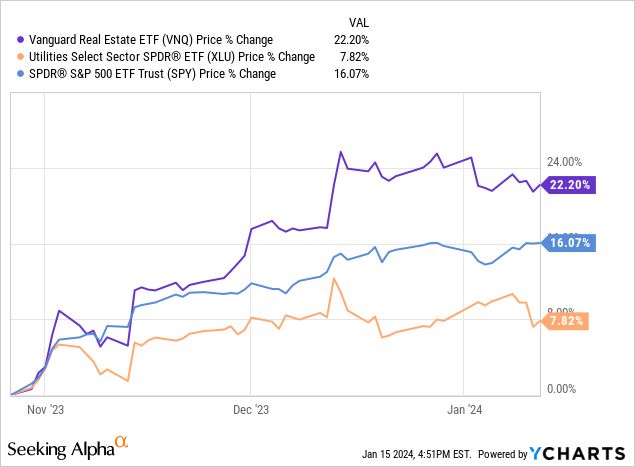
Anticipating substantial market upheaval, we will explore the factors driving this shift, as well as the key traits of stocks likely to outperform in the upcoming period.
Anticipating Market Upheaval
We believe that the current dynamics are set to undergo a dramatic reversal, with tech (QQQ) potentially underperforming high-yielding stocks. Historical data supports that dividend stocks tend to yield higher returns over the long term compared to non-dividend-paying stocks. This is largely due to their disciplined capital allocation and sustainable profitability, factors that are unlikely to change in the foreseeable future.
Furthermore, the recent underperformance of dividend stocks is primarily attributable to the preferences of income-focused investors, who favored alternative income sources under the assumption of prolonged higher interest rates.
In addition, the overvaluation of growth stocks relative to interest rates makes their risk-reward proposition unattractive, while many dividend stocks, despite recent rallies, remain significantly undervalued compared to historical averages, offering an enticing risk-reward profile.
Lastly, historical patterns and current economic indicators suggest a looming recession, which, coupled with the Federal Reserve’s likely rate cuts in the coming quarters, could prompt a resurgence in dividend stocks, particularly those with defensive business models.
Identifying Promising Stocks
Amidst these anticipated market shifts, identifying stocks with specific traits becomes paramount. We advocate for prioritizing companies with the following characteristics:
- Defensive business models
- Robust balance sheets
- Stable and growing dividends
- Sufficiently high current yield and attractive valuation
Companies in sectors like utilities, consumer staples, real estate, and healthcare often demonstrate resilience against economic volatility and technological disruptions, providing stable cash flows for reliable dividend payments. A strong balance sheet is crucial to avoiding financial distress that may lead to dividend cuts during economic downturns.
Ensuring a safe and growing dividend payout is essential, as dividend cuts often result in significant stock underperformance. Lastly, seeking stocks offering attractive starting yields and valuations provides a substantial margin of safety against adverse macroeconomic and company-specific outcomes.
Key Takeaways for Investors
Given the expected market shifts favoring dividend stocks and the impending macroeconomic conditions, a significant market upheaval is likely in the coming months. By focusing on stocks with resilient businesses, healthy balance sheets, growing dividends, and attractive valuations, investors position themselves for potential gains while mitigating the downside in the absence of favorable conditions for dividend investors.
Noteworthy stocks that align with these criteria include Enterprise Products Partners (EPD), Energy Transfer (ET), and ATCO (OTCPK:ACLLF).
Editor’s Note: This article discusses one or more securities that do not trade on a major U.S. exchange. Please be aware of the risks associated with these stocks.
5 Stocks Our Experts Predict Could Double In the Next Year
By submitting your email, you'll also get a free pivot & flow membership. A free daily market overview. You can unsubscribe at any time.