
By Andrew Prochnow
Investors who bought into VinFast Auto (NASDAQ:VFS) at its inception have found themselves on a rollercoaster ride, as the company’s shares have swung dramatically in value since its debut on the Nasdaq. What initially seemed like a promising start has turned into a bumpy journey for those with a stake in the electric vehicle (EV) manufacturer.
Following a special purpose acquisition company [SPAC] merger in August, VinFast was valued at around $23 billion, with shares opening at approximately $10 each. However, the stock’s trajectory has been anything but smooth, with prices reaching a peak valuation of $210 billion and sinking to a nadir of $11 billion.
Today, VinFast shares are trading at approximately $6.50 per share, reflecting a 93% decline from the stock’s 52-week high and a 30% increase above the 52-week low. The volatility seems to stem more from speculative interest than intrinsic company performance, leaving shareholders in a state of uncertainty.
VinFast, a part of the Vietnamese conglomerate Vingroup, made its mark as an EV manufacturer but now finds itself at a crossroads, navigating through financial challenges and operational aspirations.
Economies of Scale: The Road to Efficiency
Like many manufacturers, VinFast aims to achieve economies of scale to reduce its production costs. As production volumes increase, fixed costs associated with manufacturing can be spread over a larger number of units, driving down the average cost of production. VinFast delivered around 3,000 battery-electric vehicles (BEVs) in Q3 of 2022, which surged to 10,000 in Q3 of 2023, with ambitions to produce hundreds of thousands annually by 2026.
Crucial to its expansion, VinFast is constructing a $4 billion manufacturing facility in the United States, with plans to produce 150,000 BEVs annually, alongside a large EV manufacturing facility in Vietnam. However, the pivotal questions revolve around the demand for VinFast’s vehicles and the funding needed for its ambitious plans, which could dilute the value of existing shares.
Valuation Analysis: The Donation Dilemma
In a surprising move, Vingroup’s Chairman, Pham Nhat Vuong, injected approximately $1.5 billion into VinFast last year. Although this injection bolsters the company’s financial position, it raises questions about its ability to raise capital from traditional sources. While this donation could signify a vote of confidence, it also clouds the company’s financial outlook and complicates its valuation.
Limited Visibility Into the Company’s Future Earnings
Looking at VinFast’s financials, the company generated revenues of about $700 million in 2021 and $633 million in 2022. However, the lack of visibility into the company’s future earnings further contributes to its uncertain outlook.
VinFast’s Upward Trajectory in the EV Market
Impressive Revenue Growth
Amidst the tumultuous market of electric vehicles, VinFast has managed to secure its foothold with an impressive revenue milestone. The company raked in a commendable $755 million in revenue during the first three quarters of 2023, pointing to a tantalizing possibility of hitting a figure well over $1 billion for the entire fiscal year.
Moreover, projections for 2024 are no less alluring, with consensus estimates hinting at a revenue haul of around $1.4 billion, further underscoring VinFast’s incredible growth trajectory.
Unprecedented Demand for EVs
The automotive industry has witnessed a frenzied demand for VinFast’s electric vehicles, with an estimated surge in sales ranging between 40,000 to 50,000 units in 2023. This signifies an astonishing 70-100% upswing from the preceding year.
However, while this surge is certainly impressive, the challenge lies in predicting the company’s future revenues, as VinFast has refrained from providing any concrete projections for its EV sales in the upcoming years.
Market Volatility and Competitive Landscape
The EV sector, although burgeoning, has become fiercely competitive with the influx of new players. An analysis by CarGurus showed that EVs spent an average of 82 days on dealer lots in comparison to 64 days for traditional gas-powered vehicles, adding to the complexity of the market dynamics.
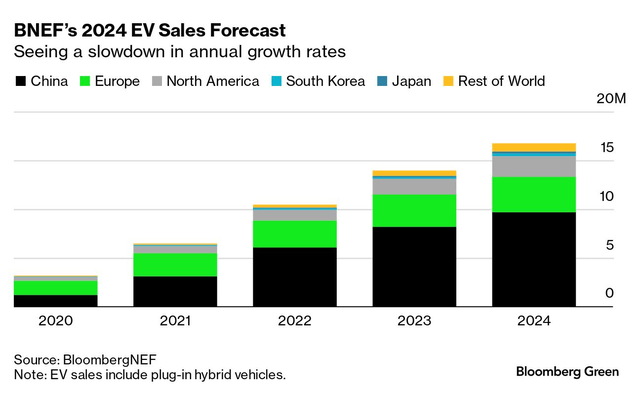
Furthermore, the global EV market’s explosive growth has led to a surplus of inventory, prompting manufacturers to resort to price cuts. With the escalating production by EV manufacturers, it is uncertain how VinFast’s expanded capacity will fare in the possibly saturated market when it comes online in 2026.
Challenges and Valuation
Assessing VinFast’s true valuation proves to be a formidable hurdle, especially with the ambiguity surrounding its near-term financials. The company’s revenue predictions are ensnared in a labyrinth of uncertainties, hindered by the enigma of VinFast’s unique appeal and the capricious state of the global economy in the imminent future.
Adding to the complexity are VinFast’s substantial annual expenses, exacerbating an already precarious financial scenario. Evidently, the $2 billion loss incurred in 2022 is set to linger in 2023, mirroring similar levels in 2024 and 2025. The golden horizon seems to materialize for VinFast by 2026, with a prospective reduction in expenses alongside the proliferation of production capacity, contingent on successful vehicle sales.
Comparative Company Analysis
With the intricacies of conducting a traditional discounted cash flow analysis infeasible, a comparative company analysis [CCA] provides a compelling alternative. It’s especially valuable in the context of a swelling cohort of companies vying for eminence in the electrifying EV industry. Moreover, the comparability of publicly traded EV companies aligns with examining their market valuations gleaned from their respective market capitalizations.
Crucially, the table below illustrates the 2023 BEV deliveries from a selection of prominent manufacturers in the domain, alongside their associated market capitalizations, thereby shedding light on their relative valuations.
|
Manufacturer |
2023 BEV Deliveries |
Market Capitalization |
The data underscores a fascinating revelation – Chinese BEV manufacturers such as BYD, Li Auto, Nio, XPeng, and Leapmotor appear to command discounted valuations when compared to their Western counterparts. A detailed exploration of this facet will be unveiled in the subsequent section.
Market Dynamics and Future Prospects
The rollercoaster journey of VinFast’s shares has culminated in a phase of stagnation, mirroring the similar valuation accorded to Rivian. Both companies, despite impressive vehicle deliveries, grapple with substantial losses, encapsulating the trials and tribulations of the frenetic EV sector.
The Duel of EV Titans: Rivian vs. VinFast
Rivian’s staggering Q3 2023 loss of approximately $1.3 billion, as well as an anticipated full-year loss of about $4 billion, has set the financial world abuzz. In stark contrast, VinFast expects a loss of roughly $2 billion in 2023. Nevertheless, there’s a glimmer of hope amidst the chaos: Rivian flexes its muscles, hinting at a potential positive operating profit as early as fiscal year 2024 or 2025, whereas VinFast’s prospects for an operating profit may extend to 2026 or beyond.
Rivian vs. VinFast: Cash Reserves Face-Off
A fundamental distinction between these behemoths lies in their cash reserves. Rivian rounds off the end of Q3 2023 with a staggering $9 billion in cash, overshadowing VinFast, which struggles with less than $200 million. It’s a tale of David and Goliath where the mighty Rivian stands in a position of undeniable strength, flaunting a significant cash advantage that dramatically influences its higher valuation.
Financial Positioning: A Clash of Titans
Examining their financial positions unearths a David-and-Goliath narrative where Rivian boasts about $16 billion in total assets contrasted with a mere $6 billion in total liabilities, resulting in a resounding positive book value. Conversely, VinFast finds itself on less stable ground with approximately $5 billion in total assets against a staggering $7 billion in liabilities, yielding a negative book value.
EV Delivery Battle: Rivian’s Upper Hand
Rivian is projected to deliver around 80,000 battery electric vehicles (BEVs) in the upcoming year, showcasing dominance in the imminent market. On the other hand, VinFast’s delivery estimate for 2024 remains shrouded in ambiguity, casting a shadow of uncertainty. Astonishingly, both companies delivered roughly 2.5% of the total BEVs that Tesla unleashed in 2023, reflecting their modest market penetration, which mirrors their respective market capitalizations.
Strong Financials Brighten Rivian’s Valuation
Despite these comparisons, the reasons for Rivian’s superior valuation become starkly apparent when considering its stronger financials, positive book value, and higher cash reserves. If Rivian manages to achieve an operating profit in 2024, it could potentially trade at an even greater premium to VinFast, perpetuating its market dominance.
Investment Takeaways: Signposts in a Murky Landscape
The soaring success and valuation of Tesla, a formidable EV giant, serves as the touchstone against which other global EV manufacturers are measured. While both Rivian and VinFast grapple with substantial annual losses, the market has bestowed valuations of $15-17 billion for these companies, signaling potential. These valuations roughly amount to 2.0-2.5% of Tesla’s total valuation, aligning with the percentage of vehicles that Rivian and VinFast delivered in 2023, in comparison to Tesla.
Determining whether these valuations are “fair” remains a daunting task, as projecting future revenues, expenses, and earnings for these nascent companies, especially VinFast, proves to be a Herculean feat.
On the bright side, VinFast is poised to scale its production capacity to hundreds of thousands of EVs by around 2026. Moreover, VinFast eludes the negative stigma associated with Chinese EV manufacturers, elevating its valuation. However, uncertainty prevails as consumers’ embrace of VinFast’s vehicles and the need for substantial capital infusion loom large on the horizon, potentially diluting existing shareholders’ stakes.
Amidst this quagmire, potential investors in VinFast may be well advised to await clarity around its future production and capital raising plans before leaping into a new position, especially considering the company’s paucity of cash.
In a world where 96.6% of VinFast shares rest in the hands of insiders and only 1-2% are publicly traded, the limited liquidity exposes VinFast’s shares to unpredictable movements, as witnessed when the stock debuted publicly last August. Although VinFast has proposed making 10-20% of its shares publicly tradable by the year’s end, cautiousness behooves investors and traders in maneuvering the VinFast equity market. Recent upgrades in VinFast’s shares, including price targets set by Wedbush, Chardan Research, and BTIG, have failed to buoy the stock. An evident slump over the previous 30 days, a 16% dip, underscores the market’s apprehension pending clarity over VinFast’s capital raising strategy.
For now, patience seems to be the sage counsel for potential investors eyeing VinFast as the company steers through a labyrinth of uncertainties and potential hurdles.
Investors may want to hold off on entering a new position in VinFast until the company clearly articulates its future plans to raise additional capital.