Setting the Stage: Nvidia’s Landmark GTC Event
Last night, Nvidia (NVDA) commenced its annual GPU Technology Conference (GTC), hosting a keynote by CEO Jensen Huang that was met with fervent anticipation – perhaps unmatched in the annals of AI history. Huang, the maestro of the AI orchestra, orchestrated an evening that will be etched in the minds of tech enthusiasts for years to come.
A Glimpse into GTC
Before delving into the crux of Huang’s revelations, a primer on GTC is in order for the uninitiated. The GPU Technology Conference is a revered congregation for industry professionals, spanning the realms of gaming, artificial intelligence, data science, and beyond. Like clockwork, Nvidia offers a forum at GTC for experts to disseminate knowledge, foster networking, and explore the cutting edge. It’s a techie’s haven, complete with keynotes, sessions, and exhibitions that rejuvenate the minds of developers, researchers, and enthusiasts.
Huang: The Enigmatic Maestro
Commanding the stage with a presence akin to a rockstar, Jensen Huang, clad in his signature leather jacket, captivated the audience with more than his sartorial choice. In a symphony of words, Huang declared, “This is not a concert. Welcome to a developers’ conference.” His charisma reverberated through the venue as he steered the discourse towards the epicenter of the evening – artificial intelligence.
Unveiling Nvidia’s Blackwell AI Chips
Since its inception in ’93, Nvidia has been a torchbearer in specialized chips, revolutionizing graphics processing with accelerated computing. Under Huang’s stewardship, the company transitioned from a gaming-centric entity into a juggernaut of AI and autonomous tech. With the spotlight on Blackwell chips, dubbed B200, Nvidia set a new benchmark by enabling the inception of AI models with a mammoth capacity – 10 trillion parameters, dwarfing the outputs of competitors like OpenAI.
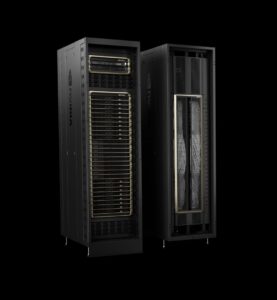
“I want to show you the soul of Nvidia, the soul of our company, at the intersection of computer graphics, physics and artificial intelligence, all intersecting inside a computer.” – Jensen Huang
Blackwell’s launch is heralded as Nvidia’s most triumphant milestone, a quantum leap into the future of AI.
Expanding Horizons: Nvidia’s AI Ecosystem
Beyond Blackwell, Huang unveiled a tapestry of new AI partnerships that underscore the vast and varied horizons of AI applications.
Embracing the Future: Diverse Partnerships
From a collaboration demonstrating the integration of AI in Apple’s XR headsets to Dell’s strategic alignment utilizing Nvidia’s technology in data centers, the implications are unmistakable. And in the healthcare realm, a partnership with Johnson & Johnson for AI-assisted surgical procedures heralds a groundbreaking era in the operating room.
The Pioneering Journey of Nvidia in AI Robotics
In a world where surgical precision is already a reality with systems like da Vinci from Intuitive Surgical (ISRG), the entry of Nvidia into the market is poised to unlock even greater value. Many experts predict that AI will automate a significant portion of surgical procedures in the near future.
The Rise of Robotics
Nvidia’s unveiling of the Project GROOT Foundation AI model and the Thor system-on-a-chip for robotic use has sparked excitement in the tech realm. With industry giants like OpenAI, Microsoft (MSFT), Tesla (TSLA), Amazon (AMZN), and Intel (INTC) heavily investing in humanoid robot development, Nvidia’s foray into this arena promises a future of advanced robotics.
The Final Verdict
At the recent GTC event, Jensen Huang boldly declared that the introduction of the Blackwell GPU would be Nvidia’s most successful product launch to date. This forward-looking statement underscores the potential of the Blackwell architecture to revolutionize computing power and efficiency.
Given Nvidia’s history of innovation and the indispensable role GPUs play in advancing AI, gaming, and data analytics, Huang’s optimism is well-founded.
The upcoming Blackwell GPU advancements are set to cement Nvidia’s position as a frontrunner in technology, offering unparalleled capabilities to developers and consumers.
Of particular interest are Nvidia’s Project GROOT Foundation AI model and the Thor system-on-a-chip, marking a significant step in the evolution of humanoid robots. These developments position Nvidia at the forefront of the technological revolution, shaping the future of robotics.
Nvidia’s venture into AI robotics, alongside other industry giants, heralds a new era of sophisticated robotic functionalities, presenting a compelling investment opportunity in cutting-edge technology.
While AI-powered humanoid robots may seem like a concept from science fiction, leading companies and visionaries in AI regard humanoid robots as the next phase of AI – AI 2.0. Their substantial investments in this technology signify the dawn of a new era, shaping the evolving landscape of artificial intelligence.
Embark on the journey towards AI 2.0 with actionable insights into the AI stocks we are backing for the future.