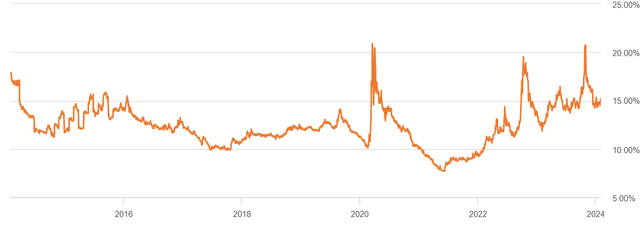
For many income investors, AGNC Investment Corp. (NASDAQ:AGNC) has been a favored choice. The company has historically boasted an impressive yield, with few exceptions.
However, this high yield may not be as reliable as it appears. The company’s business model raises concerns about the sustainability of its dividends in the long term, which could impact those reliant on consistent income. Thus, the shares shouldn’t be viewed favorably, and a SELL recommendation seems appropriate.
Evaluating Dividend History
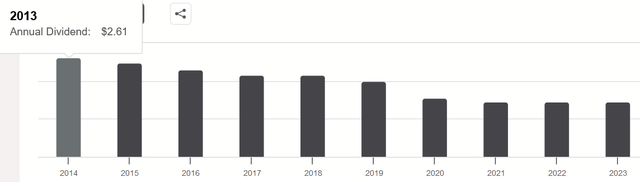
Reviewing AGNC’s annual dividend history provides valuable insights into the company’s performance and its ability to deliver consistent returns to shareholders.
Over the last decade, AGNC’s dividend per share has dwindled significantly, dropping from $2.61 to $1.24 by 2023. This decline raises questions, considering the company’s purported commitment to providing favorable long-term returns through attractive monthly dividends.
How did a company that places such high priority on dividends let its dividend history unfold this way? Examining AGNC’s business strategy offers insight into how it affects its financial performance.
Unpacking the Business Strategy
AGNC operates primarily as an investment fund without involvement in the origination or servicing of real estate mortgages. According to its annual report, the company focuses on leveraging its investments in Agency residential mortgage-backed securities (“Agency RMBS”).
Essentially, AGNC uses borrowing as leverage to magnify returns on its fixed-income investments. However, this strategy also amplifies potential losses, making dividend sustainability questionable.
Furthermore, the company adopts hedging strategies, using derivatives such as credit default swaps to mitigate risks. While these strategies may offer upside potential, their true impact on the company’s earnings and dividends remains uncertain.
Analyzing the Investment Portfolio
A close examination of AGNC’s balance sheet reveals a heavy concentration of assets in less risky Agency securities, predominantly 30-year, fixed-rate mortgages. However, the company’s reliance on financing arrangements and potential margin calls can threaten its ability to maintain dividend levels.
This reliance on leverage and potential forced asset sales at unfavorable prices, as highlighted in AGNC’s Risk Factors, further undermines the sustainability of its dividends and could lead to permanent capital losses for investors.
Assessing Cash Flow
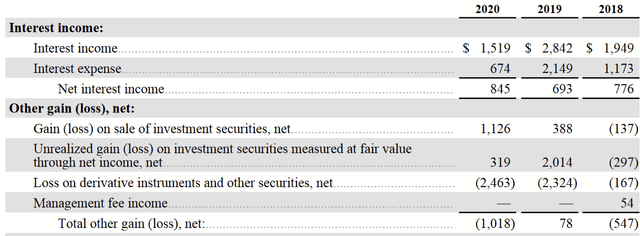
A deeper dive into AGNC’s income statements, especially the significant dividend cut in 2020 compared to 2019, provides crucial insights into its cash flow situation and the challenges it faces in maintaining dividend payouts.
Assessing AGNC’s Financial Performance: A Cautionary Tale for Investors
AGNC’s Financial Performance Under Scrutiny
The financial landscape of AGNC Investment Corp. has been tumultuous, to say the least, especially in the wake of the COVID-19 pandemic. The company witnessed a curious impact during this period, as both their interest income and interest expense decreased, resulting in a significant surge in net interest income. However, these gains were overshadowed by the heavy losses incurred by their derivatives (hedge investments), shedding light on the potential risks associated with such investments. AGNC’s management lauded their actions during this period, citing a repositioning of the portfolio and more efficient funding sources as essential elements in safeguarding the company’s liquidity. While management’s narrative paints a picture of prudent decision-making, one cannot help but question the actual efficacy of their measures.
Amid adversity, AGNC posted three consecutive quarters of substantial economic returns following a significant book value decline in the first quarter of 2020. This resilience, according to the management, underscores the importance and value of AGNC’s disciplined investment framework and risk management practices.
However, while the management’s explanation might hold some merit, it still raises concerns about the company’s performance and resilience in the face of market instability. AGNC’s historical context further complicates the situation, with the company’s stock previously trading at double-digit yields, only to witness a decline in actual income for investors. One may question whether management’s explanations suffice, especially considering the adverse impact on investors.
Delving into AGNC’s income statements reveals a volatile cash flow situation, with net interest income fluctuating over time and the company heavily reliant on the positive or negative sale of mortgage securities and their derivatives. What appears to be a simple, low-risk bond fund investment is, in reality, marred by complexities, contributing to the precarious financial position the company finds itself in.
The Peril of Share Dilution
Share dilution looms large as a significant concern, particularly as it impacts individual shareholders. The exponentially increasing number of common shares – nearly doubling over the past decade – has inevitably led to a drastic reduction in dividends. With the dividend yield consistently hovering in the double digits, AGNC faces an arduous task of producing robust returns to counteract the effects of dilution, a feat easily thwarted by substantial losses.
Furthermore, the tangible book value (TBV) has endured a significant negative impact over time, signaling a potential decline in individual share income over time and diminished capital recovery in the event of liquidation. These issues compound the challenges faced by AGNC and raise substantial red flags for savvy investors.
A Stark Conclusion
The consistent decline in the company’s dividend, coupled with a reckless approach to raising capital and making investments, paints a disconcerting picture for AGNC. The emphasis on “attractive risk-adjusted returns” appears to be a mere facade, potentially leading to a faster dilution of equity, irreversible losses, or both. In light of this, investors are better served divesting from AGNC and exploring alternative income-focused investments that offer stable income potential and avoid the pitfalls plaguing the company.
The free Daily Market Overview 250k traders and investors are reading