Berkshire Hathaway Hits Record High Amid Mixed Earnings Report
Berkshire Hathaway (NYSE: BRK.A) (NYSE: BRK.B) reached a new all-time high on May 2, just ahead of its 60th annual meeting in Omaha, Nebraska, last Saturday.
The stock has significantly outperformed the S&P 500 (SNPINDEX: ^GSPC) year to date, rising 14% compared to a 4.5% decline in the index. This trend of success extends beyond recent months. Over the past year and the last three years, Berkshire has consistently outperformed the S&P 500, tripling in value over the past five years while the index has only doubled.
The stock’s gains come even as Berkshire has been reducing its investments in equity securities and increasing its cash reserves. In the previous year, the company reduced its holdings in its top-position, Apple, by approximately two-thirds and also decreased its holdings in Bank of America, the second-largest position.
On Saturday, Berkshire reported its first-quarter 2025 results, revealing a 14% decline in operating earnings.
With the stock’s appreciation and a dip in earnings, investor concern about Berkshire’s valuation may be rising. Let’s analyze the earnings results and key insights from Chief Executive Officer Warren Buffett during the annual meeting to evaluate if the stock remains a good buy.

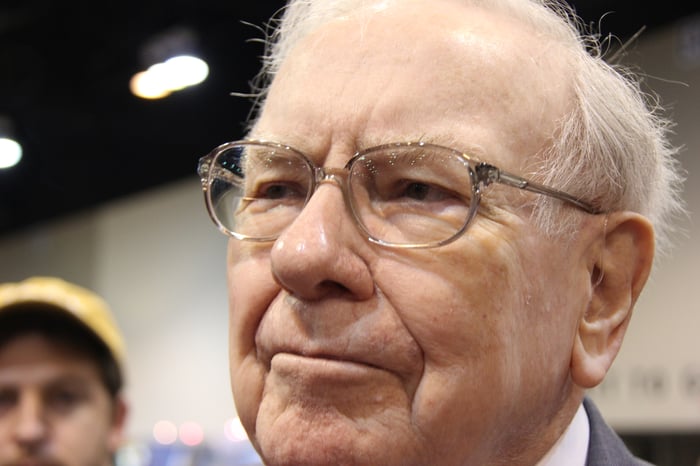
Image source: The Motley Fool.
Understanding Berkshire Hathaway’s Financial Structure
Berkshire Hathaway can be segmented into three categories: the value of its controlled companies, investments in equity securities, and its liquid cash holdings, including Treasury bills (T-bills).
As of March 31, Berkshire’s cash position stood at $347.68 billion. By May 2, the market value of its equity securities—including positions in companies like Apple, American Express, and Coca-Cola—was $277.41 billion. With a total market cap of $1.163 trillion, the valuation of its controlled businesses amounts to $537.9 billion.
Berkshire’s financial composition has shifted markedly. Three years ago, on March 31, 2022, its cash position was $106.26 billion, equity securities were valued at $390.54 billion, and its market cap was $778.63 billion, attributing only $281.83 billion to its controlled companies.
While a major acquisition could explain the increase in the valuation of controlled companies, Berkshire hasn’t made transformative investments in recent years. The firm has made smaller moves, like acquiring the remaining 8% of Berkshire Hathaway Energy and insurer Alleghany for $11.6 billion, but these actions haven’t significantly impacted its financial standing.
Performance of Controlled Businesses
The sale of public equities and an increase in market cap have placed pressure on Berkshire’s controlled operations, yet they have managed to perform well.
The company reported a record year of operating earnings in 2024, largely driven by its insurance sectors. However, first-quarter 2025 operating earnings showed a decline compared to the previous year, primarily due to lower underwriting earnings from insurance and foreign exchange losses.
|
Segment |
Q1 2024 |
Q1 2025 |
|---|---|---|
|
Insurance — Underwriting |
$2.598 billion |
$1.336 billion |
|
Insurance — Investment Income |
$2.598 billion |
$2.893 billion |
|
BNSF |
$1.143 billion |
$1.214 billion |
|
Berkshire Hathaway Energy Company |
$717 million |
$1.097 billion |
|
Manufacturing, Service, and Retailing Businesses |
$3.088 billion |
$3.060 billion |
|
Other* |
$1.078 billion |
$41 million |
|
Operating Earnings |
$11.222 billion |
$9.641 billion |
Data source: Berkshire Hathaway. *Other mainly includes changes in currency exchanges, interest, and dividend income.
The underwriting performance is subject to fluctuations based on claims from catastrophic events. Last year was particularly strong, establishing expectations for a reduction this year.
Investment income, in contrast, has shown stability. This component reflects the returns on Berkshire’s float—the total sum of premiums collected but not yet paid out in claims. The float acts as an interest-free reserve for investments, and Berkshire’s reputation for conservatism ensures sufficient liquidity for claim payouts.
With $2.893 billion in insurance investment income reported this quarter, Berkshire is achieving an annualized return of about 6% on its float.
While Berkshire’s overall operating earnings remain strong, earnings from pivotal segments, such as the BNSF railroad and manufacturing sectors, showed little growth year over year. These segments are not accelerating rapidly.
During the annual meeting, Buffett highlighted Berkshire’s focus on long-term outcomes, stating: “We don’t make decisions based on their impact on quarterly and annual earnings. Never have I suggested to my board or spoken with Charlie [Munger] about the influence of our actions on our annual earnings.”
Berkshire Hathaway: A Consideration for Long-Term Investors
Financial results will emerge in due time, reflecting the underlying performance of the business. Ultimately, the critical factor is where we stand five, ten, or even twenty years from now.
Berkshire Hathaway’s Current Position in the Market
Berkshire Hathaway’s market capitalization has significantly outpaced the gains from its public equity investments. This indicates that the bulk of its success is tied to its controlled businesses. While these subsidiaries have been enhancing operating earnings consistently, it is important to recognize that Berkshire is not as attractive an investment as it once was.
Nonetheless, Berkshire could appeal to investors who appreciate its increasing cash position and management’s shift away from purchasing public securities toward expanding wholly owned subsidiaries. However, if Berkshire’s stock price continues to rise faster than the growth of its controlled businesses, its valuation may eventually stretch too thin.
Evaluating a $1,000 Investment in Berkshire Hathaway
Before opting to invest in Berkshire Hathaway, prospective investors should consider the following:
The Motley Fool Stock Advisor analyst team recently highlighted what they believe are the 10 best stocks to purchase at present, notably excluding Berkshire Hathaway. The selected stocks stand a solid chance of yielding substantial returns in the near future.
For instance, consider when Netflix was featured on this list on December 17, 2004; a $1,000 investment at that time would today be worth $611,589!* Similarly, Nvidia made the list on April 15, 2005; those who invested $1,000 would currently see their investment grow to $697,613!*
It is significant to note that Stock Advisor has recorded a total average return of 894%—a notable outperformance against the 163% of the S&P 500. Be sure to check out the latest top 10 stock list available when you join Stock Advisor.
See the 10 stocks »
*Stock Advisor returns as of May 5, 2025
Daniel Foelber has no position in any stocks mentioned. The Motley Fool holds positions in and recommends Apple, Bank of America, and Berkshire Hathaway. The Motley Fool has a disclosure policy.
The views and opinions expressed herein belong solely to the author and do not necessarily represent those of Nasdaq, Inc.