Baidu and Alibaba Shift Focus to AI, Raising Investment Opportunities
Baidu (BIDU) and Alibaba (BABA) are leading players in China’s tech sector, both making significant moves toward artificial intelligence (AI). Baidu dominates in online search and AI cloud services, while Alibaba excels in e-commerce and cloud computing. Both companies are profitable and investing heavily in AI research and applications, attracting renewed investor interest following recent market improvements.
With China’s AI sector expanding rapidly, Baidu and Alibaba have emerged as pivotal players in this trend.
Baidu’s AI Strategy Drives Growth
Baidu, known as “China’s Google,” has established itself as an AI-centric organization. Recent results indicate this strategy is paying off, particularly in first-quarter 2025, where its AI Cloud business grew revenue by 42% year over year. This segment now accounts for 26% of Baidu Core’s revenue, up from 20% last year.
A central factor in Baidu’s success is its model-as-a-service platform, Qianfan. This platform enhances AI capabilities while attracting enterprise clients, boosting subscription revenues. Despite challenges such as U.S. chip export restrictions, Baidu continues to innovate with its ERNIE 4.5 and ERNIE X1 models set for release in April 2025.
Nonetheless, Baidu reported a negative free cash flow of RMB 8.9 billion in Q1, reflecting high investment in AI initiatives, despite a 16% operating margin. The company faces challenges in online advertising, where core revenues fell 6% year over year, compounded by competition from TikTok and Tencent.
Alibaba’s E-Commerce and AI Momentum
Alibaba has shown substantial recovery over the past year. Its diversified ecosystem encompasses various sectors, including Chinese marketplaces and international retail. E-commerce still accounts for over half of its total revenue.
The latest fourth-quarter results highlight a strong performance in Cloud and AI, with Alibaba Cloud’s revenue up 18% year over year. AI-related product revenue has maintained triple-digit growth for seven consecutive quarters, boosted by significant demand for AI infrastructure.
In e-commerce, Alibaba has seen a 12% increase in customer management revenue, thanks to service fee rollouts and improvements in user engagement. The company has returned $16.5 billion to shareholders via dividends and stock buybacks, emphasizing its financial stability.
Challenges include fierce competition and rising operational costs in both e-commerce and cloud services. Alibaba’s free cash flow dipped by 76% due to escalated capital expenditures. Moreover, geopolitical risks may complicate its international commerce initiatives.
Stock Performance: BIDU vs. BABA
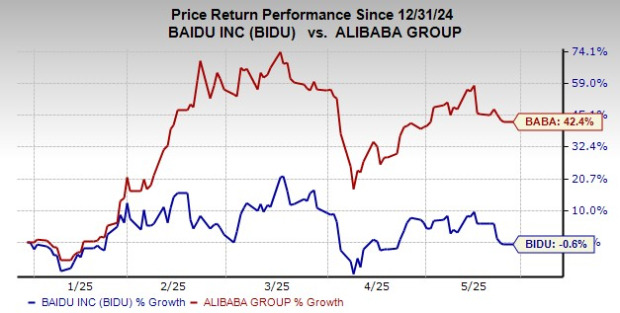
Year-to-date, Baidu’s shares have struggled amidst concerns over China’s economic outlook and U.S.-China relations. Conversely, Alibaba’s stock performance has shown relative strength, reflecting investor confidence in its recovery and growth strategy.
Alibaba Outshines Baidu with Stronger Growth Potential
Alibaba Group (BABA) has experienced a significant stock increase of 42.4% this year. Meanwhile, Baidu, Inc. (BIDU) has not performed as well, leading to a lower valuation for its shares. Currently priced in the mid-$80s, Baidu has a forward P/E ratio of 7.84 compared to Alibaba’s 11.13.
Growth Estimates for Baidu and Alibaba
In the last 30 days, Baidu’s earnings estimates have not changed. In contrast, Alibaba’s current-year earnings per share (EPS) estimates have declined. Analysts forecast Baidu’s revenue to rise 2.2% to $18.9 billion, while EPS is expected to drop 4.3% to $10.08. Alibaba’s revenue is projected to increase 3.8% to $143.4 billion, and its EPS is anticipated to rise 17.9% to $10.62. This growth momentum suggests that Alibaba is better positioned for investment in AI and other sectors, justifying its higher valuation.
Stock Rankings and Growth Strategies
Both Baidu and Alibaba hold a Zacks Rank #3 (Hold). Each company aims to lead in the expanding AI market, but with different strategies. Baidu focuses on autonomous driving and AI-based cloud services, presenting a high-risk, high-reward profile. Its current valuation is appealing, given the potential of these initiatives, though regulatory factors in China may impact its stability.
Conversely, Alibaba benefits from a diversified business model that spans e-commerce, logistics, and cloud computing. This model provides multiple revenue streams that bolster its AI investments. While not as aggressive as Baidu in autonomous driving, Alibaba’s integrated approach offers a more stable foundation for growth, especially with its international presence in markets like Southeast Asia.
Conclusion
Both Baidu and Alibaba present strong narratives for AI-driven growth. However, Alibaba’s diversified model, consistent revenue from e-commerce, and international opportunities give it a competitive advantage over Baidu.
Baidu, Inc. (BIDU), Tencent Holdings Ltd. (TCEHY), and Alibaba Group Holding Limited (BABA) offer distinct investment prospects. For more detailed stock analysis, please refer to the respective company reports.
The views expressed in this article are those of the author and do not necessarily represent the views of Nasdaq, Inc.
5 Stocks Our Experts Predict Could Double In the Next Year
By submitting your email, you'll also get a free pivot & flow membership. A free daily market overview. You can unsubscribe at any time.