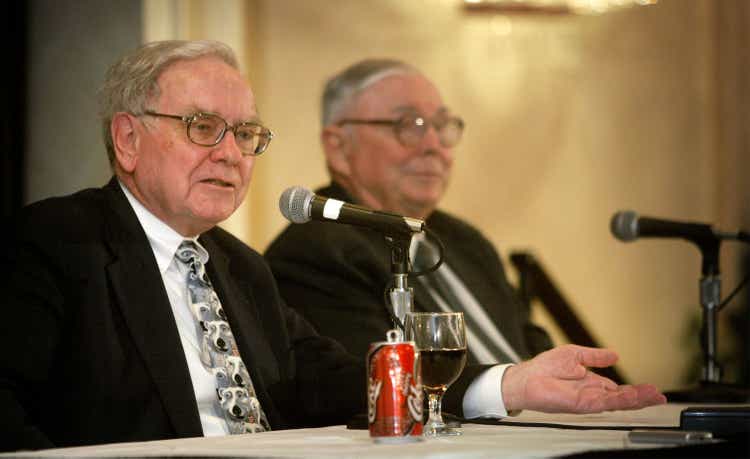
Berkshire Hathaway (NYSE:BRK.A, NYSE:BRK.B) has long been synonymous with the iconic investor Warren Buffett. The company’s stock has yielded strong returns over the years, earning the unwavering trust of long-term investors. However, the impending departure of Mr. Buffett has cast a shadow of uncertainty over the conglomerate’s future. As the torch is set to be passed to the next generation of leaders in the next five years, shareholders are left pondering the potential impact on Berkshire’s trajectory.
The recent exit of Charlie Munger, the long-time advisor and deputy to Mr. Buffett, has compounded these concerns. Although Mr. Munger’s role had diminished in Berkshire’s day-to-day operations in the years leading up to his departure, his absence has intensified speculation about Berkshire’s future without the guiding presence of its 93-year-old Chairman. The impending leadership transition is poised to be a litmus test for the company.
Evaluating Berkshire’s Current Position
Berkshire’s portfolio encompasses a diverse array of wholly-owned subsidiaries and public market investments. Its portfolio comprises high-quality businesses operating in mature industries, meticulously handpicked by Buffett over several decades. Notably, Apple stands as the Group’s largest asset, representing approximately 20% of its Net Asset Value.
The operating subsidiaries span various sectors, including Manufacturing, BNSF railways, Services and Retailing, BHE and utilities, and Insurance and reinsurance underwriting. Individually, the majority of these businesses are considered highly valuable and would command premium valuation multiples in their respective industries. Moreover, Berkshire’s long-term management outlook and adept capital reallocation from mature to growing businesses add substantial value to the conglomerate.
In the fiscal year 2022, Berkshire’s operating businesses produced after-tax earnings surpassing $21 billion. When excluding investment income from the estimation of operating earnings, applying a conservative valuation multiple of 15x on these earnings pegs the value of the operating subsidiaries at over $300 billion. This valuation appears relatively frugal, especially when benchmarked against the S&P500’s average PE ratio of 21x. Furthermore, Berkshire’s capital relocation strategy further augments the cost-effectiveness of this valuation. These conservative measures are warranted in light of mounting long-term interest rates and the uncertain returns that the next generation of managers may secure.
Separately, Berkshire’s investment portfolio, valued at approximately $520 billion, includes equity securities, fixed-income instruments, and cash. Cash and debt instruments account for roughly 40% of the portfolio, offering a buffer to overall value during equity market downturns. Factoring in the investment portfolio, Berkshire’s conservative estimated value nears $840 billion, encroaching upon its current market capitalization of close to $790 billion.
Berkshire Hathaway, USD million
FY2021
FY2022
Q3 2023
Investment portfolio
520,526
Investments in equity securities
318,621
The Future of Berkshire Hathaway: Navigating Post-Buffett Uncertainties
The Future of Berkshire Hathaway: Navigating Post-Buffett Uncertainties
Berkshire Hathaway, famously helmed by investment maestro Warren Buffett, is not just a run-of-the-mill holding company but a diversified lineup of prime businesses, carefully valued and managed over the years. As the financial world speculates about the future of the company in the wake of Mr. Buffett’s eventual departure, a number of intriguing questions arise, casting a shadow over the company’s hitherto unblemished performance.
The Value of Berkshire after Buffett
The market consensus on Berkshire Hathaway’s Net Asset Value (NAV) currently hints at a lingering reverence for Mr. Buffett’s legacy. The company is trading at a slight discount to its NAV, signaling confidence in Buffett’s stewardship of capital and a reluctance towards liquidation. This is starkly contrasted by the fate of poorly managed holdings, like United Corporations (OTCPK:UCPLF), whose stock is currently trading at a significant discount due to management’s refusal to liquidate, and a lack of shareholder trust in the leadership. Hence, concerns arise about potential plunges in Berkshire’s valuation post-Buffett.
The Margin of Safety in Berkshire
Warren Buffett’s cautious approach to buybacks and the accumulation of a substantial cash reserve at Berkshire Hathaway serves as a reassuring buffer, positioning the company favorably for a smooth transition post-Buffett. This war chest of cash, amounting to around $150 billion, is poised to fuel substantial share buybacks if the market price falls significantly below NAV. Such strategic moves could uphold per-share value and buoy the stock, potentially outperforming the market. The prudence of these precautions is attributed to Buffett’s life-long approach of meticulously weighing worst-case scenarios and risks.
Buy, Hold, or Sell?
Currently trading at a modest discount to NAV, Berkshire’s future, absent Warren Buffett’s guidance, bears uncertainties that could widen this discount. The potential downside in the share price post-Buffett could trigger unease among investors, possibly leading to an underperforming market position for Berkshire. Amidst this speculation, deciding whether to buy, hold, or sell becomes an intricate conundrum. While a potential price decline may lure some investors to await more favorable entry points, the longer-term value growth of the stock remains an undeniable factor that demands consideration.
Conclusion
As the venerable Warren Buffett’s eventual departure looms, Berkshire Hathaway faces uncharted territory. While the halo of Buffett’s acumen may no longer grace the company, Berkshire’s resilient foundation, bolstered by an astutely built cash reserve and the potential for share buybacks, is cause for cautious optimism. The company’s prudent approach to navigating this pivotal transition speaks volumes and underscores the continued potential for Berkshire Hathaway to offer enduring value, even in a post-Buffett era.
Editor’s Note: This article discusses one or more securities that do not trade on a major U.S. exchange. Please be aware of the risks associated with these stocks.
The free Daily Market Overview 250k traders and investors are reading