Capital One Finalizes $35 Billion Acquisition of Discover Financial
After nearly 15 months of negotiations, Capital One (COF) has officially completed its acquisition of Discover Financial Services. This $35 billion deal significantly alters the credit card industry landscape by creating a new leader in loan volume.
With the merger finalized, Capital One is positioned to capture an increased share of card spending and strengthen its competition against major industry players like Visa (V) and Mastercard (MA). Additionally, Capital One gains control of Discover’s payments network, one of only four in the United States, which opens up more revenue opportunities from interchange fees and reduces its dependence on the Visa-Mastercard duo.
The road to completion was not easy. Although shareholders from both companies approved the deal in February, it faced extensive regulatory scrutiny. Last month, the Federal Reserve and the Office of the Comptroller of the Currency granted final approval after the U.S. Department of Justice chose not to contest the merger.
Conditional to approval, Capital One must resolve existing enforcement issues associated with Discover. In 2023, Discover disclosed that it had overcharged merchants on certain credit card transactions since 2007, which resulted in regulatory inquiries and required corrective measures.
Overall, Capital One’s acquisition is viewed as a transformative moment in consumer finance, potentially enhancing competition and promoting innovation within the credit card and payments sectors.
Key Details of the Capital One-Discover Merger
As part of the agreement, Discover shareholders will receive 1.0192 Capital One shares for each share they hold in Discover. Moreover, three members from Discover’s board—Thomas G. Maheras, Michael Shepherd, and Jennifer L. Wong—will now serve on Capital One’s board.
At the time of the announcement in February 2024, it was expected that the merger would yield significant benefits for shareholders, including expense synergies estimated at $1.5 billion by 2027 and network synergies of $1.2 billion. This should result in over 15% accretion to adjusted non-GAAP EPS by 2027.
Additionally, the transaction is set to strengthen Capital One’s balance sheet, with a pro forma CET1 ratio projected at around 14% upon closing.
Current Status and Future Plans for Customers
Currently, there will be no immediate changes to customer accounts or banking relationships for either Capital One or Discover clients. Both companies plan to provide comprehensive information ahead of any developments. Capital One intends to continue offering Discover-branded credit card products alongside its existing offerings.
Capital One’s “Digital First” banking model will be enhanced by incorporating Discover Financial’s national direct savings bank. This combination is expected to improve the overall ability of the merged company to compete with larger financial institutions and drive national banking growth.
Throughout its history, COF has committed to a strategic acquisition approach to diversify its services and expand market presence. Notable acquisitions include ING Direct USA, HSBC’s U.S. Credit Card Portfolio, and TripleTree, which have been vital in transforming the company from a monoline credit card issuer to a multifaceted financial services entity with a solid footing in retail banking, commercial lending, and digital banking platforms.
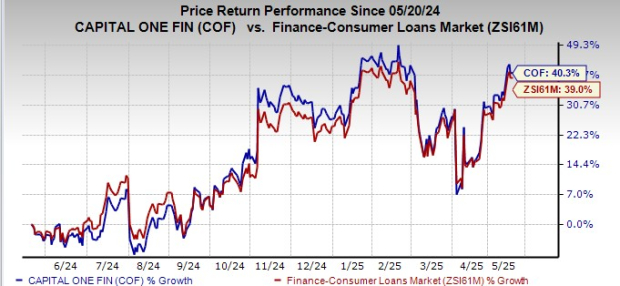
Over the past year, Capital One’s shares surged by 40.3%, surpassing the industry growth of 39% during the same period.

Image Source: Zacks Investment Research
Currently, COF has a Zacks Rank #3 (Hold).
Market Outlook
As developments unfold, stakeholders will monitor how the merger influences market dynamics and competition in the consumer finance landscape.
The views and opinions expressed herein are those of the author and do not necessarily reflect those of Nasdaq, Inc.