The global autonomous vehicle market, valued at $4.44 trillion in 2023, is projected to exceed $41.75 trillion by 2034, growing at a compound annual growth rate (CAGR) of 32.3% from 2026 to 2034, according to Fortune Business Insights. This booming sector is attracting major players like China’s WeRide (WRD) and San Francisco-based Uber Technologies (UBER), both advancing their autonomous vehicle strategies. Uber is focusing on partnerships, collaborating with companies like Amazon’s Zoox to deploy robotaxis in Las Vegas during summer 2023, with expansions to Los Angeles by mid-2027. WeRide aims to deliver 2,000 purpose-built robotaxi vehicles by 2026 in collaboration with Zhejiang Farizon.
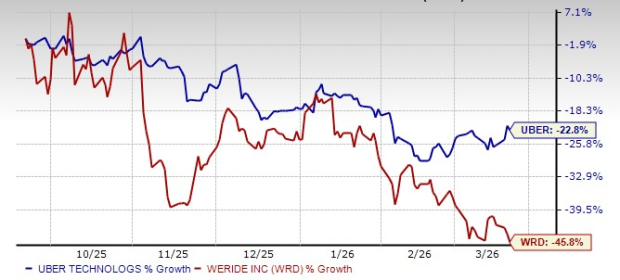
WeRide’s international collaborations are gaining traction, notably with an upcoming investment from Grab to accelerate Level 4 autonomous vehicle rollouts in Southeast Asia, and the introduction of GXR and Robobus vehicles in Singapore slated for passenger service by early 2026. Currently, WeRide operates Level 4 robotaxis in multiple locations, including Shanghai, Abu Dhabi, and Riyadh, and is also expanding its autonomous shuttle services. Both companies are facing competitive pressures, with Uber’s shares declining by double digits over the past six months, while WeRide, having traded on Nasdaq since 2024, has a worse share performance during the same period.
Looking ahead, WeRide is perceived as a stronger investment option compared to Uber, currently holding a Zacks Rank of 2 (Buy) versus Uber’s Rank of 3 (Hold). Analysts are optimistic about WeRide’s prospects as it continues pushing forward with its global expansion and technology integration.