NVIDIA Corporation (NVDA) has launched its new Vera Rubin platform aimed at enhancing its capabilities in the artificial intelligence (AI) compute market. This new architecture integrates central processing units (CPUs), graphics processing units (GPUs), networking, and storage into a cohesive system, shifting away from standalone chips. The platform is designed to efficiently manage all phases of AI workloads, from training to real-time inference, addressing the growing demand from enterprises for enhanced processing speed and efficiency.
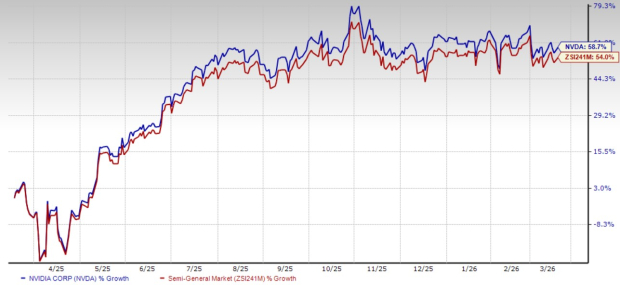
The Vera Rubin platform is expected to outperform NVIDIA’s previous Blackwell architecture, reducing the number of GPUs required for large models and decreasing inference costs. Revenue from NVIDIA’s Compute segment grew by 58% year-over-year to $51.33 billion in Q4 of fiscal 2026, and estimates are set for a further surge, with projections for fiscal 2026 revenues reaching $260 billion—a 60% increase. This growth is anticipated to be fueled by increasing adoption of Vera Rubin, particularly among major cloud providers and AI developers.
In the competitive landscape, NVIDIA faces challenges from Advanced Micro Devices, Inc. (AMD), which is promoting its MI300 series accelerators, and Intel Corporation (INTC), with its Gaudi AI accelerators. Both companies are vying for market share in the AI compute space, signaling a dynamic shift in the industry as enterprises seek alternative solutions beyond NVIDIA’s ecosystem.