Eli Lilly’s Stability Amid Market Turbulence Sparks Investor Interest
In today’s volatile political and economic landscape, pharmaceutical powerhouse Eli Lilly and Company LLY stands out as a potential safe investment. The healthcare sector’s resilience during economic downturns is well-recognized; when illness strikes, the need for medication and treatment remains constant, regardless of economic conditions.
Chronic health conditions continue regardless of market fluctuations, compelling patients to seek care. For this reason, healthcare companies, particularly drug manufacturers like Eli Lilly, often maintain stable revenue during recessions. Additionally, demographic shifts, especially the aging population in the U.S. and worldwide, suggest that healthcare demand will likely increase.
A key driver for LLY’s performance is its promising obesity drug, orforglipron. Analysts from Cantor Fitzgerald recently began coverage on Eli Lilly, highlighting the company’s strong position within the obesity treatment market. Last week, the firm released topline phase 3 results for this medication aimed at adults with type 2 diabetes, achieving significant blood sugar reduction compared to a placebo in the initial phase of the study.
This positive news has drawn the attention of traders as well. Recently, there was a significant purchase of call options nearing $77,000, expiring on August 15, 2025. These call options indicate active speculation, as it requires LLY’s stock price to exceed the premium paid to result in profitability.
Despite the bullish sentiments, concerns about Eli Lilly’s valuation persist. Currently, LLY Stock trades at nearly 71 times its trailing earnings, a level some investors might find excessive. Moreover, the stock’s price-to-book ratio exceeds 52, marking a notable increase compared to previous years.
Inverse and Leveraged ETFs as Alternative Options
Investors face challenges with LLY’s high share price of over $800, which complicates smaller trades. This factor is where Direxion comes into play, offering alternative investment pathways.
Two new exchange-traded funds (ETFs) have emerged in this space. The first, Direxion Daily LLY Bull 2X Shares ELIL, aims to provide 200% of the daily performance of LLY Stock. Conversely, the Direxion Daily LLY Bear 1X Shares ELIS tracks 100% of its inverse performance.
These ETFs offer investors easy access to either a leveraged long or a short position without the complexities associated with the options market. Additionally, Direxion ETF shares are traded like other publicly listed securities.
Risks Associated with Leverage and Inverse ETFs
However, investors must be cautious. Leveraged and inverse ETFs can be highly volatile. Furthermore, these specialized funds are typically designed for very short-term exposure, as prolonged holding can lead to volatility decay due to daily compounding.
Performance of ELIL and ELIS ETFs
The ELIL ETF debuted in late March and has seen approximately a 4% decline since launch. Nevertheless, recent indicators suggest potential for recovery in the short term.
- Over the past six years, LLY Stock has generally shown an upward trend, with a roughly 58% likelihood of profitability when held for a week.
- In recent months, LLY has alternated between five weeks of upward movement and five weeks of decline, but the overall trend remains positive, which could bode well for ELIL.
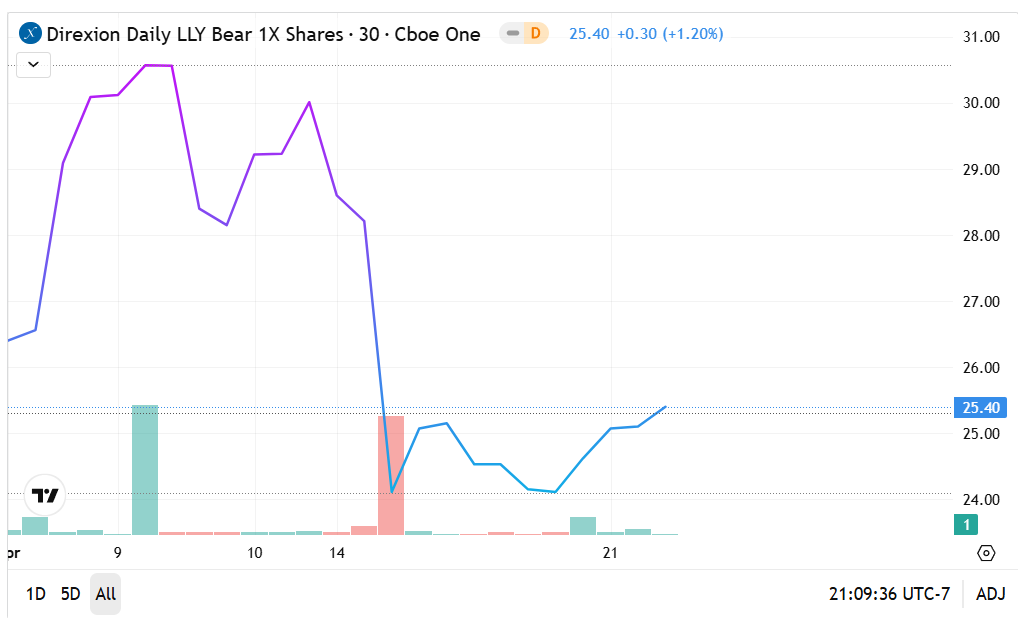
On the other hand, the ELIS ETF, which launched concurrently with ELIL, has also faced challenges, losing about 3% since its introduction.
- Given the limited data available, it’s difficult to make predictions for future performance. However, LLY’s chart indicates a potential bullish flag, suggesting caution for ELIS investors.
- While there’s a possibility for LLY to rise in the next three weeks, ongoing valuation concerns might weigh on the stock, making ELIS a noteworthy option.
Featured image by Rigby40 on Pixabay.