Trump’s Trade Policies Create Risks and Opportunities for the Market
President Donald Trump is on a self-declared mission to restore U.S. prominence, which may indeed come to pass. However, his international trade policies have raised concerns among world leaders and business executives. Lawmakers and executives are carefully observing directives like the Liberation Day tariffs, as this new paradigm brings both significant risks and opportunities.
Positive Outlook for Financial Stocks
On a positive note, the market—especially the financial sector—has demonstrated more resilience than skeptics anticipated. Notably, shares of JPMorgan Chase & Co. JPM have rebounded after a dip earlier in April. Much of this optimism stems from the big bank’s first-quarter earnings report, which exceeded bottom-line estimates while providing an upbeat outlook.
Deregulation Hints at Growth Potential
Another potential boost for the financial ecosystem comes from the Trump administration’s deregulatory efforts. Earlier this year, Bank of America analyst Ebrahim H. Poonawala noted that executives from various banks believe that relaxed regulations could allow financial teams to focus on growth rather than compliance. This shift may enable the White House to release previously trapped efficiencies.
Furthermore, President Trump’s proposed housing policies could provide a fresh start for the housing market. His plans to cut federal construction regulations, make federal land available for housing, and reduce energy costs might lower housing expenses. This increase in mortgage activity could strengthen the banking sector.
Cautionary Signals in Real Estate
Nonetheless, not all is straightforward under the Trump administration. Policies aimed at large-scale deportations and cuts to housing assistance could lead to inflation, potentially hindering the real estate market and decreasing demand for mortgages.
Despite the recent rally in JPM Stock, it is important to note that it remains down for the year, along with other major banks in the Big Four. As of writing, JPMorgan Chase is down 3.23% year-to-date, making it the highest-performing bank among its peers, yet still not a resounding signal of confidence.
Concerns About Recession Risks
The major banks, which are vital to the global economy, have raised alarms regarding recession risks. As such, despite some signs of optimism within the financial landscape, the overall sentiment remains cautious.
Trading with Direxion ETFs
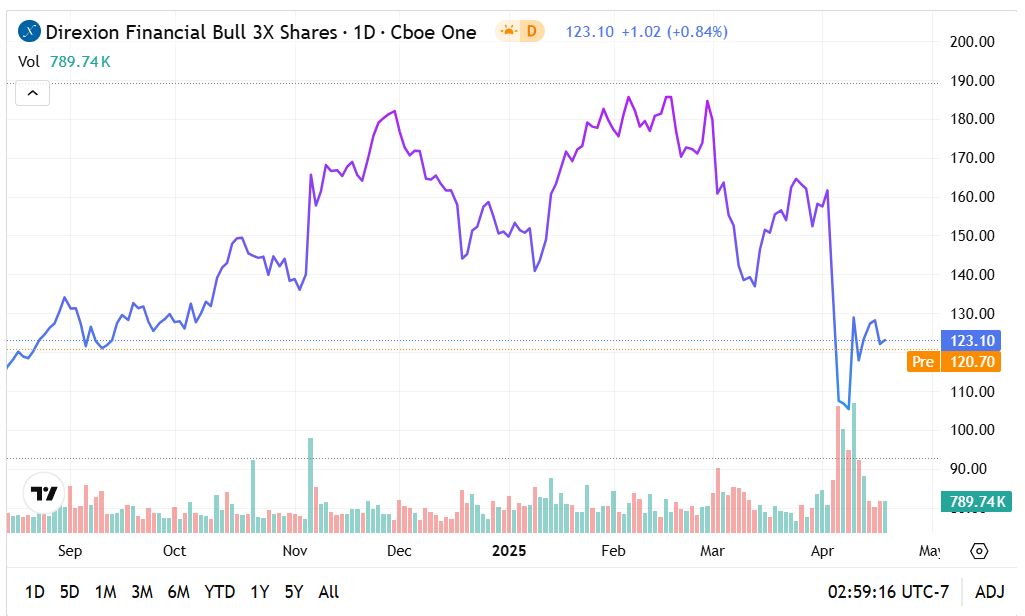
In light of the mixed views in the financial sector and the market at large, traders may choose to speculate through Direxion’s ultra-leveraged exchange-traded funds (ETFs). For those optimistic about market gains, the Direxion Daily Financial Bull 3x Shares FAS offers an opportunity for maximum upside. Meanwhile, pessimists can turn to the Direxion Daily Financial Bear 3x Shares FAZ.
Both ETFs follow the performance (or inverse performance) of the Financial Select Sector Index. However, given their 300% leverage, traders must exercise extreme caution. Although the potential for quick gains is appealing, the risks of significant losses are equally substantial.
Risks of Holding ETFs Long-Term
Investors should be aware that leveraged and inverse ETFs—especially those with 3X leverage—should not be held for more than a single day due to volatility erosion. Daily compounding may cause returns to stray from initial expectations.
Examining the FAS ETF
The FAS ETF, despite showing some potential, has faced challenges, losing more than 18% since the beginning of January.
- From a discrete-event analysis perspective, the FAS ETF has recorded a “4-6” sequence in the last 10 weeks, with four up weeks and six down weeks. Statistically, this sequence indicates a 54.32% chance of growth in the following week.
- On the weekly chart, FAS has bounced off its 200-day moving average, suggesting that bulls may indeed have an opportunity to advance.

Overview of the FAZ ETF
Currently, neither the FAS nor the FAZ makes a decisive case for investment. However, the FAZ ETF has shown a slight decline of less than 1% year-to-date, giving it a relatively better standing.
- Analysis reveals that the FAZ ETF has demonstrated a “6-4” sequence over the past 10 weeks, with six weeks up and four down. Statistically, this trend suggests a 57.58% chance of decline in the next week.
- The weekly chart indicates that the 50-day moving average has consistently imposed resistance on this ultra-bear fund, warranting caution among speculators.

Featured image by 3D Animation Production Company on Pixabay.
This post contains sponsored content and is for informational purposes only, not investment advice.
© 2025 Benzinga.com. Benzinga does not provide investment advice. All rights reserved.