“`html
Quantum Computing Stocks Soar Following Google’s Breakthrough
In December, shares of quantum computing companies surged after Alphabet‘s (NASDAQ: GOOG) (NASDAQ: GOOGL) Google unit announced significant advancements in the field on December 9. This news has potentially brought quantum computing closer to its promise of tackling problems that traditional computers struggle with.
Experts in technology anticipate strong future growth in quantum computing. According to the Boston Consulting Group (BCG), the global quantum computing market for hardware and software is projected to reach between $90 billion and $170 billion by 2040. In contrast, this market was valued at approximately $770 million to $900 million in 2023. BCG’s forecast suggests a compound annual growth rate (CAGR) of around 31% to 37% until 2040.
Where to invest $1,000 right now? Our analyst team just revealed what they believe are the 10 best stocks to buy right now. See the 10 stocks »
Understanding Quantum Computer Functionality
To grasp the basics of quantum computing, we turn to IBM (NYSE: IBM), recognized as a leader in this space.
Classical computers use binary bits (0s and 1s) to process information, whereas quantum computers utilize quantum bits, or qubits. These qubits can exist in superposition, which means they can represent both 0 and 1 simultaneously. This property allows qubits to dramatically increase the amount of data processed at once.
Investing in Quantum Computing: ETFs vs. Individual Stocks
While some individual quantum computing stocks may become significant long-term winners, identifying which ones will flourish is challenging at this nascent stage. Additionally, investing in pure-play quantum stocks carries high risks. Consequently, some investors might consider an exchange-traded fund (ETF) that focuses on quantum computing. ETFs can be bought and sold like stocks, but their built-in diversification can reduce overall risk.
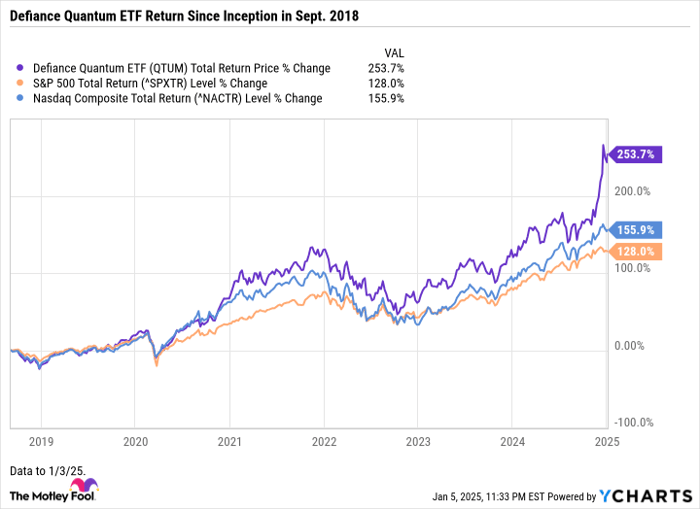
Currently, the only dedicated ETF is Defiance Quantum (NASDAQ: QTUM), but more options may soon emerge.

Data by YCharts. Since its launch, Defiance Quantum ETF has outperformed the S&P 500 and Nasdaq indexes, even before the December surge in quantum stocks.
Overview of Defiance Quantum ETF
Launched in September 2018, Defiance Quantum ETF had approximately $839 million in net assets as of January 3. This index fund aims to replicate the performance of the BlueStar Quantum Computing and Machine Learning Index, with machine learning being a subset of artificial intelligence (AI).
As of January 3, the ETF comprises 71 holdings, each assigned equal weights that are adjusted semi-annually. The expense ratio for this ETF stands at 0.40%, which is reasonable given its specialized focus.
Top 10 Holdings in Defiance Quantum ETF
|
Holding No. |
Company |
Market Cap |
Weight (% of Portfolio) |
1-Year Return |
|---|---|---|---|---|
|
1 |
Rigetti Computing (NASDAQ: RGTI) |
$4.6 billion |
3.56% |
1,860% |
|
2 |
D-Wave Quantum (NYSE: QBTS) |
$2.7 billion |
3.07% |
988% |
|
3 |
IonQ (NYSE: IONQ) |
$10.3 billion |
2.21% |
300% |
|
4 |
Palantir Technologies |
$182 billion |
1.52% |
397% |
|
5 |
Teradyne |
$21.3 billion |
1.50% |
28.9% |
|
6 (tie) |
Alchip Technologies* |
$241 billion TWD (around $7.3 billion) |
1.48% |
(12.2%) |
|
6 (tie) |
Onto Innovation |
$8.9 billion |
1.48% |
29.8% |
|
6 (tie) |
Taiwan Semiconductor Manufacturing |
$1.08 trillion |
1.48% |
111% |
|
8 (tie) |
Marvell Technology |
$102 billion |
1.47% |
109% |
|
8 (tie) |
Tower Semiconductor |
$5.8 billion |
1.47% |
70.9% |
| N/A | Defiance Quantum ETF |
$839 million in assets under management |
100% |
60.4% |
| N/A | S&P 500 Index | N/A | N/A |
28.1% |
| N/A | Nasdaq Composite Index | N/A | N/A |
35.4% |
Data sources: Defiance Quantum ETF, Yahoo! Finance, and YCharts. *Alchip is listed on the Taiwan Stock Exchange. Data is accurate as of January 3, 2025.
The top three holdings consist of pure-play quantum computing companies. Palantir (fourth place) offers AI-enhanced data analysis tools for both governmental and commercial audiences. Teradyne (fifth place) develops testing equipment for semiconductors, electronics, and wireless communications, also engaging in industrial automation. Onto Innovation specializes in semiconductor equipment, while Taiwan Semiconductor Manufacturing is the largest chip foundry globally, producing chips for various clients. The last three entries on the list pertain to chip manufacturers.
The weights of holdings drop significantly after the top three, with many companies having very similar percentages. This gives potential investors an idea of the fund’s composition. Defiance Quantum ETF holds a broad array of major tech firms, including those in semiconductors and cloud computing.
With 71 holdings, the Defiance Quantum ETF offers substantial diversification, which mitigates risk. The equal weighting of all holdings and regular adjustments every six months further contribute to reducing risk levels.
Industry Leaders in Quantum Computing: IBM and Alphabet
Generally recognized as a frontrunner in quantum computing, IBM holds a 1.34% weight in the ETF. The company has rolled out several quantum chips in recent years, with its second version of Heron, first unveiled in December 2023, touted as its most effective performance yet.
“`
Exploring Quantum Computing: A Look into Key Players and Investment Opportunities
IBM and Google Lead the Charge in Quantum Innovations
IBM continues to expand its quantum computing offerings through its cloud service, giving developers access to an open-source software platform named Qiskit. This platform enables the creation of quantum applications, positioning IBM as a significant player in the quantum sector.
Alphabet Strengthens Its Position with Revolutionary Technology
With a 1.36% weighting in the Defiance Quantum ETF, Alphabet stands as perhaps the second most influential company in quantum computing among major tech firms. On December 9, Google Quantum AI announced Willow, its latest quantum chip. This advanced chip can “reduce errors exponentially as we scale up using more qubits.” Reducing error rates is vital, as increasing qubit numbers has traditionally led to higher error rates. Willow completed a standard benchmark computation in under five minutes, a task that would reportedly take one of today’s fastest supercomputers 10 septillion years to accomplish—a time frame longer than the age of the universe.
Identifying Pure-Play Quantum Computing Stocks
According to the Defiance Quantum ETF’s holdings, three pure-play quantum computing stocks exist: Rigetti Computing (ranked No. 1), D-Wave Quantum (ranked No. 2), and IonQ (ranked No. 3). Investing in these companies comes with high risks, as they report minimal revenue, significant net losses, and are heavily spending cash.

Data by YCharts.
Notably, IonQ stands out as potentially the least risky option among its peers for several reasons. Over the past year, the Maryland-based company earned revenue of $37.5 million, which, while modest, surpasses the revenue of Rigetti and D-Wave combined. IonQ’s financial success is largely due to securing multiple long-term development contracts and selling systems to various customers.
Particularly advantageous for IonQ are its strategic partnerships with two major players: Amazon and defense giant Lockheed Martin.
Is IonQ a Smart Investment Choice Today?
Before making any investment in IonQ, it’s essential to weigh some key points:
According to the Motley Fool Stock Advisor analyst team, IonQ is not among the 10 best stocks recommended for investors at this time. The stocks selected have significant potential for future growth.
For context, consider how Nvidia landed on this list on April 15, 2005. A $1,000 investment then would now be worth $885,388!
Stock Advisor delivers investors a clear roadmap for success, including offers on portfolio building, regular updates from analysts, and two new stock picks each month. The Stock Advisor service has more than quadrupled the S&P 500’s return since 2002.
Explore the 10 stocks »
*Stock Advisor returns as of January 6, 2025
John Mackey, former CEO of Whole Foods Market, an Amazon subsidiary, is a member of The Motley Fool’s board of directors. Suzanne Frey, an executive at Alphabet, is also a member. Beth McKenna does not hold any positions in the stocks mentioned. The Motley Fool recommends positions in Alphabet, Amazon, Palantir Technologies, and Taiwan Semiconductor Manufacturing. Additionally, they endorse International Business Machines, Lockheed Martin, Marvell Technology, and Teradyne. The Motley Fool has a strict disclosure policy.
The views and opinions expressed herein are those of the author and do not necessarily represent those of Nasdaq, Inc.