Exploring New Opportunities in Options Trading for MTDR
This week, Matador Resources Co (Symbol: MTDR) investors were introduced to fresh options for the September 20th expiration. When investors consider purchasing options, one of the crucial factors influencing the price is the time value. With 210 days until expiration, these newly available contracts provide a window for sellers of puts or calls to potentially garner a higher premium compared to contracts with a closer expiration date.
Unveiling Intriguing Contract Opportunities
Our team at Stock Options Channel deployed the YieldBoost formula to scrutinize the MTDR options chain for the new September 20th contracts. In this analysis, one put and one call contract surfaced as particularly compelling.
The put contract positioned at the $57.50 strike price currently boasts a bid of $4.80. By opting to sell-to-open this put contract, an investor commits to acquiring the stock at $57.50 but also stands to collect the premium. This action could potentially position the cost basis of the shares at $52.70, before broker commissions. For investors eyeing MTDR shares, this presents an enticing alternative to the current market price of $59.67 per share.
Understanding Probabilities and Historical Context
The $57.50 strike represents a roughly 4% markdown from the stock’s current trading price, placing it out-of-the-money by that percentage. As things stand, the current analytical data, including greeks and implied greeks, indicates a 64% likelihood that the put contract might expire worthless. Stock Options Channel will meticulously track these odds over time, offering insights on fluctuations through a dedicated chart. In case of a worthless expiration, the premium could deliver an 8.35% return on the cash commitment or an annualized return of 14.51%, a metric we fondly term the YieldBoost.
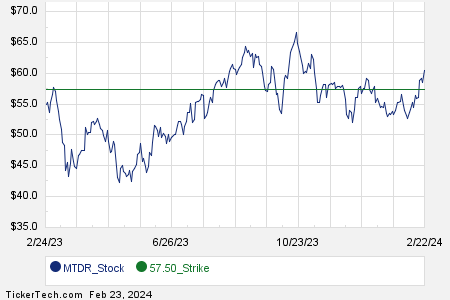
To discern the best approach, investors should scrutinize MTDR’s trailing twelve-month trading history. The $57.50 strike is highlighted in a chart below, aiding market participants in gauging the stock’s trajectory for informed decision-making.

Shifting focus to the calls segment, the call contract situated at the $67.50 strike price currently records a bid of $4.00. Opting to purchase MTDR shares at the existing price of $59.67 per share and subsequently selling-to-open the call contract as a “covered call” necessitates committing to selling the stock at $67.50. In this scenario, the call seller also stands to collect the premium, culminating in a total return (excluding dividends) of 19.83% if the stock gets called away upon the September 20th expiration, pre-broker commissions. However, untapped potential exists if MTDR shares witness a substantial uptick, underlining the significance of analyzing the stock’s trading history and business fundamentals. The chart below highlights the $67.50 strike in red.

Given that the $67.50 strike denotes an approximate 13% premium from the current trading price, signifying it’s out-of-the-money by that percentage, there’s a probability that the covered call contract might expire without value. Presently, analytical data suggests a 99% chance of this outcome. Stock Options Channel will meticulously track these odds over time, offering insights through a chart to showcase fluctuations. In a scenario of a worthless expiration, the premium could usher in a 6.70% boost to the investor’s return, or an annualized return of 11.65%, a metric we affectionately term the YieldBoost.
Delving into specifics, the implied volatility in the put contract scenario above stands at 41%. In contrast, the actual trailing twelve-month volatility, considering the previous 251 trading days’ closing values and today’s $59.67 price point, stands at 40%. For a plethora of put and call options contract ideas worthy of examination, StockOptionsChannel.com awaits your perusal.
 Top YieldBoost Calls of Stocks with Insider Buying »
Delve Deeper:
- Cheap Stocks To Watch
- SMTS Videos
- Institutional Holders of TAAG
The opinions expressed here belong solely to the author and may not align with those of Nasdaq, Inc.
5 Stocks Our Experts Predict Could Double In the Next Year
By submitting your email, you'll also get a free pivot & flow membership. A free daily market overview. You can unsubscribe at any time.