From Mars to Cannabis: Sorting Robotics Takes Manufacturing to New Heights
“I worked on a project called MOXIE, which is currently on Mars producing oxygen from its atmosphere,” says Nohtal Partansky, founder of Sorting Robotics. While this might sound like the plot of a science fiction film, it is the background of a significant shift in cannabis manufacturing.
With a degree in aerospace engineering and experience at NASA’s Jet Propulsion Laboratory (JPL), Partansky appeared to be on a path to influence outer space. However, his passion for solving real-world problems drew him back to Earth. In 2018, he and his co-founder established Sorting Robotics with a modest $6,000 in seed funding. The company’s original focus was on creating automation technologies for various industries, exploring the potential of robotics across many sectors.
A turning point came in 2020 when Partansky gained hands-on experience within the cannabis industry. “I co-founded a co-packing company with friends, managing 30 trimmers and packaging flower for California brands. That experience taught me what operators truly need,” he recalled. Witnessing the inefficiencies associated with manual processes, he identified an opportunity to revolutionize cannabis manufacturing through robotics.
See also: ‘This Is How You Make Quality Joints’ – How One Machine Produces 900 Pre-Rolls An Hour And Why They’re Better Than Cones
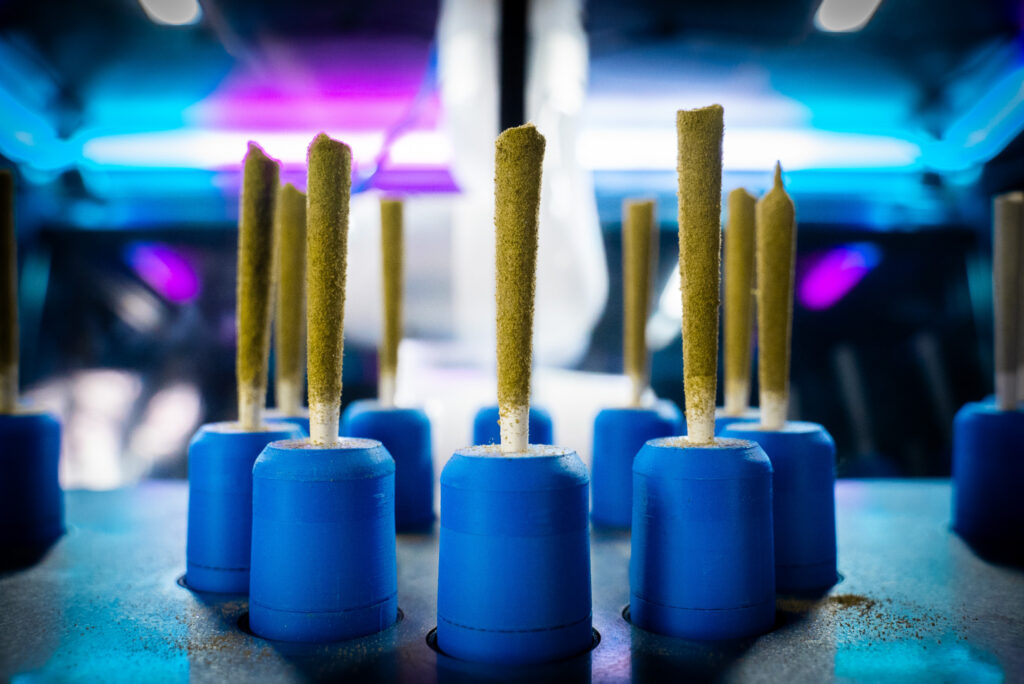
This pivot resulted in the development of two innovative machines: the Goo Robot and the Stardust system. “The Goo Robot is designed for live resin-infused joints,” Partansky shared with Benzinga. By automating the precise injection of concentrates into pre-rolls, this machine delivers consistency and scalability—vital for cannabis operators facing growing consumer demand. Additionally, the Stardust system streamlines the labor-intensive process of kief-coating pre-rolls, a technique popularized by brands like Jeeter.

With a price tag of $75,000 for the Goo Robot and $240,000 for the Stardust system, these machines represent a valuable investment. “Almost all of our customers see a return on investment within a year,” Partansky states. This rapid ROI is attributed to the automation of labor-intensive tasks that allows operators to increase production without significantly raising labor costs.
“The principles are the same,” Partansky reflects on his NASA background. “Whether it’s a robot on Mars or one in a cannabis facility, the focus is on precision, scalability, and problem-solving.” His engineering skills combined with genuine insights into cannabis operations have positioned Sorting Robotics as a crucial player in this rapidly evolving industry.
Why Automation Makes Economic Sense
Sorting Robotics did not just enter the cannabis industry—it has fundamentally altered it by offering solutions to labor-intensive challenges that ensure high precision. The Goo Robot and Stardust system, designed for live resin-infused and kief-coated pre-rolls, have become essential tools for manufacturers pursuing operational scalability.
Before the Goo Robot’s introduction, the infusion process was completely manual. “It was difficult for operators to scale efficiently, and product consistency was a persistent issue,” Partansky explains. By automating this detailed task, the Goo Robot simplifies the creation of cold-infused joints—widely known as “donut” joints or “donut holes.”
Similarly, the Stardust system addresses a major bottleneck. Partansky points out that “joints coated in cannabis concentrates are extremely popular,” often featured by brands like Jeeter. Manual production limits scalability, but the Stardust system automates the coating process with robotic arms, reducing variability and ensuring a consistent quality while cutting labor expenses.
See also: Leonardo DaVinci Meets Bungee Jumping: The Curious Origins Of A World-Leading Cannabis Vaporization Brand
Though the technology behind these systems is intricate, their economic impact is clear. “A $100,000 machine may seem pricey,” Partansky acknowledges, “but it’s less than the annual salary of a couple of employees. Plus, machines don’t tire, make mistakes, or take breaks.” Automation provides the reliability that operators need to stand out in a crowded market.
Sorting Robotics’ systems are versatile and cater to a diverse range of operators. “Our Goo Robot baseline is around 20,000 joints a month,” Partansky says. “That’s about 10 pounds of flower per week—not an unrealistic figure even for smaller businesses.” Whether a cannabis operation is a boutique grower or a large multi-state operator, automation simplifies expansion and decreases reliance on manual labor.
Interest in Sorting Robotics’ automation systems extends beyond North America, with inquiries coming from places like Germany. However, regulatory volatility in emerging markets remains a concern. “Operators are cautious because the regulations aren’t stable yet,” Partansky notes. “Once these markets mature, the need for automation will surge.”
Collaboration with clients has played a vital role in Sorting Robotics’ success. “We partner closely with our customers to refine our systems. Their feedback is crucial for our innovation,” Partansky explains. This approach allows the company to stay ahead of trends while meeting the changing requirements of cannabis manufacturers.
The Future of Cannabis Automation
As Sorting Robotics solidifies its status as a leader in cannabis manufacturing, Partansky is setting his sights on future advancements. The Goo Robot and Stardust system have raised the bar for automation, but this is merely the beginning. Next on the agenda? Enhancing quality control and optimizing end-of-line packaging—areas ripe for innovation.
“Quality control doesn’t have to be performed by humans,” he asserts. “Using robotic sensors and neural networks, we can replicate human judgment to ensure that every product meets high standards.” Most quality checks currently rely on manual inspection by workers, tasked with spotting issues like uneven packing or incorrect weights. Automating these processes could save time and improve quality assurance, ensuring only the best products reach consumers.
Partansky envisions a system where cannabis manufacturing operates with the same efficiency as a Coca-Cola bottling line, but with the flexibility to adapt to the industry’s unique demands. “Imagine a setup where joints are scanned, assessed as ‘go’ or ‘no-go,’ and packaged seamlessly,” he explains. The variability inherent in cannabis products necessitates machines capable of managing a multitude of formats and specifications, unlike the standardized lines utilized in food and beverage production.
Adaptability is essential, especially given the current fragmentation of the cannabis market. “The industry hasn’t evolved to the point where we have just a few standard configurations,” Partansky states. “There are countless variations in cartridges, pre-rolls, and edibles. Our machines must be flexible enough to handle this diversity.”
Despite regulatory challenges in emerging markets, Partansky remains optimistic about the future of cannabis automation. He draws parallels with the candy industry, recalling how initially dismissed products became standard offerings. “Cannabis is on a similar journey. The trends we see today are paving the way for tomorrow’s market,” he asserts.
For Sorting Robotics, this means anticipating and addressing the needs of a growing industry. “Our mission is to create solutions that not only tackle today’s challenges but also prepare businesses for the future,” concludes Partansky. “As the industry expands, so do the obstacles—and we intend to tackle them head-on.”
Images courtesy of Sorting Robotics.
© 2025 Benzinga.com. Benzinga does not provide investment advice. All rights reserved.
5 Stocks Our Experts Predict Could Double In the Next Year
By submitting your email, you'll also get a free pivot & flow membership. A free daily market overview. You can unsubscribe at any time.