When the digital revolution swept through the fashion industry in 2020, many dismissed it as a passing fad. Pixelated clothing resembled garb from early 2000s video game characters, NFTs seemed confined to techies, and augmented reality was a distant dream. However, fast forward to today, and terms like digital, metaverse, and NFT have become ubiquitous, permeating the minds of consumers and the strategies of brands. Whether through the regular unveiling of non-fungible tokens, the launch of virtual marketplaces, or the rise of virtual influencers, the landscape of digital fashion is expanding, paving the way for a future full of innovation and creativity.
As we enter spring, the realm of virtual events is taking center stage. Several digital fashion weeks coincided with the traditional fashion week schedules in Paris, New York, and Milan. In Milan, the Digital Fashion Week recently concluded its fourth edition, where Limitless Innovation, Nolu Factory, and HGVIS came together to showcase the latest advancements in Phygital technologies—AI, AR, VR, NFTs, and NFCs.
Enhancing Customer Experience and Reducing Returns

Imagine having the ability to try on any item in the world without stepping foot inside a store. In my own encounters, I’ve come across instances where physical products looked unrealistic or subpar, leaving a negative impression of the brand. This was my experience with Ikea Studio, where some furniture appeared cartoonish and failed to meet expectations, necessitating a visit to a physical store for verification.
Contrastingly, some companies like OuttaWRLD are setting a new standard. By offering cutting-edge virtual try-ons, real-time customization of various color options, and captivating brand narratives, they provide customers with an immersive brand experience. I vividly recall witnessing the incredible realism of a virtual T-shirt projected in my room through the OuttaWRLD app, underscoring the importance of accurate depiction of shades, textures, and shadows.
In the realm of clothing, precise rendering plays a pivotal role. The ability to view intricate details, cuts, and quality, coupled with the opportunity to virtually try on the garments, holds immense significance, particularly for the younger demographic. Recent studies indicate that 70% of younger consumers crave more immersive and engaging interactions with their favorite products.
Considering these developments, I couldn’t help but ponder the prospect of digitizing all the stunning outfits I’ve ever admired in movies or fashion magazines—a feat made possible by AI technology. Companies like Unleash The Dragon have successfully leveraged AI to accurately transpose garments onto users’ photos, factoring in their unique physical attributes, thereby reducing post-purchase returns.
Immersive 4D Scanning Redefining Virtual Apparel
“The capability to create virtual collections that mirror reality at 95% accuracy enables brands to gauge customer satisfaction beforehand, mitigating the issue of excess inventory and wastage from producing unnecessary samples,” contends Barbara Fontana Ozawa, the visionary founder of Eretikosiki. This innovative company, with bases in Milan and Tokyo, collaborates with renowned fashion labels not only to design collections but also to host virtual reality fashion shows. Barbara’s digital masterpieces stand out for their blend of creativity, sophistication, and realism, achieved through 4D body scanning technology that captures clients’ models’ morphological features and measurements.

Eretikosiki CEO Barbara Fontana Ozawa and her digital works.
By seamlessly integrating cutting-edge technologies and creative vision, Eretikosiki is revolutionizing the fashion landscape, bridging the gap between physical and virtual realms. The meticulous attention to detail and commitment to realism not only enrich the consumer experience but also significantly reduce costs and waste for fashion companies.
Revolutionizing Fashion Tech: From NFC Wallet Jackets to Virtual Runways
Looking at the dresses transferred by Barbara using scanning, you are amazed at how realistically the texture, elements, and fit are conveyed with every movement of the digital avatar. Interestingly, it was Barbara who created the breathtaking background animation for the Digital Fashion Symposium Milan.

Digital Fashion Symposium Milan Conference
Revolutionizing Payment Methods
The beauty of new technologies is that their integration with physical objects can take any form. What if I told you that you can integrate any gadget or information into your jacket — for example, a phone, a passport, or an e-wallet? At the Digital Fashion Symposium Milan, Digiseq spoke about its recent collaboration with Hugo Boss for the Hahnenkamm Races, which took place January 15-21, 2024, in Austria. Visitors who purchased a jacket from ski jacket from the latest BOSS x Perfect Moment capsule collection could transform it into a smart device thanks to a custom tag on the sleeve containing various
technologies that were personalized to the individual wearer’s needs for the weekend. With a single tap of their jacket sleeve, customers could access the race, slopes and shops, and even make contactless payments. It was interesting to learn that the potential of such technology is estimated at hundreds of millions of dollars. Analysts predict that the wearable tech market will surpass half a trillion dollars by 2032. The main thing is to work on issues of data security and protection from accidental activations and theft.

BOSS x Perfect Moment ski jacket with NFC wallet on a sleeve
Innovative Virtual Showcases
After the DFW Symposium Milan conference, we had the opportunity to experience a virtual event by attending the Fashion Metaverse Conference (#FMC24) organized by Yiqin (Isola) Zhu, the founder of the digital fashion platform HGVIS. The event took place in Spatial, one of the leading competitors of Roblox, featuring nine thematic spaces designed by metaverse figures such as IRA X LAB and Dr. Martha Boeckenfeld, an award-winning Web3 influencer.
From March 26th to 30th, participants could interact with others, enjoy games, collect wearables, try on clothing, and listen to presentations from over 70 experts in the fields of fashion, technology, AI, and Web3.
I want to say that the virtual experience is worth trying at least because it requires less time and energy. Before an offline event, you have to gather, prepare business cards, and travel to the location, often in another country. Meanwhile, with Spatial, you just need a couple of clicks to upload your avatar and enter the room. Still, even if it’s remote, people are going to be late for some speeches (me not being the exception), which is why it was so hilarious watching avatars literally running to the venue entrance once arriving at the shore of the Shmerz theatre.

Marco Pizzini speaking at the Fashion Metaverse Conference
Created by Marzio Camasso, an artist and a VR designer, known otherwise as Shmerz, the Movie Theater was a central place of the conference with a seating capacity of 220, where attendees were listening to the speeches by web3 industry leaders.
One of the most significant insights from the conference speeches centers around the strong connection between the on-chain and off-chain dimensions of Web3 communities, and the evolving landscape of digital fashion seamlessly bridging the physical and virtual realms. This transformation profoundly impacts our understanding of identity, style, and community dynamics. Specifically, various emerging projects shared compelling use cases and insights into virtual clothing production, metaverse design, consumer experiences, and sales strategies.
Among others, digital creator platforms like LIVVIUM and Phygital Twin showcased their role in assisting fashion designers in creating and marketing digital clothing. Through experimentation with digital prototypes, these platforms help minimize the reliance on physical samples, thereby reducing waste in the fashion industry.
Embracing the Evolution: AR/VR Technologies in Fashion
The Fusion of Fashion and Technology
Witnessing the dynamic convergence of talent and innovation at the nexus of technology and fashion is truly exhilarating. The seamless integration of cryptocurrencies, AI, and AR/VR into our daily lives is undeniable. As we delve deeper into this realm, fears associated with new technologies dissipate, paving the way for individuals to craft their personalized experiences.
Virtual Reality Unveiling New Horizons
The intersection of the metaverse and physical reality finds a pivotal link through AR and VR technologies. Virtual Reality enables users to be fully immersed in digital landscapes, providing an escape into entirely new realms. Meanwhile, Augmented Reality overlays virtual elements onto the tangible world, enriching everyday experiences by blending virtual fashion seamlessly into our reality.
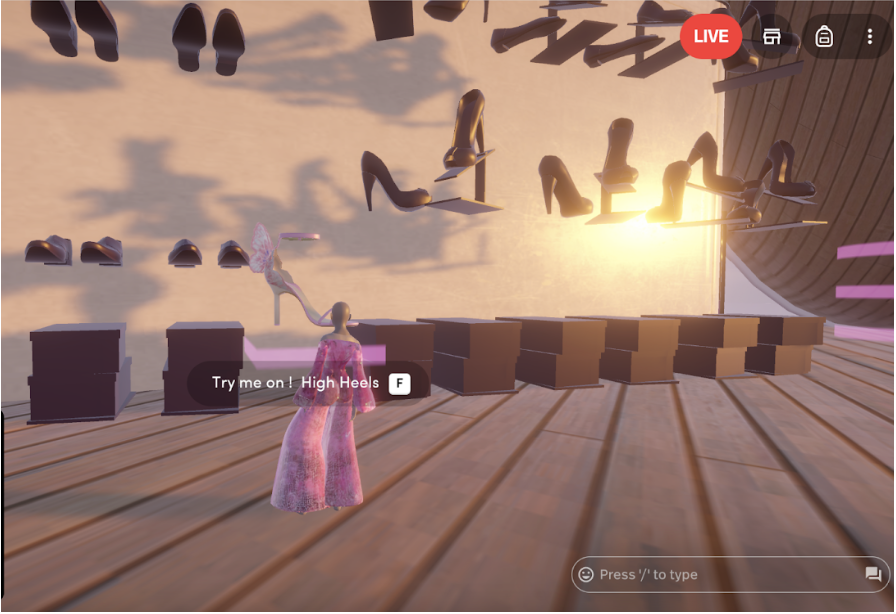
Chic Shop where you can try virtual collection by CryptoPinkBabe
A Glimpse into the AR World
Events like FMC24 showcase the democratization of access to virtual gatherings, allowing individuals worldwide to engage in the Web3 community. AR innovator, Marco Pizzini, CEO of Metagate, unveiled the vast potential of augmented reality in urban settings. From virtual runways and concerts to guided tours and promotional events, the spectrum of possibilities in the AR realm is expanding rapidly.
Blurring Boundaries with Virtual Fittings
Post-conference activities offered a unique virtual fitting experience at the PinkCryptoBabe’s glamorous pink Chic Shop. Attendees had the opportunity to not just try on but also keep selected items from the stunning collection of dresses and suits, bridging the gap between the physical and digital realms of fashion seamlessly.
Promising a Future of Sustainable Fashion
The amalgamation of digital and physical fashion realms ushers in exciting prospects for consumers, designers, and brands alike. With the potential to reshape consumer perceptions, consumption habits, and interactions with fashion, these technologies hold the promise of nurturing a more sustainable and captivating fashion industry.
The views and opinions expressed herein are the views and opinions of the author and do not necessarily reflect those of Nasdaq, Inc.