Gold Shines Amid Economic Uncertainty, Outperforming Other Assets
Gold’s Resurgence Amid Market Turmoil
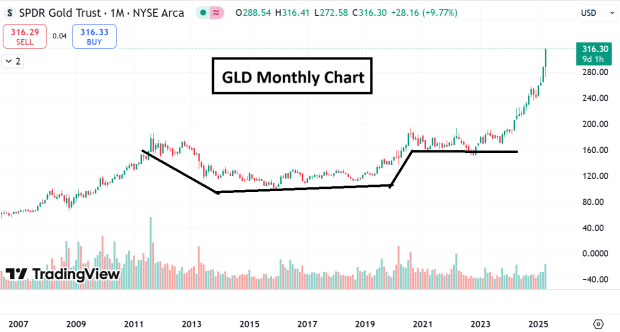
In recent years, gold had lagged behind equities and various other asset classes. However, as equity markets struggle, trade tensions mount, and macroeconomic uncertainties increase, gold has reestablished itself as a safe haven. An extended period of aggressive money printing and a near-zero interest rate policy (ZIRP) initially failed to boost gold prices. Nevertheless, President Donald Trump’s unpredictable tariff policies have ignited significant trade disputes between the United States and China, creating an environment rife with uncertainty. Under these conditions, gold is reclaiming its appeal. Following years of erratic price movements, gold and the SPDR Gold Trust ETF (GLD) emerged from a substantial cup-with-handle base structure early last year, continuing its upward trend.

Image Source: TradingView
Following the age-old Wall Street adage, “There’s always a bull market somewhere,” it’s clear that currently, this market exists within gold. As of 2025, gold prices have surged more than 28% year-to-date, significantly outperforming the S&P 500 Index by 42.5%.
Gold Confirms Its Role as a Safe Haven
Historically, gold has been recognized as a reliable form of wealth, a medium of exchange, and a safe haven. Many fiat currencies have depreciated due to governmental corruption or inflation, yet gold’s distinct properties and reputation have allowed it to maintain its value over millennia. In fact, this year, the GLD has outperformed the iShares Silver ETF Trust (SLV) by more than double. Additionally, the MicroSec Gold 3x (GDXU) gold miners ETF has led the market, achieving gains of 180% so far in 2025.
Is Now the Time to Invest in Gold?
While holding a portion of one’s portfolio in gold can be wise for risk management, it’s essential to consider timing before making purchases. Investors who acquired gold near its peak in August 2011 took nearly ten years to see a profit.
Here are two reasons why investing in gold at this juncture may not be advisable:
1. Gold is 25% Above its 200-Day Moving Average: This indicator often acts like a rubber band; when prices stretch too far from the moving average, a corrective pullback is likely. Currently, gold’s price sits 25% above its 200-day moving average, a situation historically linked to poor short-term returns.

Image Source: @subutrade
2. Fibonacci Target Achieved: Gold has reached the 2.618% Fibonacci extension level from its prolonged bear market. Although this does not definitively indicate a price peak, it does suggest a potential pause in upward movement.

Image Source: TradingView
In conclusion, while gold’s recent performance is impressive, current market signals indicate that chasing after this commodity at elevated levels may not be prudent.
Zacks Research Chief Identifies “Stock Most Likely to Double”
Our expert team has recently highlighted five stocks with the greatest potential for gains of +100% in the near future. Among these, Director of Research Sheraz Mian has pinpointed one specific Stock poised for significant growth.
This top recommendation features an innovative financial firm boasting a rapidly expanding customer base, which has already surpassed 50 million. The firm provides a diverse array of cutting-edge solutions, putting this Stock in a strong position for impressive gains. Though not every elite pick turns into a winner, this one holds promise, potentially outperforming previous Zacks’ Stocks Set to Double, such as Nano-X Imaging, which skyrocketed 129.6% in under nine months.
Free: see Our Top Stock And 4 Runners Up.
Interested in the latest recommendations from Zacks Investment Research? Download our report on the 7 Best Stocks for the Next 30 Days by clicking here.
SPDR Gold Shares (GLD): ETF Research Reports
iShares Silver Trust (SLV): ETF Research Reports
This article originally published on Zacks Investment Research (zacks.com).
Zacks Investment Research
The views and opinions expressed herein are the views and opinions of the author and do not necessarily reflect those of Nasdaq, Inc.