
U.S. consumers are witnessing a seismic shift in their video consumption habits. With traditional cable TV on the decline, the era of direct streaming from media-holding companies has arrived. As this tectonic shift reshapes the media landscape, investors are eyeing the stocks that stand to benefit from this streaming revolution.
Streaming Dominance: A Three-Way Showdown
The fierce competition in the streaming arena has led to a plethora of services vying for market share. In a recent study conducted by The Motley Fool, among 2,000 Americans, Netflix emerged as the undeniable industry leader, with over 260 million paid subscribers worldwide. Once reliant on third-party content, Netflix has strategically built a formidable portfolio of original programming, anticipating the day when media companies would withhold their content for their own streaming platforms.
The Power of Original Content
Following closely behind is media behemoth Walt Disney, who entered the streaming race with Disney+ in late 2019. Leveraging its unrivaled content portfolio, Disney boasts a trio of services, including Disney+ (150 million subscribers), ESPN+ (26 million), and Hulu (48.5 million), providing a diverse range of content to attract subscribers.
A Prime Contender
Meanwhile, tech giant Amazon has capitalized on its extensive Prime membership base, which exceeds 200 million subscribers. With the recent acquisition of MGM for $8.5 billion and forays into live sports, such as NFL Thursday Night Football rights, Amazon’s streaming service is poised for aggressive growth.
On the periphery, HBO Max stands as the closest contender with 94 million users, a far cry from Amazon’s third-place position, showcasing the substantial distance between the top three and the rest of the pack.
Insights from the Streaming Frontline
Consumers’ perspectives shed light on the dynamics shaping the streaming industry. The survey revealed that a whopping 62% of respondents believe there are too many streaming options, with over a third actively reducing the number of services they subscribe to. This sentiment underscores the evolving challenges faced by streaming platforms as they seek to retain and attract subscribers in an increasingly crowded and competitive landscape.
Furthermore, the landscape of streaming has shifted, with media companies reclaiming their prized content and distributing it across various platforms, posing a significant inconvenience to consumers.
Notably, seasonal variations in streaming usage have emerged, with peaks during summer and declines during holidays, coinciding with the surge in live sports and holiday programming. The absence of such content on most streaming platforms highlights a persistent weakness in their offerings.
The Impact of Live Sports
Live sports remain a pivotal draw for viewers, underscoring the importance of securing broadcasting rights as companies battle for dominance in the streaming market. Notably, NFL games accounted for 93 of the top 100 most-watched TV programs in 2023, cementing the NFL’s unrivaled influence on U.S. households.
With Amazon and Disney possessing broadcasting rights for NFL games, the absence of such content leaves Netflix at a notable disadvantage, highlighting the pivotal role of live sports in shaping the future of streaming.
Identifying the Prime Investment
For investors eyeing the streaming battlefield, evaluating the stocks of industry leaders is crucial. While each company presents a compelling investment case, discerning the most promising stock necessitates a nuanced analysis of their respective valuations and growth prospects.
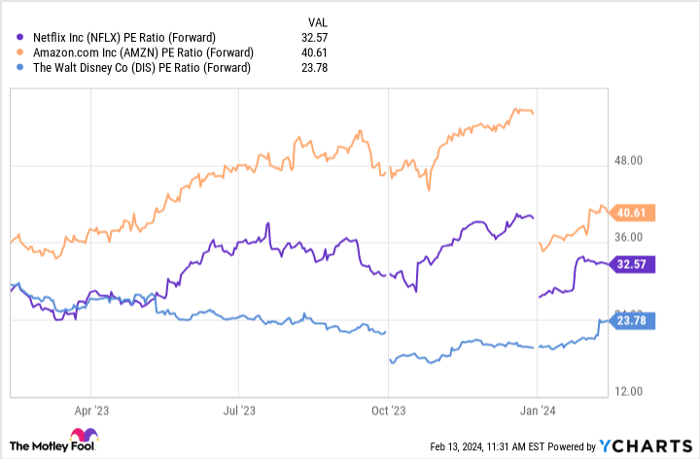
NFLX PE Ratio (Forward) data by YCharts
Comparing forward P/E ratios, Disney emerges as the most attractively priced stock at approximately 24 times earnings, followed by Netflix at 33 and Amazon at 41. Furthermore, based on consensus long-term analyst estimates, Netflix is poised to experience the swiftest earnings growth, followed by Amazon and Disney.
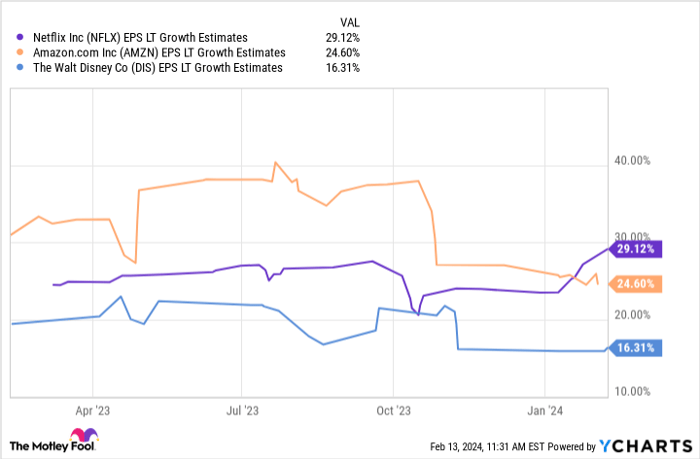
NFLX EPS LT Growth Estimates data by YCharts
Assessing the PEG ratio, a favored metric of renowned investor Peter Lynch, unveils Netflix’s compelling valuation, with a PEG ratio of 1.1, signaling an attractive proposition for its prospective growth. Subsequently, Disney follows with a PEG ratio of 1.4, trailed by Amazon at 1.6.
With Netflix’s expansive content library and the potential incorporation of high-profile live sports, the remarkably vast audience, appealing valuation, and growth prospects position it as a compelling contender for investors seeking exposure to the streaming industry.
Investing in Netflix: A Worthy Pursuit?
Prior to investing in Netflix, careful consideration is advised. The Motley Fool Stock Advisor analyst team has identified what they perceive as the 10 best stocks for potential investors, with Netflix not featuring on this coveted list. The selected stocks are projected to yield substantial returns in the forthcoming years.
The Stock Advisor service offers investors a comprehensive guide for success, encompassing portfolio construction, periodic updates from analysts, and two new stock picks each month. Notably, the Stock Advisor service has markedly outperformed the S&P 500 since 2002*.
Explore the 10 stocks
*Stock Advisor returns as of February 12, 2024
John Mackey, former CEO of Whole Foods Market, an Amazon subsidiary, is a member of The Motley Fool’s board of directors. The Motley Fool has positions in and recommends Amazon, Netflix, Walt Disney, and fuboTV. The views and opinions expressed herein are those of the author and do not necessarily reflect the views and opinions of Nasdaq, Inc.