The race for AI supremacy is heating up, and Nvidia (NASDAQ: NVDA) finds itself at the epicenter. The demand for high-powered chips capable of training and running advanced artificial intelligence (AI) models is unprecedented. Mega-tech companies are battling fiercely, snatching up Nvidia’s data center GPUs, while AI startups are sprouting with skyrocketing valuations, reminiscent of a gold rush.
AI undoubtedly represents a revolutionary technology, but there is an underlying sense of a bubble on the horizon. Companies like Mistral AI, founded less than a year ago, are already commanding billion-dollar valuations. Notably, the valuation of server maker Super Micro Computer defies all logic. The caution that should accompany such exuberance seems to be dissipating into thin air.
The Driving Force of the AI Revolution
Nvidia’s GPUs have become the driving force behind the AI revolution. Not only are Nvidia GPUs optimal for the complex computations required in AI model training, but the proprietary CUDA platform, established over the past 16 years, has set the standard for accelerated computing. In the frenzied race for AI dominance, companies are flocking to Nvidia’s GPUs as the most viable option.
This surge in demand for Nvidia’s AI accelerators is evident in the company’s financial performance. The data center segment generated a staggering $18.4 billion in revenue in the latest quarter, marking a fivefold increase from the previous year. Profits have soared as well, with Nvidia reporting a net income of $32.3 billion on $60.9 billion in revenue for fiscal year 2024.
The meteoric rise of Nvidia’s stock, tripling over the past year, has propelled the company’s market capitalization beyond $2 trillion.
The Inevitability of Shortages
Nassim Nicholas Taleb, a renowned risk expert, once said, “I’ve seen gluts not followed by shortages, but I’ve never seen a shortage not followed by a glut.” The inertia driven by Nvidia’s CUDA platform has hindered competitors, but a wave of rival AI accelerators is amassing. Nvidia’s exceptional profits and pricing power are poised to dwindle once supply catches up with demand.
Competitors are entering the fray, with Advanced Micro Devices unveiling new AI-centric data center GPUs and Intel preparing to launch the third generation of its Gaudi line of AI accelerators. OpenAI’s pursuit of substantial funding for semiconductor factories to produce AI chips and cloud giants like Amazon, Alphabet, and Microsoft developing their AI chips illustrate the impending competition.
Shortages eventually give way to oversupply as demand fails to meet lofty projections. While the demand for AI chips may surge in the coming years, falling short of exaggerated estimates is a realistic possibility, leading to a surplus of AI chip supply. This shift spells trouble for Nvidia’s pricing power, with CUDA losing its dominance amid the emergence of viable alternatives. Major cloud companies have a vested interest in supporting AI accelerators from various suppliers.
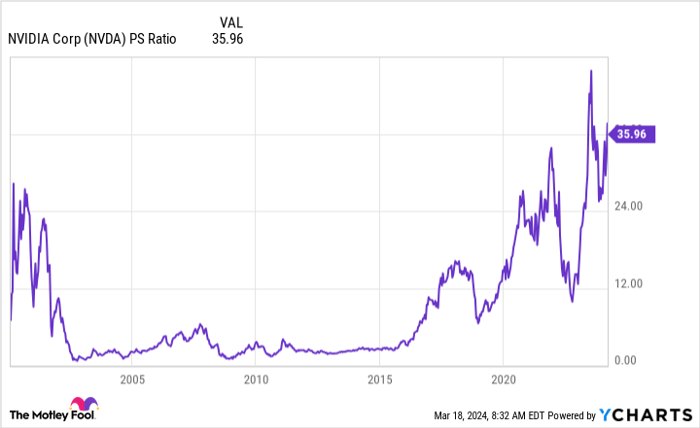
It’s not the first time Nvidia’s stock has soared due to groundbreaking technology. The dot-com bubble of the late 1990s and early 2000s also propelled Nvidia’s valuation to extreme levels, resulting in a harsh aftermath for shareholders.
Comparatively, Nvidia’s stock is currently pricier relative to sales than at any point during the dot-com bubble era. While the demand for AI is tangible, and Nvidia’s revenue is skyrocketing, the phrase “This time is different” rings alarm bells. Embracing this notion in investing is often a dangerous gamble.
The volatile market dynamics that typically follow shortages could strip Nvidia of its pricing power and profits once again. By investing in Nvidia now, you might inadvertently pay a significant price to relearn the hard lessons of speculative bubbles.
Should you invest $1,000 in Nvidia right now?
Before diving into Nvidia stock, consider this:
The analysts at the Motley Fool Stock Advisor have identified what they believe are the 10 best stocks for investors to buy at this moment—Nvidia didn’t make the list. The selected stocks hold the potential to yield substantial returns in the foreseeable future.
Stock Advisor offers a user-friendly roadmap for success, providing guidance on portfolio construction, regular analyst updates, and two fresh stock picks every month. Since 2002, the Stock Advisor service has dramatically outperformed the S&P 500*.
Explore the 10 stocks
*Stock Advisor returns as of March 18, 2024
John Mackey, former CEO of Whole Foods Market, an Amazon subsidiary, serves on The Motley Fool’s board of directors. Suzanne Frey, an executive at Alphabet, also sits on The Motley Fool’s board of directors. Timothy Green holds positions in Intel. The Motley Fool is invested in and recommends Advanced Micro Devices, Alphabet, Amazon, Microsoft, and Nvidia. The Motley Fool endorses Intel and offers options trading advice for Microsoft. The Motley Fool maintains a disclosure policy.
The author’s expressions are personal and do not necessarily match those of Nasdaq, Inc.