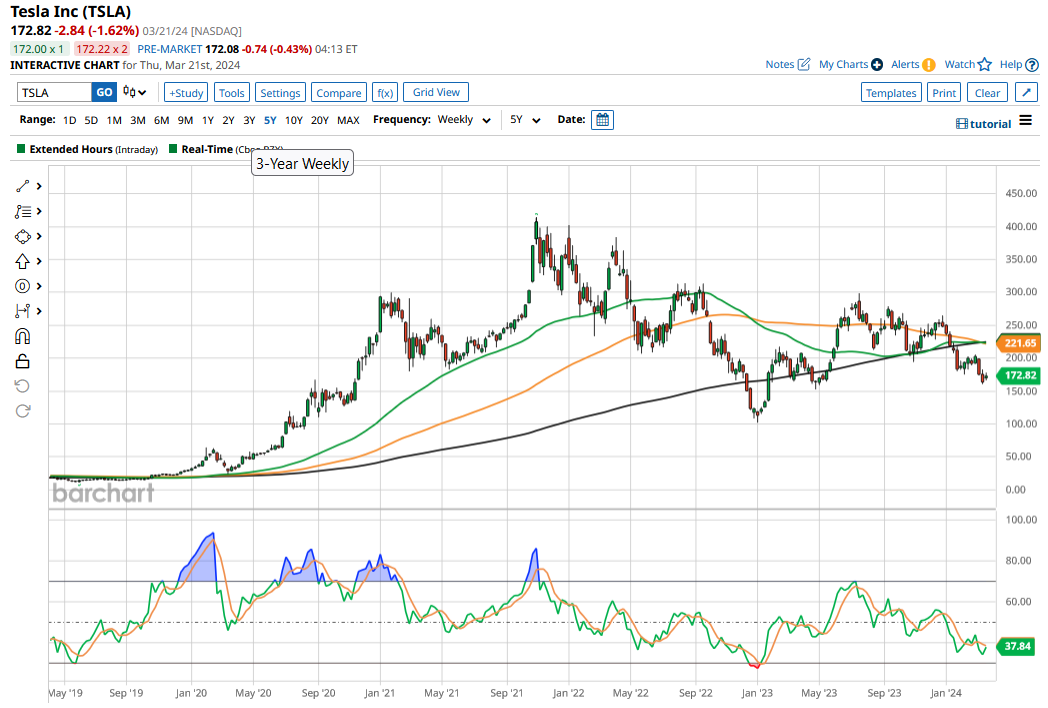
Tesla (TSLA) has long been a darling for retail investors seeking growth stocks. However, the year 2024 has unfolded as a rude awakening for Tesla shareholders. As the worst-performing stock in the S&P 500 Index ($SPX) on a YTD basis, Tesla’s trajectory stands in stark contrast to the previous year, where its shares soared by over 100%.
Among the elite “Magnificent 7,” Tesla finds itself at the bottom of the barrel in terms of stock performance. With analysts like Wells Fargo’s Colin Langan questioning the sustainability of Tesla’s growth narrative, sentiments surrounding the famed electric vehicle (EV) maker have soured further amidst reports of production cutbacks at its China plant.
How far will Tesla stock plummet amidst a faltering growth narrative? Let’s delve deeper into the saga.

The Tale of Tesla’s Growth Trajectory
In the not-so-distant past, during Tesla’s Q4 2020 earnings call, the company boasted of a lofty 50% long-term delivery growth rate. CEO Elon Musk fervently projected that Tesla could sustain an annual growth rate exceeding 50% for years to come.
While Tesla did indeed witness delivery growth upwards of 50% in 2021 as forecasted (a precise 87% surge), the momentum waned in 2022, with delivery growth tapering to around 40%. Fast forward to 2024, and Tesla is tempering expectations, cautioning that this year’s delivery growth may fall significantly below the stellar 2023 performance. Langan echoes this sentiment, projecting stagnant deliveries this year and a decline next year.
Not just limited to revenue growth, Tesla’s bottom line has also taken a hit. Gross margins plummeted 15% year-over-year in the past fiscal year, alongside a 23% slump in adjusted earnings per share (EPS) to $3.12.
Analysts foresee a marginal drop in Tesla’s adjusted EPS in 2024 despite predicting a nearly 13% revenue uptick. The disparity between revenue growth and profitability has persisted over multiple quarters as Tesla spearheaded an EV price war, elevating pressure on profit margins. This industry-wide pricing turmoil has compelled players to slash prices to stay competitive.
Tesla’s strategic focus on scaling volumes over maximizing profits has led to a contraction in its margins. This approach has not just impacted Tesla but has also reverberated through the broader industry.
Forecasting Tesla’s Stock Trajectory
Tesla’s stock remains a subject of heated debate, evident in the vast range of Wall Street target prices from a low of $85 to a high of $320. Opinions diverge sharply, with some envisaging a near halving of the current stock price, while others anticipate a doubling from present levels.

Adding to the intrigue, Cathie Wood of Ark Invest proposes a base case 2027 target price of $2,000 for Tesla. Even her most conservative estimate tags the stock at $1,400, while the bullish scenario paints a tantalizing $2,500 picture.
Recent adjustments in target prices signal escalating concerns regarding Tesla’s growth trajectory. Goldman Sachs, for instance, clipped Tesla’s target price from $220 to $190. Their best-case projection hints at a surge to $300, while the worst-case scenario foresees the stock trading within the $65-$85 range – a hefty 30x the expected 2024 EPS.
Predicting Tesla’s Bottoming Out
While the impasse looks daunting, I envision Tesla finding its floor soon, with $150 demarcating a probable nadir – approximately 35x the anticipated 2025 EPS. Short-term catalysts elude the company, positioned in a hiatus between growth spurts. With projects like the Cybertruck and a new cost-friendly model on the horizon, Tesla currently stands in a state of limbo, prompting a cautious investment approach.
Market sentiment towards EV stocks has significantly chilled, compounding Tesla’s woes as it awaits the fruition of its new growth avenues in the ensuing years.
Elaborating on Tesla’s future roadmap during the Q4 earnings call, Musk articulated, “Tesla is currently between two major growth waves. We’re focused on making sure that our next growth wave, driven by next-gen vehicle, energy storage, full self-driving, and other projects, is executed optimally.”
Insight from the Valuation Maestro Ashwath Damodaran
Notwithstanding the downward revisions by longtime Tesla bulls like Adam Jonas of Morgan Stanley, valuation expert Ashwath Damodaran, despite his muted optimism toward Tesla, discerns some value near the prevailing price levels. Damodaran divulged a recent buy at around $180 per share, with Tesla standing out as his sole investment pick among the Magnificent 7, distintinguishing itself from highly overvalued entities such as Nvidia (NVDA) and Microsoft (MSFT).
Ironically, Damodaran, who misread Tesla in the past, factored in a robust five-year revenue CAGR of 31% in his latest assessment. While 2024 may pose challenges for Tesla, given the dwindling sales growth and shrinking margins, a brighter outlook looms in 2025 and beyond, particularly as interest rates return to normalized levels. The EV landscape might also witness a pricing correction as the industry consolidates – a nascent trend evident in Tesla’s markups on its popular Model Y.
Looking ahead, investors eyeing the long term should mull over Tesla shares at current valuations. Positioned at the frontier of multiple industries including electric vehicles, renewable energy, autonomous driving, robotics, and supercomputing, Tesla bears significance as a trailblazer. While the near future appears foggy at best, the recent downturn could present an opportune moment to secure Tesla shares for a lengthier investment horizon.
As of the publication date, Mohit Oberoi held positions in: TSLA , MSFT , NVDA . All content in this article serves purely informational purposes. Access the Barchart Disclosure Policy for additional details.
The opinions and assertions articulated in this piece represent the author’s perspectives and do not necessarily mirror those of Nasdaq, Inc.