At the time of a business’s initial public offering (IPO), experts and financial pundits rush to dissect the mountainous regulatory disclosures, often exceeding 100 pages. Deciphering the latest financial outcomes, deciphering the addressable market, and ascertaining the company’s position in the broader ecosystem are all pieces of the puzzle that provide glimpses into the company’s future.
It was this last piece that eluded me when I initially studied Arm Holdings (NASDAQ: ARM) late last year. I fully grasped the company’s supremacy in providing central processing units (CPUs) to the smartphone industry, but failed to connect the dots on how Arm would capitalize on the surging demand in the realm of generative artificial intelligence (AI). Back then, I wrote, “Arm Holdings is trying to cast itself as the next Nvidia — but wishing doesn’t make it so.”

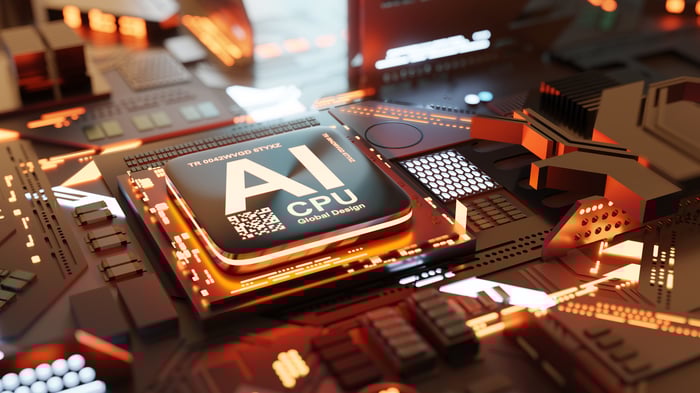
Image source: Getty Images.
Unveiling the Underlying Potential
Before diving into how I misjudged the company, it’s essential to comprehend how Arm generates revenue. In its simplest form, the company develops the blueprints used to build many of the world’s most popular CPUs. These designs constitute the intellectual property (IP) that propels Arm’s growth.
The lion’s share of the company’s revenue emanates from the licensing and royalties it garners from other firms for the use of its designs. These processors are omnipresent in virtually every facet of technology, encompassing smartphones, tablets, personal computers, smart TVs, as well as cloud computing, hyperscale computing, and data centers. Additionally, Arm’s technology permeates into smartwatches, thermostats, drones, and automobiles. The company asserts authority over a “significant proportion of all chips with embedded processors.”
The licensing segment offers licenses for using specific products and applications for a defined duration. Owing to the multitude of companies licensing its technology, Arm enjoys economies of scale, allowing it to license its designs at a cost lower than what these companies would incur if they attempted to internally develop similar technology. In addition to licensing these designs, Arm also receives royalties, which can be a percentage of the average selling price (ASP) for each chip sold or a flat fee per unit.
Arm works closely with its major clients, ensuring that the chip designs meet meticulous specifications, as these agreements historically extend over years and multiple generations of future chips.
Where My Lens Was Skewed
When Arm initially announced its IPO, I meticulously scrutinized the regulatory disclosures to comprehend its competitive edge. One statement loomed large: “The CPU is vital in all AI systems, whether it is handling the AI workload entirely or in combination with a co-processor, such as a GPU or … [neural processing unit].” I remarked at the time, “This ignores the fact that the GPU does much of the heavy lifting, and there are plenty of CPU peddlers out there.”
That’s where I erred. Failing to fully grasp the all-pervading nature of Arm’s IP, which is utilized by 70% of the world’s population, as stated by the company, I prematurely concluded that Arm would likely be relegated to the periphery in the realm of AI. Boy, was I wrong.
In a recent interview, CEO Rene Haas unveiled the extraordinary opportunity, and it was nothing short of revelatory. The current proliferation of AI has significantly bolstered the demand for Arm’s higher-end processor designs. For instance, Haas cited Nvidia’s (NASDAQ: NVDA) GH200 Grace Hopper Superchip, which amalgamates accelerated CPU and GPU technology to meet AI’s requisites, utilizing a staggering 144 Arm version 9 (V9) CPU cores. Nvidia isn’t the lone entity loading up on Arm’s latest processor designs. Microsoft’s (NASDAQ: MSFT) new AI server chips employ over 100 V9 processors. And these are just a couple of instances amid a multitude.
Moreover, Haas noted that many existing clients are transitioning to the V9, which offers enhanced computing power and boasts a royalty rate twice as much as its forerunner, further intensifying Arm’s fortunes. Devices such as smartphones will require to accommodate a certain amount of AI processing on the device, amplifying the need for higher-end CPUs.
Companies are intent on “future-proofing” their smartphones and other gadgets, incorporating additional computing power to handle the arduous demands of AI. When extending this beyond smartphones to connected TVs, smart doorbells, smart appliances, and automobiles, the magnitude of the opportunity becomes crystal clear.
A Lesson Acknowledged
Nobody relishes acknowledging misjudgment, but I certainly erred in assessing Arm Holdings. This became apparent when the company reported its recent financial results.
For its fiscal 2024 third quarter, Arm generated record revenue of $824 million, marking a 14% year-over-year increase, fueled by a license revenue surge of 18% and an all-time high royalty revenue surge of 11%. This propelled adjusted earnings per share (EPS) to $0.29, denoting a 32% upsurge.
However, it’s Arm’s remaining performance obligation (RPO) — encompassing contractually bound revenue yet to be recognized — that vividly underscores the company’s future growth potential. In the third quarter, RPO surged to $2.43 billion, representing a 38% year-over-year growth.
Management anticipates the company’s accelerating growth trajectory to persist. In the fourth quarter, Arm’s guidance predicts a revenue range of $850 million to $900 million, constituting a 38% surge at the midpoint, significantly outstripping the third quarter’s 14% gain.
Due to Arm’s growth momentum, the valuation may seem stretched by certain measures — but not all. While the shares are currently trading at 1,677 times earnings and 44 times sales (as of this writing), this fails to account for the company’s projected growth. Assessed in terms of Arm’s forward price/earnings-to-growth (PEG) ratio, it reveals a valuation of less than 1 — the yardstick for an undervalued stock.
Now that I have a clearer understanding of the company’s potential, I intend to acquire shares once The Motley Fool’s trading rules permit. I firmly believe that Arm has a bright future — and I don’t intend to miss out.
Should you invest $1,000 in Arm Holdings right now?
Before venturing into Arm Holdings, contemplate this:
The Motley Fool Stock Advisor analyst team has pinpointed what they believe are the 10 best stocks for investors to buy now… and Arm Holdings didn’t make the list. The 10 stocks on this roster could yield remarkable returns in the years to come.
Stock Advisor equips investors with a straightforward blueprint for success, furnishing guidance on constructing a portfolio, periodic analyst updates, and two new stock picks monthly. The Stock Advisor service has exceeded the return of S&P 500 by more than threefold since 2002*.
See the 10 stocks
*Stock Advisor returns as of February 12, 2024
Danny Vena holds positions in Microsoft and Nvidia. The Motley Fool has positions in and recommends Microsoft and Nvidia. The Motley Fool recommends the following options: long January 2026 $395 calls on Microsoft and short January 2026 $405 calls on Microsoft. The Motley Fool has a disclosure policy.
The views and opinions expressed herein are the views and opinions of the author and do not necessarily reflect those of Nasdaq, Inc.