Intel’s New AI Chip Export Rules Heighten U.S.-China Trade Tensions
Intel Corporation INTC has notified its Chinese clients that a license will now be necessary to export specific advanced artificial intelligence processors. This change was communicated last week.
Details of the New Restrictions
What Happened: The licensing requirement targets chips with a total DRAM bandwidth of 1,400 gigabytes per second or more, or an I/O bandwidth of 1,100 gigabytes per second, according to reports from Financial Times.
The Gaudi series from Intel, which includes processors that surpass these limits, will be subject to these new regulations. Notably, this series is comparable to Nvidia Corporation’s NVDA H20 processor.
Broader Market Impact
This announcement coincided with Nvidia’s warning regarding a potential $5.5 billion loss due to similar export restrictions imposed by the U.S. government.
Why It’s Important: This latest licensing rule signifies a pronounced escalation in the ongoing trade tensions between the U.S. and China. Even as the Trump administration has suspended reciprocal tariffs for several nations, it has continued to impose increased duties on imports from China.
In retaliation, China implemented additional tariffs of up to 125% on U.S. goods over the weekend.
Financial Consequences for Other Firms
Advanced Micro Devices, Inc. AMD revealed in a filing on Wednesday that these export restrictions could result in charges of up to $800 million tied to inventory and purchase commitments.
Meanwhile, ASML Holdings ASML released its first-quarter earnings on Wednesday. It highlighted that rising tariffs have added uncertainty to its market outlook, contributing to broader market weakness.
Market Reactions
Price Action: Intel’s shares dropped by 3.12% on Wednesday, continuing a downward trend that has seen its stock fall nearly 47% over the past year. Year-to-date, Intel is down 4.9%, according to Benzinga Pro data.
Other affected stocks also fell; AMD shares decreased by 7.35%, while ASML and Nvidia shares declined by 7.06% and 6.87%, respectively. These movements reflect broader pressure impacting the semiconductor sector.
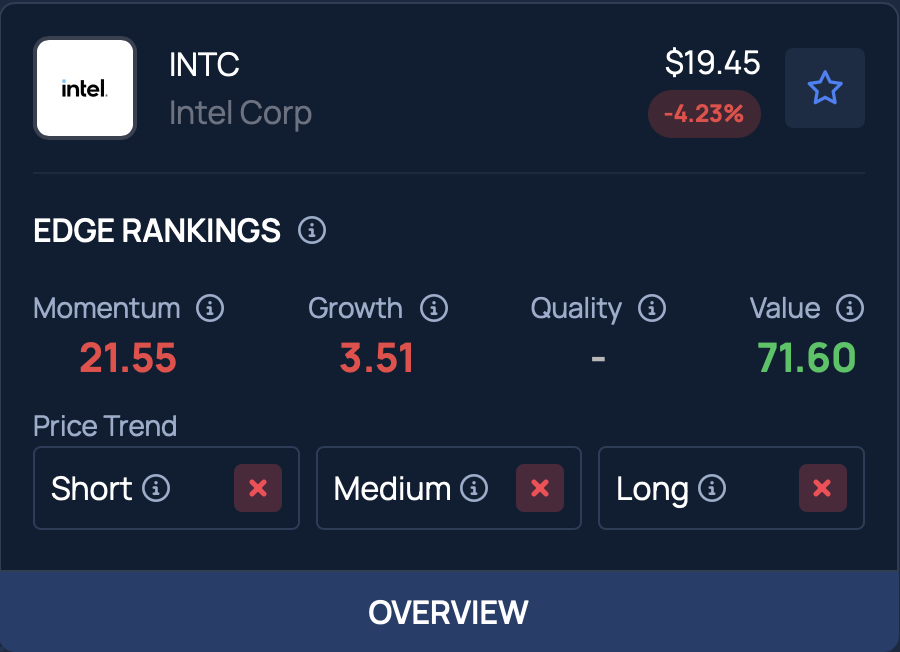
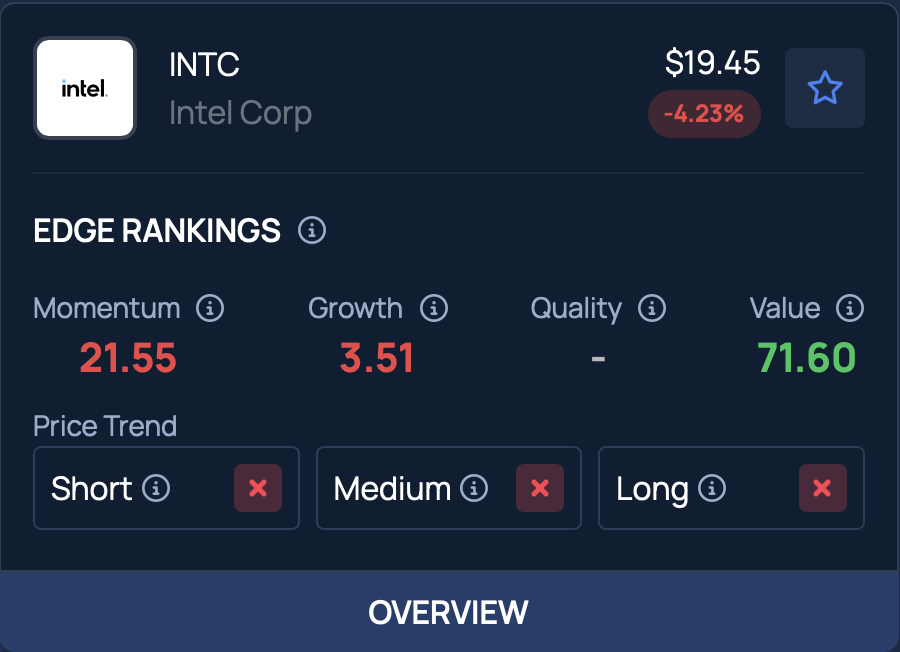
Currently, Intel holds a growth score of 3.51%, according to Benzinga Edge Stock Rankings. Click here to see how it compares with Nvidia, ASML, AMD, and other leading firms in the chip industry.
Read More:
Photo Courtesy: Tada Images On Shutterstock.com
Disclaimer:This content was partially produced with the help of AI tools and was reviewed and published by Benzinga editors.
Market News and Data brought to you by Benzinga APIs