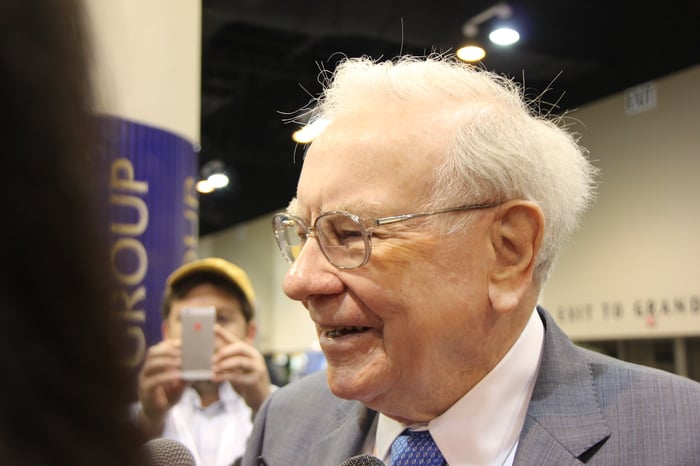
Warren Buffett to Step Down as CEO of Berkshire Hathaway
Warren Buffett has announced his intention to retire as chief executive officer of Berkshire Hathaway (NYSE: BRK.A) (NYSE: BRK.B) at the end of 2025. Vice Chairman of Non-Insurance Operations, Greg Abel, will assume the role. While Buffett will maintain his position as chairman, this transition marks a pivotal moment for the $1.1 trillion conglomerate. Buffett has been at the helm since 1965, overseeing an impressive 19.9% annualized return through 2024, nearly double that of the S&P 500.
Following the news, Berkshire shares fell approximately 5%, indicating investor uncertainty regarding new leadership. As changes loom, it’s essential to assess Berkshire’s current performance and how Abel might influence its trajectory.
Overview of Berkshire’s Assets
Before examining Berkshire’s latest earnings release, it’s valuable to review the company’s diverse assets that Abel will soon govern. Berkshire Hathaway currently owns 189 operating businesses, featuring well-known entities like BNSF Railway, Dairy Queen, and See’s Candies. However, the acquisition of GEICO in 1996 stands as a crucial pillar of its growth. As a property and casualty insurer, GEICO collects premiums upfront, generating what is known as “float.” This float allows Berkshire to invest capital until policy claims are made. Over the last two decades, Berkshire’s float has surged from $47 billion to $173 billion, enabling a stock portfolio valued at approximately $279 billion. The corporation holds stakes in 44 publicly traded companies, with Apple, Coca-Cola, and American Express being the leading investments.
In addition to its operational businesses and investments, Berkshire has accumulated a record $348 billion in cash and cash equivalents. Most of these assets are invested in short-term U.S. Treasury bills, which currently yield between 4% and 4.3%. Should yields remain stable, Berkshire stands to earn nearly $14 billion in interest over the next year.
Potential Uses for Berkshire’s Cash Under Abel
Despite the current strategy of holding cash in Treasury bills, Buffett has previously expressed his discomfort with this approach. He stated in a shareholder letter that, “Over the long term, however, [Treasury bills] are riskier investments — far riskier than widely diversified stock portfolios that are bought over time.” Buffett noted that Berkshire invests in Treasury bills only when “it can’t find anything exciting to invest in,” citing safety and liquidity as the main advantages.
At Berkshire’s latest annual meeting, Abel discussed his capital allocation strategy, emphasizing financial stability. He stated:
“We will have a fortress of a balance sheet. We’ve got significant cash right now, and it’s a tremendous asset to have that. This will continue to be our philosophy.”
Abel outlined his capital allocation priorities, focusing first on reinvesting in existing businesses, followed by acquiring entire companies, and finally considering partial ownership in publicly traded companies.
He reassured shareholders, saying, “How Warren and the team have allocated capital for the past 60 years will not change. It is the approach we will take going forward.”
Berkshire Hathaway’s Resilience in Economic Downturns
With substantial cash reserves, Berkshire Hathaway is well-positioned to capitalize during potential recessions. Historically, the company has thrived in such conditions.
For instance, during the 2008 financial crisis, Berkshire invested $5 billion in preferred shares of Goldman Sachs, realizing a gain of $3.7 billion three years later. In 2009, it provided a $303 million loan to Harley-Davidson at a steep 15% interest rate, allowing the company to maintain financing. Additionally, in 2011, Buffett invested $5 billion in Bank of America preferred stock and warrants, which has since generated over $30 billion in paper profits.
While the timing of the next recession remains uncertain, Berkshire’s incoming CEO possesses both financial liquidity and a strategic framework to leverage opportunities when they arise.
Should Investors Buy, Hold, or Sell Berkshire Hathaway Stock?
Warren Buffett’s success underscores the importance of leadership. It’s common for investors to question how an incoming CEO will perform. For now, they must trust Buffett’s wisdom, which has consistently delivered exceptional returns.
Abel has the full support of Buffett and steps into a company with ample cash reserves and $45.8 billion in operating earnings over the past year, positioning him for a favorable outcome.
The main question is whether Abel can navigate Berkshire’s future as effectively as Tim Cook did for Apple after Steve Jobs. Nevertheless, given its robust business model and potential advantages during economic downturns, Berkshire continues to present an appealing opportunity for long-term investors.
Is Now the Right Time to Invest in Berkshire Hathaway?
Before making a purchase of stock in Berkshire Hathaway, consider the following:
The Motley Fool Stock Advisor team has recently identified what they believe to be the 10 best stocks for immediate investment — and Berkshire Hathaway does not appear on that list. These stocks have the potential for significant returns in upcoming years.
Consider this: When Netflix made the list in December 2004, an investment of $1,000 would have grown to $614,911!*
Similarly, if you had invested $1,000 in Nvidia when it joined the list in April 2005, you would now have $714,958!*
It’s worth noting that Stock Advisor‘s total average return is 907%, significantly outperforming the 163% return for the S&P 500.
*Stock Advisor returns as of May 5, 2025
American Express is an advertising partner of Motley Fool Money. Bank of America is an advertising partner of Motley Fool Money. Collin Brantmeyer has positions in American Express, Apple, and Berkshire Hathaway. The Motley Fool has positions in and recommends Apple, Bank of America, Berkshire Hathaway, and Goldman Sachs Group. The Motley Fool has a disclosure policy.
The views and opinions expressed herein are the views and opinions of the author and do not necessarily reflect those of Nasdaq, Inc.