Tesla Faces Demand Challenges Amid Soaring Stock Prices
Since the presidential election, Tesla (NASDAQ: TSLA) has been a star performer among stocks, but rising concerns about demand loom large.
Start Your Mornings Smarter! Wake up with Breakfast news in your inbox every market day. Sign Up For Free »
Investors watched Tesla’s shares surge 61% between November 5 and the end of the year. However, the stock later fell just shy of doubling following the Federal Reserve’s change in its interest rate forecast for 2025. This initial price rise is not unexpected, given CEO Elon Musk’s significant support for President-elect Trump during the campaign, which left many hopeful for favorable regulations once Trump takes office.
Musk has made efforts to connect with the president-elect at Mar-a-Lago. The market has high hopes that Trump’s administration might facilitate the rollout of autonomous vehicles (AVs), enabling Tesla to expand its plans and introduce its new Cybercab more smoothly.
Yet, despite these optimistic views, Tesla must confront a more pressing challenge: demand for its vehicles seems to be stagnating. The company’s most recent delivery figures support this notion.

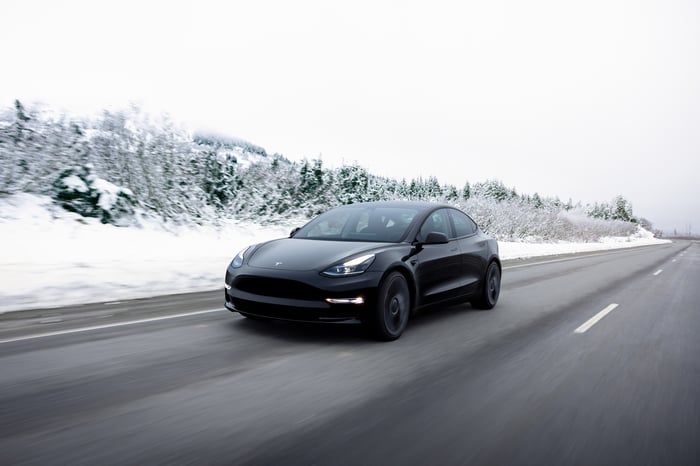
Image source: Tesla.
Weak Deliveries Point to Demand Issues
Tesla’s latest report reveals a significant concern for the company. The electric vehicle leader announced fourth-quarter deliveries of 495,600, a mere 2.3% increase from a year earlier but falling short of the anticipated 510,000. Following this news, the stock saw a decline of 6%.
Overall, Tesla’s vehicle deliveries fell for the first time last year, slipping from 1.81 million to 1.79 million—a trend observed despite the recent addition of the Cybertruck to its offerings.
Is There a Demand Problem?
While the focus has largely been on electoral outcomes and future technology, it appears that Tesla’s primary challenge is centered around demand.
This year, the electric vehicle market has encountered various hurdles. Buyer enthusiasm seems to have diminished after early adopters have made their purchases, leading to a rise in hybrid sales. Musk himself highlighted concerns about raised interest rates impacting vehicle sales, a trend seen industry-wide, not just restricted to EVs. Furthermore, competition with lower-priced alternatives from China and other markets is intensifying.
There are also concerns that Tesla has not updated its current vehicle models, which might contribute to falling prices for used Teslas. While this drop does not immediately affect Tesla’s finances, it may lead potential customers to opt for a pre-owned vehicle instead of a new one.
Potential Uncertainties Ahead
The Trump administration is likely to bring fluctuating conditions for the market and Tesla stocks. While regulatory changes might boost Tesla’s autonomy initiatives, Trump has also signaled intentions to eliminate the $7,500 EV tax credit, potentially raising costs for Tesla vehicles within the United States.
Implications for Investors
Though one quarter’s delivery results do not definitively indicate a long-term demand issue for Tesla, they pose a risk for the stock, especially since its post-election rally has inflated its valuation.
Musk anticipates a 20% to 30% growth in deliveries for 2025, which could suggest the slowdown is temporary—but investors should regard this number cautiously as a measure of demand rather than assured growth. Hopes for a rebound might rely on the forthcoming budget-friendly Model Q, expected to be priced under $30,000.
Amid weak Q4 deliveries, decreasing evidence of demand, potential cuts to EV tax credits, and a seemingly high valuation, Tesla’s prospects appear challenged as it heads towards 2025.
Currently, while Tesla’s focus on autonomy offers potential for long-term gains, any early signs of weak demand could translate into a difficult year ahead for the stock. Investors should keep a close eye on these developments, as underwhelming demand could become a significant red flag.
The Q4 financial results will be released soon, and it will be important to assess whether insufficient deliveries affected pricing strategies this quarter. A failure to show demand growth could leave Tesla’s stock stagnant until a substantial breakthrough in autonomy materializes.
A Second Chance for Potential Profits
Have you ever felt you missed out on major stock investments? Keep an eye on our expert team of analysts, who occasionally issue “Double Down” recommendations for companies they believe are set to rise.
- Nvidia: Investing $1,000 when we doubled down in 2009 would have grown to $358,640!*
- Apple: A $1,000 investment when we doubled down in 2008 would now be worth $46,181!*
- Netflix: If you invested $1,000 when we doubled down in 2004, you’d have $478,206!*
Currently, we’re highlighting three outstanding “Double Down” stocks, and the opportunity may not come again soon.
See 3 “Double Down” stocks »
*Stock Advisor returns as of December 30, 2024
Jeremy Bowman has no position in any of the stocks mentioned. The Motley Fool has positions in and recommends Tesla. The Motley Fool has a disclosure policy.
The views and opinions expressed herein are solely those of the author and do not necessarily reflect the opinions of Nasdaq, Inc.