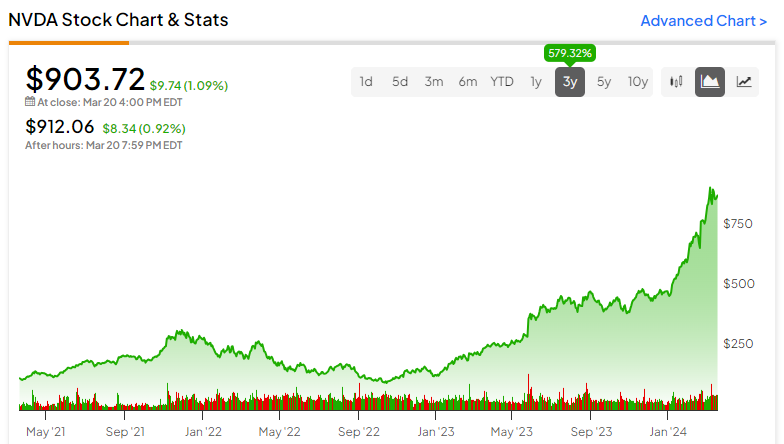
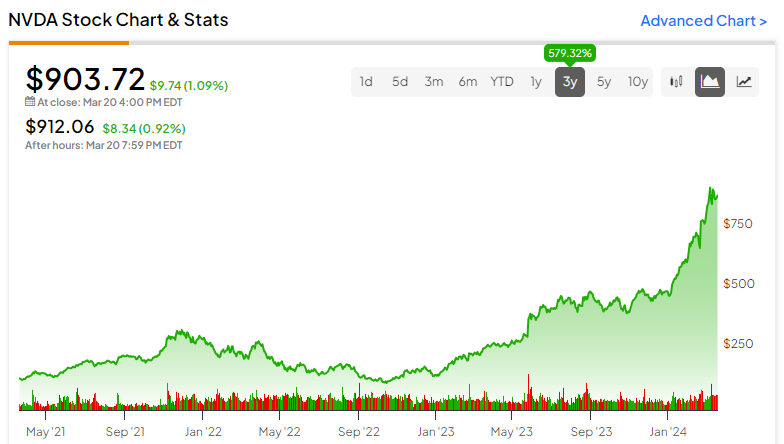
Nvidia (NASDAQ:NVDA) has achieved remarkable success in the stock market, showcasing exponential growth over the past 18 months, with shares skyrocketing nearly 7 times. While such rapid ascension might raise concerns about overvaluation, it is prudent to remember that sustained momentum often serves as a reliable harbinger of future stock performance, especially for companies consistently surpassing market expectations.
My personal bullish outlook on NVDA stock is not solely fueled by momentum but also by the pivotal role the company occupies in the burgeoning AI revolution, which is still in its nascent stages.
Nvidia: The Anchoring Force in AI
At the epicenter of the AI revolution stands Nvidia, leveraging its graphic processing units (GPUs) known for their prowess in handling complex AI and language models. Originally designed for the gaming realm, GPUs have seamlessly transitioned into the realm of AI, driven by their exceptional parallel processing capabilities, enabling simultaneous handling of multiple tasks. The transformative strides we witness in AI today, such as advancements in facial recognition and autonomous vehicles, owe their existence to Nvidia’s cutting-edge GPU technology.
Nvidia’s supremacy emanates from its GPU architecture featuring a plethora of cores densely packed onto a single chip. This design facilitates robust processing power within a compact space, a crucial element for efficient AI operations. Furthermore, Nvidia’s emphasis on high-bandwidth memory elevates data accessibility for these cores, thereby accelerating AI computations. Consequently, Nvidia has surged ahead in the race for AI hardware superiority.
In the realm of AI, hardware is just one facet; Nvidia’s CUDA software plays a pivotal role by granting direct access to GPU instructions, empowering developers to create and refine AI initiatives. This integrated software ecosystem has positioned Nvidia as a comprehensive destination for all AI-related endeavors.
Dispelling the Notion of Nvidia’s High Cost
While Nvidia’s stock may seem prohibitively expensive to some, hovering around $900 per share, this apparent valuation discrepancy does not equate to overpricing. From a valuation perspective, Nvidia’s stock retains intrinsic value and remains within justifiable ranges. Currently trading at 35.4x forward earnings, Nvidia does command a premium compared to the S&P 500, yet it aligns well with industry standards. The company’s projected robust growth trajectory further underscores its investment potential, with an estimated annual earnings growth of 34.78% over the medium term.
This translates to Nvidia’s PEG ratio standing at 1.02. Although the conventional fair value benchmark is pegged at 1.0, Nvidia’s ratio still remains attractive, especially considering the long-term AI trends and the market’s favorable stance on U.S. tech enterprises.
Looking ahead, Nvidia is forecasted to trade at 29.77x earnings for 2026, 25.26x earnings for 2027, and 21.49x earnings for 2028. Notably, Nvidia consistently surpasses analysts’ most optimistic predictions, a testament to its resilience and potential to outperform expectations in the future.
Analysts’ Perspective on Investing in NVDA Stock
Given its pivotal role in the AI domain and compelling valuation metrics, Nvidia stock garners a Strong Buy rating from analysts. Presently, Nvidia boasts 39 Buy ratings, two Hold ratings, and zero Sell ratings. The average target price for Nvidia stock sits at $913.74, indicating a modest 1.1% upside potential. The highest target price forecast stands at $1,200, while the lowest sits at $608.40.

Deciphering Nvidia’s Dominance in the AI Arena
As Nvidia cements its commanding position in the AI realm, two critical factors come to the fore: its competitive edge in the generative AI market and the nascent stage of the AI revolution.
Amidst its exceptional growth trajectory, Nvidia has fortified its market presence, paving the way for further expansion. Though contenders like Intel (NASDAQ:INTC) eye Nvidia’s throne, the path to rivalling Nvidia remains uncertain. Nvidia’s latest H200 chipset has emerged as indispensable for generative AI and large language models, exhibiting between 1.4 to 1.9 times the speed of the previous H100 in large language model inference – a remarkable advancement within a mere year.
Furthermore, with the AI market poised for accelerated growth, marked by SoftBank’s (OTC:SFTBY) Masayoshi Son contemplating a $100 billion venture in the AI chip sector and OpenAI’s Sam Altman seeking $7 trillion for a series of AI chip factories, demand surges while reshaping the semiconductor landscape.
Given the sector’s near-term momentum, the persistent demand-supply gap for GPUs, and the burgeoning scope of the AI revolution, my optimism towards Nvidia remains unwavering.
Disclosure
The views and opinions expressed herein are the views and opinions of the author and do not necessarily reflect those of Nasdaq, Inc.