Strategies for Investors Considering Pinnacle West Stock Options
Investors interested in acquiring shares of Pinnacle West Capital Corp (Symbol: PNW), currently priced at $94.77 per share, may want to explore alternative strategies, such as selling put options. A noteworthy contract to consider is the October put at the $80 strike, which has a bid of $1.45 as of this writing. By collecting this premium, investors can secure a 1.8% return based on the $80 commitment, translating to a 3.6% annualized rate of return—a strategy we term the YieldBoost at the Stock Options Channel.
It’s important to note that selling a put option does not grant investors the same potential for upside as owning shares directly. The put seller will only gain shares if the contract is exercised. The buyer of the put will exercise the option at the $80 strike only if that action provides a superior outcome than selling at the current market price. For the put seller, unless Pinnacle West Capital Corp’s shares decline by 15.6% to trigger the contract, leading to an effective cost basis of $78.55 per share (after subtracting the $1.45 from $80 before broker commissions), the primary benefit comes from the collected premium, yielding that 3.6% annualized return.
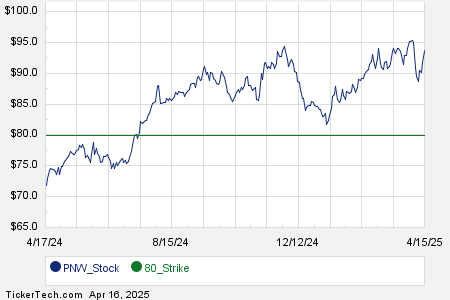
Below is a chart displaying the trailing twelve-month trading history for Pinnacle West Capital Corp, with the $80 strike marked in green for reference:

This chart, along with the Stock‘s historical volatility, can aid investors in deciding whether selling the October put at the $80 strike for a 3.6% annualized return is a worthwhile risk. Based on our calculations, the trailing twelve-month volatility for Pinnacle West Capital Corp, considering the last 251 days of trading and the current price of $94.77, stands at 18%. For additional put option ideas with various expiration dates, check out the PNW Stock Options page on StockOptionsChannel.com.
During mid-afternoon trading on Wednesday, put volume across S&P 500 components reached 1.15 million contracts, while call volume was 1.43 million, resulting in a put-to-call ratio of 0.80. This figure is notably elevated compared to the long-term median put-to-call ratio of 0.65. This indicates a higher-than-normal level of put buyers in options trading for the day relative to call buyers. Discover which 15 call and put options traders are discussing today.
 Top YieldBoost Puts of the S&P 500 »
For More Insights:
- Industrial Stocks Hedge Funds Are Buying
- Top Ten Hedge Funds Holding NIU
- Institutional Holders of KODK
The views and opinions expressed herein are those of the author and do not necessarily reflect those of Nasdaq, Inc.