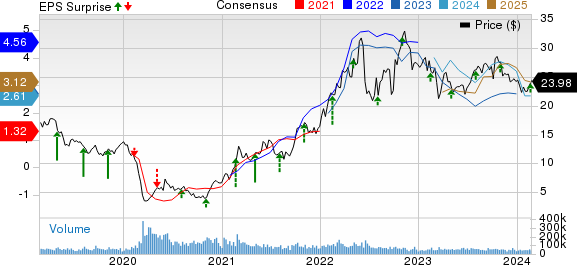
Investors were served a surprise platter by Marathon Oil Corporation as the company’s fourth-quarter 2023 adjusted net income per share came in at a hearty 69 cents, outstripping the Zacks Consensus Estimate by a solid margin of 7 cents. The star of the show was the robust domestic production, propelling the company past market expectations.
Despite a dip from the previous year’s adjusted profits of 88 cents, the company showcased its mettle in navigating challenging terrain, with weaker oil realizations casting a shadow over the bottom line. Revenues stood at $1.7 billion, slightly edging past analysts’ predictions by 2%, although a 2.4% drop from the year-ago figure left a bitter aftertaste.
Exploring the Production Landscape
Marathon’s total net production in the quarter, comprising contributions from the U.S. and International segments, surged to 404,000 barrels of oil equivalent per day (BOE/d), a significant leap from the 333,000 BOE/d clocked in the year-ago period.
The U.S. upstream unit faced headwinds as income dipped to $468 million from $510 million in the previous year due to falling commodity prices. The segment’s performance, impacted by pricing nuances, witnessed a resilient rebound, courtesy of enhanced production potential.
On the other hand, the International segment faced a tougher battle, with Equatorial Guinea operations reining in earnings of $51 million, a stark contrast from the $129 million reported a year ago.
Financial Fortitude and Projections
Total costs surged 18.9% year-over-year, reaching $1.2 billion, exceeding analyst expectations by 8.5%. The company flexed its financial muscle with an adjusted operating cash flow of $1.2 billion for the quarter.
As Marathon Oil charts its course for 2024, capital spending is earmarked between $1.9 billion and $2.1 billion, with a keen focus on shareholder returns rather than just production growth. The company aims for production levels ranging from 380,000 to 400,000 BOE/d.
The Industry Tapestry
Peering into the broader industry canvas, Marathon Oil’s counterparts also danced a varied performance waltz in the earnings arena. ConocoPhillips, EQT Corporation, and APA Corporation, stalwarts in their rights, showcased diverse tales of resilience, with nuanced market play tipping the scales for each entity.
As these energy juggernauts navigate the sea of volatility, one cannot help but marvel at the intricate dance of supply, demand, and external market forces shaping the narrative for each player in this high-stakes industry chess.
Indeed, the stage is set for a captivating saga of growth, resilience, and strategic adeptness in the ever-evolving energy sector.