Uncovering Investment Opportunities in China’s Stimulus: ETF vs. CEF
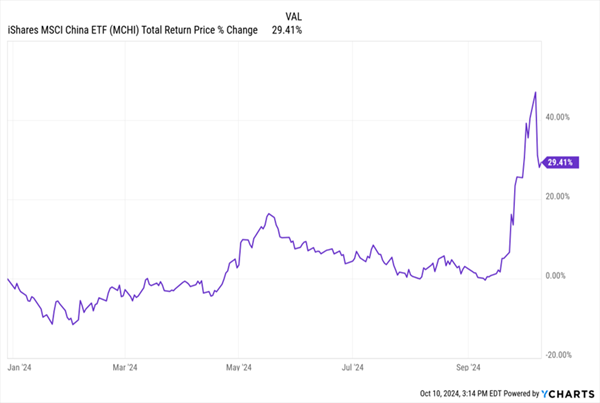
When you first glance at the chart below, you might assume it represents the latest stock surge from NVIDIA (NVDA) or a groundbreaking biopharma company. But that’s not the case:
A Surprising Index Fund Performance
This chart depicts the iShares MSCI China ETF (MCHI), which reflects the performance of the Chinese stock market, peaking recently due to a new stimulus package from the Chinese Communist Party. This announcement sparked interest from traders both in China and internationally.
Despite these gains, uncertainty looms due to limited details provided by the Chinese government regarding the implementation of the stimulus package. Last week, this uncertainty led to a reversal in stock prices, slightly dampening the bullish sentiment.
If you’re not a day trader, you might wonder how to profit from this situation. While purchasing Chinese stocks seems like an easy route, restrictions prevent foreigners from doing this directly.
Investors can opt for US-listed companies like Alibaba Group Holding Ltd. (BABA), but that introduces risks, as these stocks are linked through a variable interest entity in the Cayman Islands, meaning they don’t provide direct ownership of Chinese companies.
Alternatively, one could invest in ETFs like MCHI, which offer broad exposure to Chinese assets. However, these options may not be the most effective for long-term investment strategies.
Exploring Better Options: Closed-End Funds (CEFs)
The truth is, while short-term opportunities exist due to market frenzy, the long-term outlook for Chinese stocks has been disappointing.
Chinese Stocks vs. US Stocks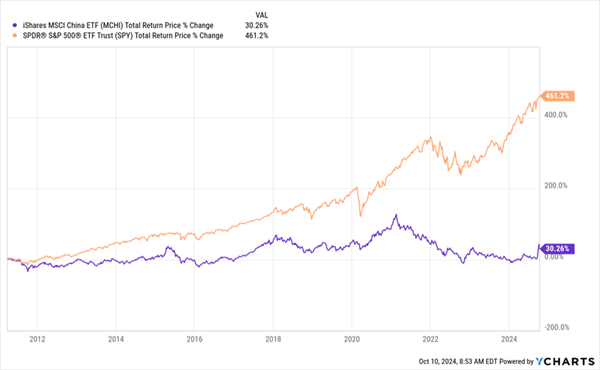
Since 2011, Chinese stocks have only returned about a tenth of the gains made by the S&P 500. For example, an investment of $10,000 in US stocks would be worth $56,120 today, while the same investment in Chinese stocks would only return $13,026, resulting in a loss of over $40,000.
The key takeaway is clear: if you decide to invest amid this frenzy, make sure to exit quickly to avoid missing more lucrative returns elsewhere.
If you’re serious about investing, the Morgan Stanley China A Share Fund (CAF) could be a worthwhile alternative to MCHI.
CAF’s Performance in Perspective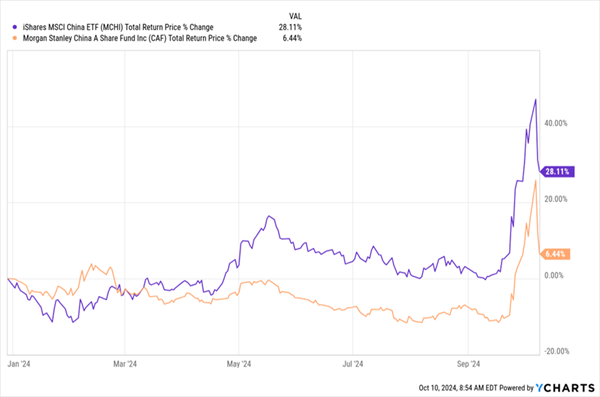
Currently, CAF is underperforming MCHI this year, and it has faced a more significant pullback following the recent stock market spike. So why consider CAF instead of MCHI? The answer lies in CAF’s smaller market cap of $275 million, compared to MCHI’s higher profile. This size difference could make CAF a hidden opportunity as the stock frenzy continues to evolve.
Although this might appear speculative, there are signs suggesting CAF is attracting less attention than MCHI. For instance, consider the discount to its net asset value (NAV):
CAF Offers a Better Value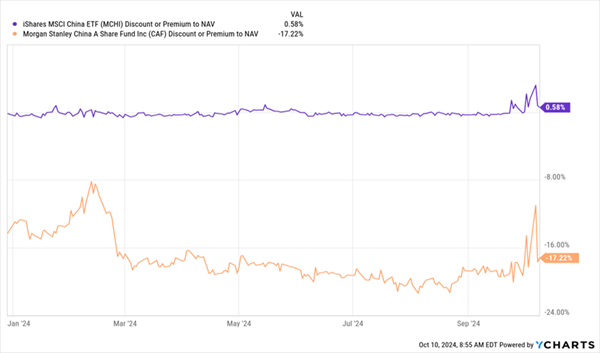
As of now, MCHI trades at a 0.6% premium to NAV, which is unusual as this often provides opportunities for savvy investors. In contrast, CAF is trading at a significant 17.2% discount, suggesting potential for growth when the market stabilizes.
Importantly, CAF’s price remains where it was before the recent trading frenzy, meaning it hasn’t fully priced in the anticipated recovery linked to the stimulus package, unlike MCHI.
Investing in CAF necessitates being alert and prepared to act quickly, which aligns with typical day trading strategy. However, our preference leans towards a longer-term with steady payouts, as evident in our investment approach at CEF Insider.
Seek Stability with 9.8% Payouts
CEFs provide the opportunity to build a diverse portfolio that supports a low-stress lifestyle, be it during retirement or while working towards it.
To that end, I’m recommending four specific CEFs, which deliver an average dividend yield of 9.8% and potential for profit as their discounts become less pronounced.
I have compiled a comprehensive investor bulletin focusing on CEF investments, including insights on maximizing yields and understanding how discounted CEFs can lead to significant financial advantages.
This methodology reflects the kind of straightforward, beneficial investment strategy needed in these unpredictable economic times.
Click here to access the in-depth investor bulletin now. You’ll also receive a complimentary report detailing the names and tickers of those four high-yield CEFs. Don’t miss this opportunity.
Also see:
- Warren Buffett Dividend Stocks
- Dividend Growth Stocks: 25 Aristocrats
- Future Dividend Aristocrats: Close Contenders
The views and opinions expressed herein are solely those of the author and do not necessarily reflect those of Nasdaq, Inc.
5 Stocks Our Experts Predict Could Double In the Next Year
By submitting your email, you'll also get a free pivot & flow membership. A free daily market overview. You can unsubscribe at any time.