Utilizing Covered Call Strategy for Steady Income in Volatile Markets
It’s uncommon to profit when the value of an investment declines. However, a straightforward options strategy can enable investors to do just that. This method has shown the potential for above-average returns while maintaining relatively low risk.
Understanding Options: A Quick Overview
No need to stress over complex calculations. In my experience, less complicated strategies tend to perform better over the long run. Rather, we should focus on an approach that is both profitable and easy to implement.
Options are standardized contracts granting the holder the right—though not the obligation—to buy or sell the underlying Stock at a predetermined price, known as the strike price. A call option allows the buyer to acquire a Stock, fund, or index, while a put option permits the sale of the same. An individual who purchases an option is referred to as the buyer, while the seller is called the writer.
Options comprise both time value and intrinsic value. In-the-money options contain both aspects, whereas at-the-money and out-of-the-money options consist solely of time value. At expiration, options lose their time value. If you’re short an option, the time value at expiration becomes profit, irrespective of the underlying Stock or ETF price movement.
Generating Income by Selling Option Premium
Many investors are not familiar with selling option premiums to create cash flow. This straightforward, yet effective, income strategy allows you to receive cash equal to the premium right away upon selling an option.
Unlike a traditional Stock dividend, you don’t need to own the Stock on the dividend payment date to receive a payout. Plus, you don’t have to wait for annual dividends averaging 2% or 3%.
The essential factor in this income strategy is ensuring that the option you sell is covered. This article will focus on the buy-write, or covered call strategy. In essence, you purchase increments of 100 shares of a Stock or ETF and subsequently sell one call option for every 100 shares owned.
Weekly covered calls begin by buying 100 shares of a Stock and then selling one weekly call option. Selling an option immediately credits your brokerage account with cash equal to the option premium, which lowers your cost basis and decreases overall trade risk. Notably, selling weekly calls allows for 52 opportunities each year, enhancing the income-generating potential of your portfolio.
This method reduces risk compared to outright Stock ownership while offering the chance for returns that surpass merely holding the Stock. The short option is ‘covered’ through the ownership of the Stock or ETF, limiting downside exposure. This strategy can yield profits in various market conditions, whether the market rises, falls, or remains stable.
Weekly options present an excellent opportunity for transforming small investments into substantial returns. This strategy could help cultivate a more consistent flow of profits.
Why This Strategy Works in Today’s Volatile Markets
Selling option premiums is particularly effective in turbulent market conditions. Weekly options intensify this approach by providing 52 chances each year to generate income, compared to a limited 12 with monthly options.
For illustration, consider the current environment for small-cap stocks, which have faced substantial declines this year. However, if trade agreements improve, these sectors may bounce back. The Direxion Daily Small Cap Bull 3X ETF (TNA) provides leveraged exposure and stands out as a candidate for this strategy.
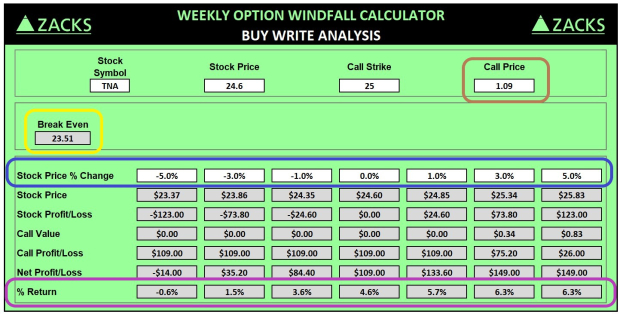
Currently, the TNA ETF trades at $24.60, with the May 2nd 25-strike call priced at 1.09 points, classifying it as an out-of-the-money option that contains only time value. Selling this option allows you to profit from the time decay as it approaches expiration. This profit materializes regardless of movements in the ETF price.
Maximizing Profit Potential
By acquiring 100 shares of the TNA ETF and selling the 25-strike call, your net cost is ($2,460 – $109) $2,351. Below is a risk/return analysis for this trade:
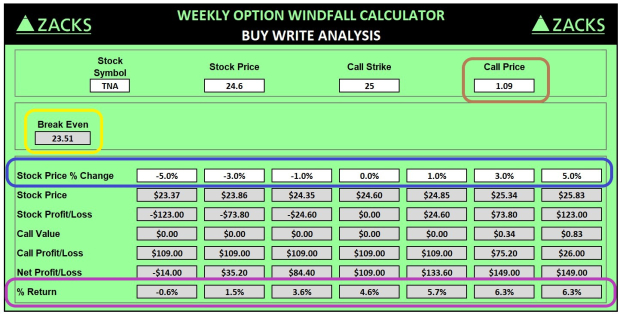
Image Source: Zacks Investment Research
The table reveals the risk/reward profile for this trade. As mentioned, the TNA ETF trades at $24.60 (orange box), and the sold 25-strike call at 1.09 points (brown box) is credited to your account. With options linked to 100 shares of the underlying Stock, the total cost for this covered call strategy is $2,351, leading to a breakeven price of $23.51, as indicated in the highlighted yellow box.
The blue row outlines TNA ETF performance under different scenarios at expiration, while the purple row illustrates the corresponding returns for the covered call strategy.
If TNA ETF stays flat at $24.60 at expiration, the 1.09 points of time value becomes your profit as the option value drops to zero, yielding a return of 4.6% in this instance.
Should the TNA ETF appreciate, the time premium continues to accrue, even if the short option incurs a loss beyond the 40.5-strike price. This loss offsets gains in the ETF. A 2% or greater increase in TNA ETF price equals a 6.3% profit for the covered call strategy at expiration.
Conversely, if TNA ETF depreciates, the collected 1.04 points in time value again converts to profit as the short option approaches zero, although this gain could be countered by a decline in ETF price depending on the extent of loss.
By purchasing a Stock or ETF at a discount due to sold option premium, profits can be realized whether the underlying asset rises, remains steady, or even falls.
“`html
Maximizing Profitability with the Covered Call Strategy
Utilizing a covered call strategy significantly increases the chances of a profitable trade. This income strategy offers a notable advantage compared to traditional stock purchases.
Understanding Cash-on-Cash Return
As previously mentioned, each call option covers 100 shares of the underlying ETF. For example, buying 100 shares of TNA at the current price of $24.60, while selling one 25-strike call at $1.09, requires an initial investment of $2,351 for this covered call trade. If you roll over the short options weekly, assuming a consistent premium, you could potentially earn $5,668 over the next year ($109 x 52). This substantial income would yield a cash-on-cash return of 241% ($5,668 cash income / original $2,351 covered call cost = 241%).
With a 241% cash-on-cash return, the investment can withstand several unfavorable events while still being profitable. Even if the underlying ETF price declines significantly, profits can remain intact. Additionally, if the timing of the trade is not ideal or if there are volatile price fluctuations, the trade may still yield returns. Such resilience offers the buy-write strategy a distinct edge over simply owning stocks outright.
Bottom Line
It’s uncommon to see a strategy that can remain profitable even when the investment’s price decreases. The buy-write strategy provides attractive returns while maintaining a lower risk profile, making it one of the top investment strategies available.
This approach can thrive in positive, sideways, or slightly declining markets, allowing investors to hold their positions through volatile conditions that might typically trigger sell-offs. Overall, the strategy presents less risk compared to traditional stock ownership while still offering the potential for enhanced gains.
The analysis above underscores the value of integrating the covered call strategy into every investor’s portfolio.
Direxion Daily Small Cap Bull 3X Shares (TNA): ETF Research Reports
This article originally published on Zacks Investment Research (zacks.com).
The views and opinions expressed herein are the views and opinions of the author and do not necessarily reflect those of Nasdaq, Inc.
“`