AI Trends and Stock Splits Drive Market Growth in 2024
For nearly 30 years, investors have pursued the latest breakthrough technology to funnel their capital. In the past two years, artificial intelligence (AI) has emerged as Wall Street’s standout trend.
However, AI is not the sole factor propelling the Dow Jones Industrial Average, broad-based S&P 500, and growth-focused Nasdaq Composite to new highs in 2024. Investor interest has also surged for public companies executing stock splits.
A stock split enables companies to adjust their share price and total share count without altering their market capitalization or operating performance. While splits are largely cosmetic, they can convey significant messages to investors.
Investors generally avoid companies that implement reverse splits, which lower share counts to elevate share prices. Such actions often signal distress and may aim to avoid delisting from exchanges.
Conversely, firms that perform forward splits tend to attract investor interest, as these make shares more affordable for average investors and employees who can’t buy fractional shares. Companies that enact forward splits often demonstrate strong growth and innovation.
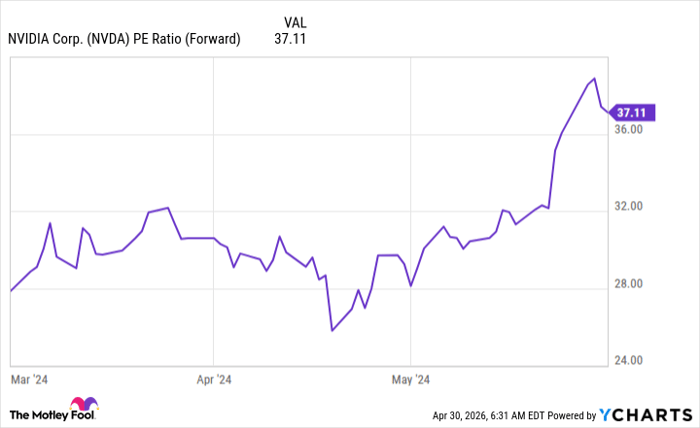
In 2024, over a dozen well-known companies executed forward splits, including the major AI players, Nvidia and Broadcom.
Fastenal’s Stock Split: A Notable Event in 2025
In 2025, only three notable companies have announced or completed forward splits, with one—gaining about 57,000% since its IPO in April 1993—being a strong buy this June.
Fastenal, the wholesale industrial and construction supplies giant, is the only high-profile company that has both announced and completed a stock split this year. On April 23, Fastenal’s board sanctioned a 2-for-1 forward split, marking the company’s ninth split in 37 years. This took effect after the market closed on May 21, lowering the share price from approximately $82 to $41.
Fastenal’s stock has appreciated nearly 210,000% since its IPO in August 1987, driven by its adaptability to economic cycles and deep integration into customer supply chains.
Fastenal’s business is cyclical, influenced by macroeconomic conditions. Historically, U.S. recessions last about ten months and expansions last around five years, which boosts demand for Fastenal’s products over time.
The firm’s managed inventory solutions, including internet-connected vending machines (FASTVend) and FASTBin inventory technology, enhance customer insights and supply chain management.
While Fastenal shows favorable long-term growth, its forward price-to-earnings (P/E) ratio of 32 raises concerns about valuation, suggesting another stock split may offer a better June investment opportunity.
O’Reilly Automotive’s Significant Stock Split
A standout investment opportunity in June for stock split enthusiasts is O’Reilly Automotive (NASDAQ: ORLY).
Although it is not the largest company to announce a 2025 split—Interactive Brokers Group holds that title—O’Reilly’s 15-for-1 forward split is the most substantial this year.
The company announced this split in mid-March and received shareholder approval at its annual meeting on May 15. Effective after June 9, shares will drop from over $1,370 to around $92.
O’Reilly Automotive benefits from both broader macroeconomic trends and specific company advantages. Consumers are retaining their vehicles longer, with the average age of cars and light trucks in the U.S. reaching a record high of 12.8 years in 2024, up from 11.1 years in 2012, according to a report from S&P Global Mobility.
O’Reilly Automotive Benefits from Aging Vehicles and Rising Loan Rates
O’Reilly Automotive is poised for growth due to several favorable market conditions. The aging vehicle fleet in the U.S. coincides with rising auto loan interest rates, which have surged from below 4% in late 2021 to between 7% and 8%. This trend encourages vehicle owners to keep their cars longer, increasing demand for auto parts from companies like O’Reilly.
Additionally, O’Reilly’s distribution model is a significant asset. By the end of 2024, the company operated 31 distribution centers and nearly 400 hub stores. These hubs supply over 153,000 stock keeping units to retail locations on a same-day or overnight basis, enhancing customer satisfaction.
Moreover, O’Reilly has an effective share-repurchase program, having spent over $25.9 billion since January 2011 to buy back 59.4% of its outstanding shares. This strategy typically enhances earnings per share (EPS), making the company’s stock more appealing to investors.
With these advantages, O’Reilly Automotive trades at a reasonable 27 times forward earnings, signaling potential for significant stock price increases.
Should You Invest $1,000 in O’Reilly Automotive Now?
Before considering O’Reilly Automotive stock, note that it was not listed among the top 10 stock picks by the Motley Fool’s analyst team. According to their analysis, these stocks could yield substantial gains in the coming years.
For context, if you had invested $1,000 in Netflix upon its recommendation on December 17, 2004, it would now be worth $651,049. Similarly, a $1,000 investment in Nvidia on April 15, 2005, would have grown to $828,224.
The Motley Fool’s Stock Advisor has achieved an average return of 979%, outstripping the S&P 500’s 171%.
For more insights, see the full list of recommended stocks.
Sean Williams does not hold positions in any of the mentioned stocks. The Motley Fool has recommendations involving Interactive Brokers Group and Nvidia. Disclosure policy applies.
The views and opinions expressed herein are those of the author and do not necessarily reflect those of Nasdaq, Inc.
5 Stocks Our Experts Predict Could Double In the Next Year
By submitting your email, you'll also get a free pivot & flow membership. A free daily market overview. You can unsubscribe at any time.