Celebrating 40 Years of the Nasdaq-100: A Benchmark of Innovation and Growth
Today marks a significant milestone for one of the most recognized indexes in finance — the Nasdaq-100 Index® is celebrating its 40th anniversary.
Over the last four decades, this index has established itself as a leading benchmark for trading and investment products internationally. The market capitalization of Nasdaq-100® stocks has surpassed $27 trillion as of year-end 2024. Investors have multiple options to engage with the Nasdaq-100, including stocks, ETFs, options, and futures. Note, there are other products that also track the Nasdaq-100, like structured products and annuities, but we focus on the main categories for clarity. Together, these products facilitate daily trading of over $620 billion in value.
Origins of the Nasdaq-100
It’s important to distinguish the Nasdaq-100 from the Nasdaq Composite® Index. The Nasdaq Composite Index reflects all companies listed on Nasdaq and was introduced in 1971 alongside the Nasdaq Stock Market®.
The Nasdaq-100, on the other hand, was created on January 31, 1985, representing the top 100 (excluding financial firms) stocks listed on Nasdaq. At its inception, the market cap was a modest $58 billion. Now, this index boasts some of the world’s largest companies, including AAPL, AMZN, NVDA, and GOOG, contributing to a remarkable $27 trillion overall.
Interestingly, the Nasdaq Financial-100TM Index also launched on that same date and still exists today.
Substantial Compound Returns Through the Years
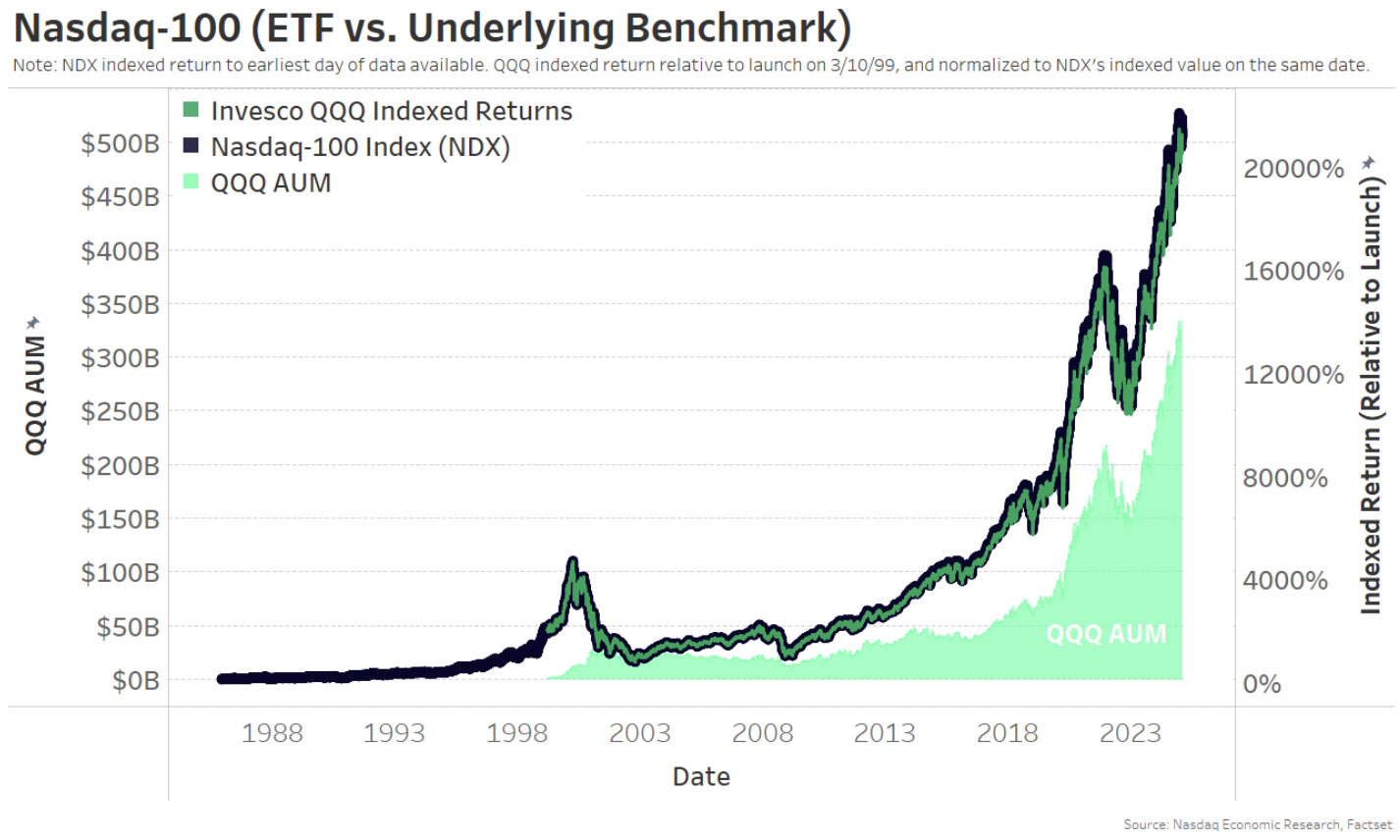
Since its launch, the Nasdaq-100 has appreciated approximately 20,000% as of December 31, 2024. This translates to an annualized compound return of 14.25%, outpacing the S&P 500’s 11.57% during the same period. The journey wasn’t without challenges; the index experienced an 83% decline during the tech bubble burst, highlighting the importance of long-term investment strategies.
Chart 1: Nasdaq-100 Index Returns Since Inception with QQQ Performance and Assets

As is common with indexes, the companies within the Nasdaq-100 have evolved over time, with IPOs introducing new firms while others leave due to mergers or smaller size. Throughout its history, the Nasdaq-100 has included over 500 different companies. Notably, only six of the original firms remain: Apple, Micron Technology, Intel, KLA-Tencor, PACCAR, and Costco.
A Hub for Innovative Tech Companies
A key factor contributing to the Nasdaq-100’s strong performance is its concentration of the world’s largest and rapidly growing tech stocks.
The representation of technology in the index, based on ICB sector classifications, has fluctuated between 25% and nearly 70%. Leadership has shifted among various sectors over the years; Consumer Services/Discretionary, Telecommunications, and Health Care have also held prominent roles at different times. It’s worth noting that as of 2021, the ICB classification underwent changes that established the Consumer Discretionary industry, retiring the Consumer Services classification. Many well-known companies from these sectors include Pepsi, Starbucks, Costco, Honeywell, Gilead, Amgen, and Biogen.
Chart 2: Nasdaq-100 Tech Sector Weights Over Time

Post-Financial Crisis Outperformance
Since the financial crisis, the Nasdaq-100 has seen remarkable outperformance, increasing more than tenfold, outperforming other U.S. and international indexes. Unlike previous cycles, this time companies in the index have shown superior earnings growth, bolstered by investments in artificial intelligence (AI) technologies.
Chart 3: Index Performance Since the End of the Financial Crisis Aligned with Earnings Growth

Reflecting the Global Economy
The Nasdaq-100 may comprise U.S.-listed companies, but it represents the global economy. The index includes American Depositary Receipts (ADRs), giving it a broader international scope. By the end of 2024, ten non-U.S. companies made up almost 4% of the index, such as ARM, Linde, and AstraZeneca.
Furthermore, nearly half of the revenues generated by companies in the index come from international markets, especially significant contributions from Asia, according to FactSet.
Chart 4: Almost 50% of Constituent Companies’ Revenue Comes from Overseas

A Diverse and Liquid Marketplace
The Nasdaq-100 Index is not just a representation of the largest companies; it is also a cornerstone of liquidity and investment vehicles. The introduction of NDX options in 1994, NDX futures in 1996, and the QQQ ETF in 1999 provided investors with ways to harness the index’s performance. Over the years, various investment products, including leveraged ETFs and options-based ETFs, have emerged.
Combined with trading in Nasdaq-100 companies, overall liquidity in the index exceeds $620 billion each day, which is sourced from:
- Nasdaq-100 Stocks: Approximately $173 billion traded daily.
- ETFs Linked to Nasdaq-100: Around $23 billion traded daily.
- Nasdaq-100 Futures: About $201 billion traded daily.
- Options on Stocks and Index: Roughly $113 billion traded daily on a delta-adjusted basis.
Chart 5: Liquidity in the Nasdaq-100 Ecosystem Exceeds Half a Trillion Dollars Daily

Cheers to the Nasdaq-100!
This index has fascinated investors and traders for years, showcasing some of the most iconic brands in the U.S. The development of investment products has enabled people to invest in the Nasdaq-100 portfolio, which supports the innovative contributions of these companies to the global economy.
It is remarkable to reflect on the achievements of the Nasdaq-100 over 40 years, highlighting its impact on global commerce.