“`html
Moody’s Downgrades U.S. Credit Rating, Widening Economic Divide
Moody’s Downgrade and Its Implications
On Friday, Moody’s Investors Service lowered the U.S. government’s credit rating from Aaa to Aa1. This change marks the last major downgrade, following S&P’s initial action in 2011 and Fitch’s rating change after the 2023 debt ceiling debate.
Moody’s provided this rationale:
We do not believe that material multi-year reductions in mandatory spending and deficits will result from current fiscal proposals under consideration.
Over the next decade, we expect larger deficits as entitlement spending rises while government revenue remains broadly flat. In turn, persistent, large fiscal deficits will drive the government’s debt and interest burden higher.
The U.S. fiscal performance is likely to deteriorate relative to its own past and compared to other highly-rated sovereigns.
The Impact on Treasuries Market
In response, Treasury Secretary Scott Bessent sought to mitigate concerns, stating:
I think that Moody’s is a lagging indicator. I think that’s what everyone thinks of credit agencies.
Despite his assurances, bond yields surged soon after the announcement. Higher yields often arise from increased perceived risk, leading investors to demand larger returns.
Typically, elevated bond yields pose challenges for both Wall Street and Main Street by increasing borrowing costs. Notably, the yield on the 10-year Treasury rose to 4.56%, with the 30-day Treasury reaching 5.03%, its highest this year.
Investor Louis Navellier, however, is not overly concerned about the impact on treasuries. He noted:
The treasury auctions are going much better under Scott Bessent than they were under Janet Yellen.
Growing Wealth Gap in Housing Market
The National Association of Realtors (NAR) highlighted the widening wealth gap in a recent report. Key findings indicated:
Higher-income households have near-total access to the housing market. Homebuyers earning $250,000 or more can afford at least 80% of home listings.
Conversely, those earning below $75,000 have seen their market access diminish. A buyer with a $50,000 salary can afford just 8.7% of available listings in March.
This ongoing situation is exacerbated by the pandemic-driven surge in home prices, which are still nearly 40% higher than pre-pandemic levels in March 2019. Consequently, lower-income Americans have been significantly impacted.
Rising Rental Costs Affect All Income Levels
The 2024 “Rental Market Report” from Zillow indicates that rental growth has also surged. The data shows:
Rents now sit 10% above what they would have been had the 4% growth trend continued over the last five years.
The income needed to afford rent jumped to $78,592 in December, with the typical asking rent for single-family homes at $2,174, up 4.4% from last year.
Student Loan Collections Add to Financial Burden
Recently, the U.S. Department of Education resumed collection efforts on defaulted student loans, creating additional financial strain. U.S. Secretary of Education Linda McMahon reported:
More than 42 million Americans hold student loans, totaling over $1.6 trillion in outstanding federal education debt. Currently, over 5 million borrowers are in default, and this could increase significantly in the coming months.
This financial pressure contributed to last Friday’s decline in the University of Michigan’s consumer sentiment survey. The index dropped to 50.8, down from 52.2 in April, reaching its second-lowest level on record.
Consumer Resilience Amid Economic Disparities
Although economic data may show resilience among consumers, this masks the struggles of lower-income Americans. The spending habits of wealthier households are significantly driving retail demand, overshadowing the stagnation or decline in spending among those with lower incomes.
According to the Fed’s report, “A Better Way of Understanding the US Consumer,” retail sales estimates show that:
Consumer resilience has been driven by middle- and high-income households, while low-income households have pulled back since mid-2021.
Understanding the “Wealth Effect”
The concept of the wealth effect explains how perceptions of financial well-being influence spending. Simply put, when individuals feel wealthier, likely due to increased asset values, they tend to spend more. This phenomenon emphasizes the growing disparity as higher-income Americans continue to spend significantly more than their lower-income counterparts.
“`
Wealth Disparity Grows as Top Households Capitalize on Stock Gains
According to Fed data, the wealthiest 10% of Americans hold approximately 93% of all stock wealth. With stocks nearing all-time highs, the wealth effect for these households is significant.
According to a report from Fox Business:
America’s wealthiest households are increasingly influencing consumer spending, driven by net worth gains due to market trends, as highlighted in a Moody’s Analytics analysis.
The report, authored by Moody’s Analytics chief economist Mark Zandi, reveals that the top 10% of U.S. households, defined as those earning $250,000 or more, account for 49.7% of consumer spending—an all-time high since at least 1989.
This contrasts sharply with less affluent households, which are still grappling with persistent inflation and rising interest rates affecting the housing market.
This scenario exemplifies the K-shaped recovery in our economy.
Understanding Wealth Creation Among the “Haves”
The primary driver for this wealth accumulation is clear: technology and artificial intelligence (AI).
For perspective, the Global X Artificial Intelligence & Technology ETF (AIQ) has outperformed the S&P 500 by nearly 50% over the last two years.
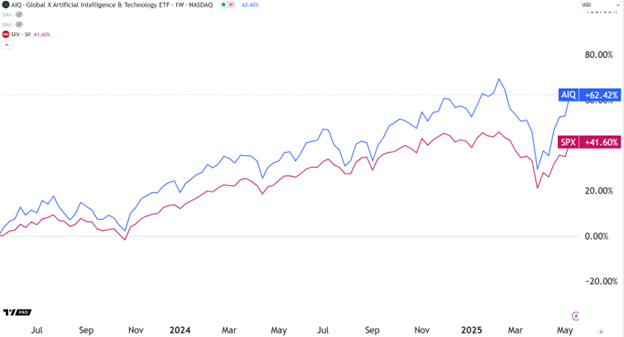
Source: TradingView
AIQ consists of 86 large- and mega-cap stocks, making its overall returns subject to various underperformers.
Examining standout performers within the AI sector reveals impressive two-year returns for several companies leading the charge:
- SoundHound AI (SOUN): +261%
- Sezzle (SEZL): +595%
- Palantir (PLTR): +979%
- GeneDx Holdings (WGS): +1,030%
- Applovin (APP): +1,360%
In contrast, here are the two-year returns for several well-known stocks that have faced challenges:
- Lululemon (LULU): -14%
- Starbucks (SBUX): -17%
- Hershey Foods (HSY): -37%
- Nike (NKE): -46%
- Dollar Tree (DLTR): -46%
- Estee Lauder (EL): -66%
This highlights the ongoing K-shaped economy in both the broader market and the stock arena.
Examining the Market Divergence
Macro expert Eric Fry emphasizes this divergence, noting that:
Artificial intelligence is dividing commerce into two distinct camps: those who successfully leverage AI and those who do not.
To remain competitive, companies must adopt and integrate AI technologies swiftly.
Failure to adapt spells danger as we edge closer to achieving artificial general intelligence (AGI).
The environment is Darwinian: adapt or risk obsolescence.
There are various avenues for investing in AGI. The most direct includes shares of companies that provide essential infrastructure to advance AI technologies, such as Nvidia.
Eric recommends that investors also explore companies that have been overlooked but are now utilizing AI to enhance efficiency and profitability.
He terms these “Stealth AGI” companies:
These include sectors like shipping, logistics, beauty, fashion, wellness, and food and beverage.
While these companies may seem less exciting compared to giants like Nvidia, they are likely to adopt AI technologies to drive significant profit improvements.
Eric has spotlighted his top stealth AGI pick in one of his latest reports. In this analysis, he provides an overview of critical stocks to avoid and highlights one AGI-related stock that recently achieved a remarkable 46% gain while the S&P 500 fell by 5%.
Reflecting on the Economic Disparity
A notable parallel is emerging: just as lower-income Americans face financial hardships from rising costs, companies that are slow to incorporate AI are lagging.
Conversely, wealthier Americans, supported by asset appreciation and the wealth effect, continue to drive spending, while AI-forward companies experience substantial growth and market returns.
This landscape reveals two significant gaps, underscoring a system that rewards those who can leverage innovation—whether in terms of financial resources or technological capabilities. Those unable to adapt are increasingly being left behind.
Monitoring these trends is vital for both social stability and individual wealth. All indicators suggest this divergence is set to intensify.
Have a good evening,
Jeff Remsburg
5 Stocks Our Experts Predict Could Double In the Next Year
By submitting your email, you'll also get a free pivot & flow membership. A free daily market overview. You can unsubscribe at any time.