Trump’s Tariffs Could Impact Majority of U.S. Imports
A global trade war has been intensifying for weeks, and it is poised to escalate significantly this Wednesday, April 2. On this date, U.S. President Donald Trump plans to implement a substantial set of reciprocal tariffs against the nation’s trading partners.
This unfolding situation may resolve peacefully with a solid agreement, or it could lead to long-term tariffs that could hurt the global economy.
Trump has dubbed this day “Liberation Day,” asserting that these tariffs will free the United States from unfavorable trading agreements with various countries.
Reports indicate that on Wednesday, Trump will target the so-called “Dirty 15,” a group of 15 trading partners with which the U.S. has significant bilateral trade deficits. Although this may seem minor in a landscape where the U.S. engages with over 100 countries, these 15 account for more than 75% of all U.S. imports.
By imposing tariffs on these nations, Trump focuses on the majority of U.S. imports. Should importers transfer these costs to consumers, the consequences could be severe and widespread.
Three Key Approaches to Tariffs
Trump has three primary strategies to address the “Dirty 15.”
First, he could enact “matching tariffs.” In this scenario, if a country imposes a 5% tariff on U.S. goods while the U.S. applies only a 2% tariff, Trump would introduce an additional 3% tariff, bringing both rates to parity.
Secondly, Trump could target value-added taxes (VATs). These indirect taxes are applied at various stages of production or distribution, particularly disadvantaging U.S. goods entering European markets. The imposition of tariffs equal to these VATs would disadvantage exporters even more significantly.
Lastly, Trump could implement non-tariff measures, which include regulatory standards that inhibit fair trade. These regulations could include country-specific sanitary standards and licensing requirements, which are complex but could be modified to promote better trade conditions.
These represent the three main methods Trump could employ against the “Dirty 15” on Wednesday.
Anticipating the Potential Outcomes
Options one and two—matching tariffs and tackling VATs—appear to be the most probable, as Trump has frequently mentioned them since taking office.
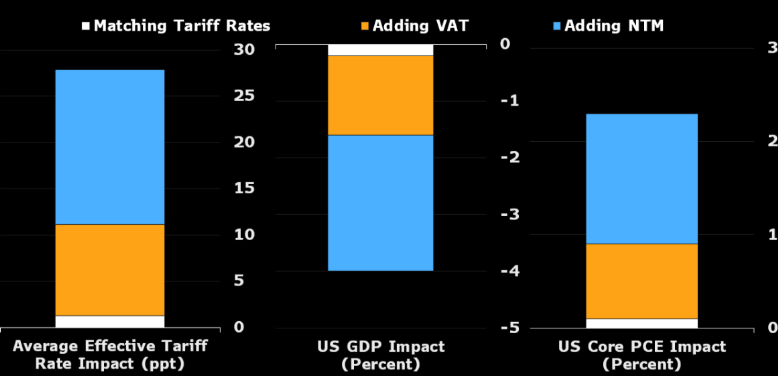
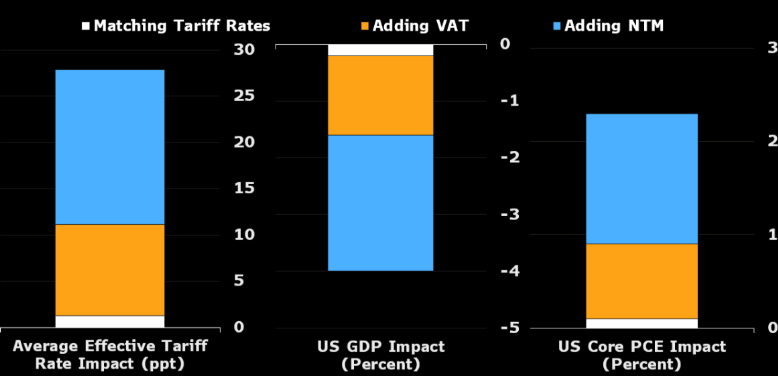
Recent research from Bloomberg suggests that matching tariffs would not significantly disturb the market. They might only raise the average tariff rate by one or two points, resulting in minor impacts on GDP growth and inflation. Such changes would likely have a negligible effect.
On the other hand, addressing VATs could have more serious ramifications. A tariff on these could raise the average tariff rate by over 10 points, impacting GDP growth by nearly two points and increasing inflation by about one point. While this outcome is not ideal, it is not catastrophic either.
Should the president choose the third option, however, the implications could be severe.
By attacking non-tariff barriers, the average tariff rate could jump by nearly 30 points, reaching levels unseen in over a century. As a result, GDP growth could decline by four points, with inflation rising by two to three points.
Currently, there is no clear indication of which strategy Trump will adopt this Wednesday.
Final Thoughts on the Trade War Risks
As noted earlier, we believe options one and two are the most likely, while option three seems less probable.
However, the recent months of Trump’s second term highlight the element of unpredictability in his administration.
And the unexpected could lead to global economic turmoil.
Readiness for such scenarios is crucial.
To assist with this, we have developed a new special report titled the Trade War Protection Playbook.
This guide includes our recommended top 10 stock market strategies to safeguard and possibly even enhance your wealth in the event of an escalating trade war.
With “Liberation Day” approaching, we encourage you to explore this report soon.
On the date of publication, Luke Lango did not hold (directly or indirectly) any positions in the securities mentioned in this article.
P.S. Stay updated with Luke’s latest market insights by reading his Daily Notes! Check out the latest version on your Innovation Investor or Early Stage Investor subscriber site.