First things first, let’s talk about AstraZeneca PLC (AZN). Focused on cancer treatments, this pharmaceutical giant raked in a whopping $18.4 billion in sales from oncology products in the fiscal year 2023, accounting for a substantial 40% of its revenue.
A New Frontier in Cancer Treatment
On March 19, AstraZeneca made waves with its declaration to acquire Canadian drug developer Fusion Pharmaceuticals (FUSN) for a hefty $2.4 billion. This move showcases the company’s strategic pivot towards pioneering next-generation cancer therapies, specifically radiopharmaceutical drugs.
At the heart of Fusion Pharma’s innovation are “next-generation” radioconjugates – a groundbreaking approach that delivers a radioactive isotope to cancer cells with pinpoint accuracy, reducing harm to healthy tissues, unlike traditional radiotherapy methods.
The Rise of Radioconjugates
Bearing in mind that a significant portion of cancer patients undergo radiotherapy during their treatment journey, AstraZeneca’s foray into this realm is both timely and strategic.
Back in 2021, Novartis (NVS) broke ground with data demonstrating the efficacy of its radiopharmaceutical drug Pluvicto in extending the survival rates of prostate cancer patients. This success paved the way for increased interest in the sector, as evidenced by subsequent notable acquisitions like Eli Lilly’s purchase of Point Biopharma and Bristol-Myers Squibb’s buyout of RayzeBio.
With AstraZeneca’s stellar track record in developing targeted cancer treatments like antibody drug conjugates and radiation therapies, the Fusion Pharmaceuticals deal marks a strategic opportunity to expand its arsenal of treatment options.
Stepping into Uncharted Territory
While AstraZeneca boasts several approved antibody drug conjugates, the realm of radioconjugates (or radioligands) remains uncharted territory for the company. The acquisition of Fusion Pharmaceuticals is, therefore, a prudent step forward in this direction.
Breaking down radioligands, we find three essential components – the ligand, the medical isotope, and the linker. Working in tandem, these components deliver targeted therapy by binding to specific receptors overexpressed in tumors, damaging the tumor cells’ DNA, and facilitating the isotope’s delivery to the tumor.
Diversifying the Portfolio
March has undoubtedly been a busy month for AstraZeneca, as it also announced the acquisition of Amolyt Pharma for $1.05 billion, aiming to enhance its rare diseases portfolio. Amolyt’s eneboparatide therapy for hypoparathyroidism presents significant blockbuster potential, with Phase III trial results on the horizon.
Building on the momentum from the $39 billion Alexion acquisition in 2021, AstraZeneca’s rare diseases segment witnessed a stellar 12% year-over-year revenue growth, reaching $7.8 billion in sales in 2023.
Charting a Path to Success
In a notable triumph, AstraZeneca recently demonstrated the efficacy of its flagship drug Tagrisso in slowing the progression of lung cancer. This breakthrough therapy, catering to non-small cell lung cancer patients with epidermal growth factor receptor mutations, extended progression-free survival significantly, earning $5.8 billion in sales in 2023.
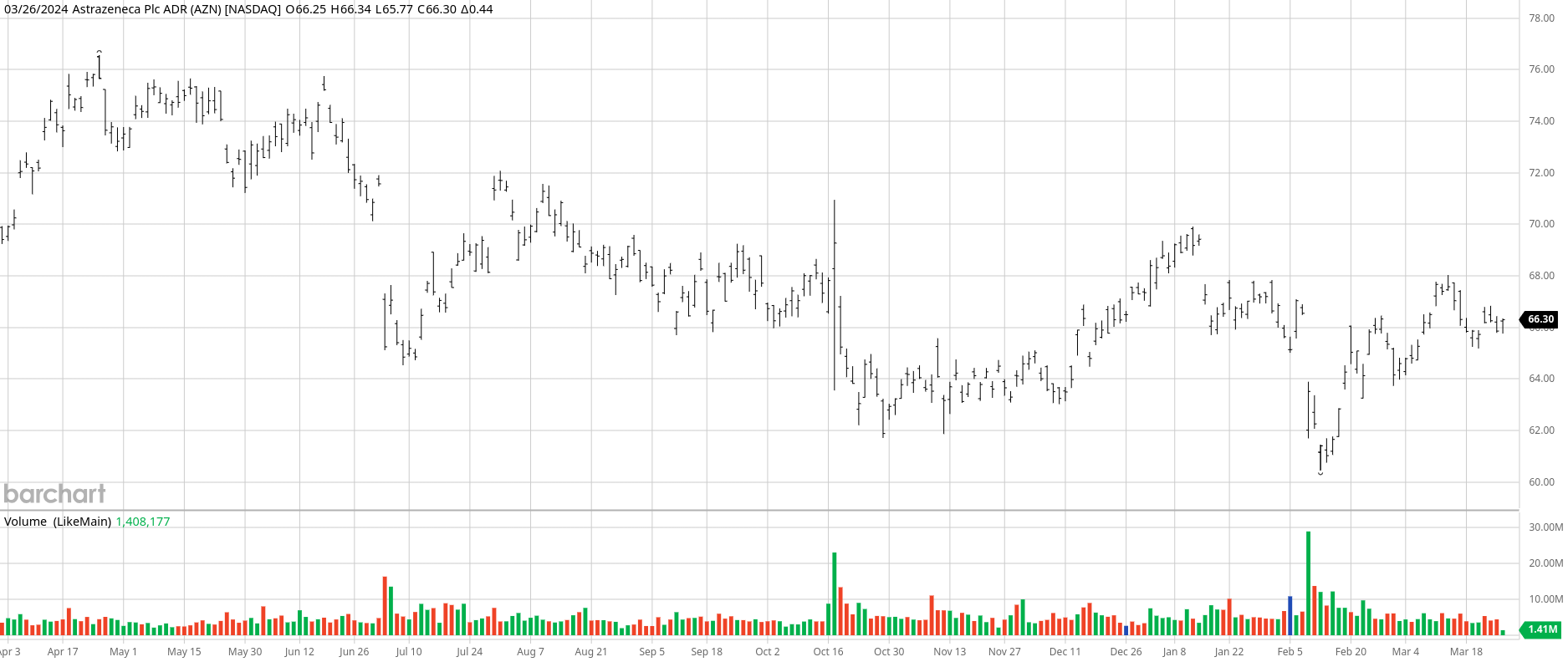
Despite facing a 1.5% year-to-date and 2.3% yearly stock dip, Wall Street’s slight skepticism presents a golden buying opportunity for investors eyeing a high-quality pharma gem at a bargain.
With a robust product lineup, promising pipelines, and newfound synergies from recent acquisitions, AstraZeneca stands poised for sustained growth in the long run. From expanding their footprint in high-profit oncology and rare disease segments to pioneering cutting-edge cancer treatments, the company’s trajectory appears vibrant and promising.
AstraZeneca’s stock is a compelling buy under $66, offering investors a chance to ride the wave of innovation and growth in the ever-evolving pharmaceutical landscape.
On the date of publication, Tony Daltorio had no direct or indirect positions in any of the securities mentioned in this article. All information provided here is purely for informational purposes. Click here to view the Barchart Disclosure Policy for more details.
The views and opinions expressed in this article belong solely to the author and do not necessarily align with those of Nasdaq, Inc.