Examining Noteworthy Shifts in ETFs
Delving into the realms of Exchange-traded funds (ETFs), where investment creativity meets stock market reality, we may stumble upon a curious anomaly – the USMC ETF (Symbol: USMC). A staggering $123.8 million dollars have been christened into this financial celebration. In the wild cosmic dance of ETFs, that’s a 5.8% surge in outstanding units from 41,880,001 to an impressive 44,300,001, all in just one week. What a whirlwind journey of wealth and wonder!
Visualizing Performance Trends
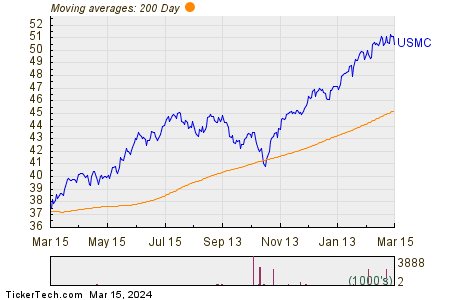
Behold the tapestry of numbers and lines that paint a vivid picture of USMC’s voyage through time. The chart reveals a year-long pilgrimage of price performance against its 200-day moving average. A rollercoaster ride indeed, with USMC’s lowest dip at $37.32 per share and its highest peak soaring to $51.39 in 52 weeks. The most recent trading echoes at $50.53, a tantalizing figure to behold. Observing the recent share price alongside the 200-day moving average unveils a treasury of technical insights that beckon exploration.
Deciphering the ETF Universe
ETFs are the chameleons of trading, hovering between the worlds of stocks and investments. Investors partake not in shares, but in cryptic entities called “units.” These units mimic stocks in trading essence, yet possess the elusive power of inception and dissolution, molding themselves to the rhythms of investor whims. The ebb and flow of units hint at a larger cosmic tango within ETFs, where the creation and destruction of units play a pivotal role.
Exploring Further Insights
As we uncover the mysteries of wealth dynamics, let’s journey deeper into the ETF landscape. Click the link below to explore the nine other ETFs that basked in the limelight of remarkable inflows, basking in the glow of financial abundance.
 Click here to find out which 9 other ETFs had notable inflows »
Additional Market Insights:
AUS Options Chain
GURE shares outstanding history
WEST Historical Earnings
The views and opinions expressed herein are the views and opinions of the author and do not necessarily reflect those of Nasdaq, Inc.