Novo Nordisk (NYSE: NVO), a Danish pharmaceutical company, is the developer of Ozempic, which is often referred to as a weight-loss drug. But there is actually a nuance, albeit an important one, to discuss.
Ozempic is a glucagon-like peptide-1 (GLP-1) agonist that uses semaglutide and is typically prescribed for patients with diabetes. While losing weight can be affiliated with taking it, the drug itself is not approved by the Food and Drug Administration (FDA) for that specific use.
Nevertheless, demand for the drug is off the charts. In 2023, sales from Novo Nordisk’s GLP-1 diabetes therapies grew 52% year over year. Ozempic and a sibling treatment called Rybelsus are to thank for that growth.
However, the real star of Novo Nordisk’s portfolio could be something else entirely. Growth in its obesity-care segment reached 154% during 2023. And guess what: Ozempic wasn’t the main attraction in that operating segment.
Let’s dig into what other blockbuster drugs the company has at its disposal, and which treatment in particular could be a hidden catalyst for the company.
The phenomenon of GLP-1 treatments
Novo Nordisk currently offers three GLP-1 medications: Ozempic, Rybelsus, and Wegovy. While these treatments all share the peptide semaglutide, Ozempic and Rybelsus are used for diabetes, while Wegovy is FDA approved for chronic weight management in obesity patients.
Despite their different uses, these drugs share an enormous total addressable market. J.P. Morgan estimates that the market for GLP-1 treatments could exceed $100 billion by 2030.
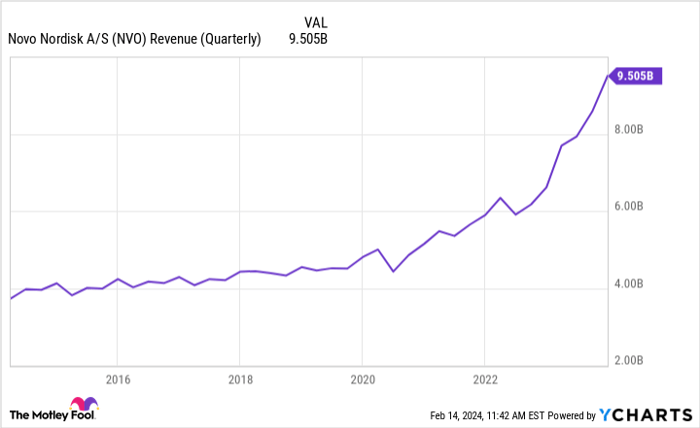
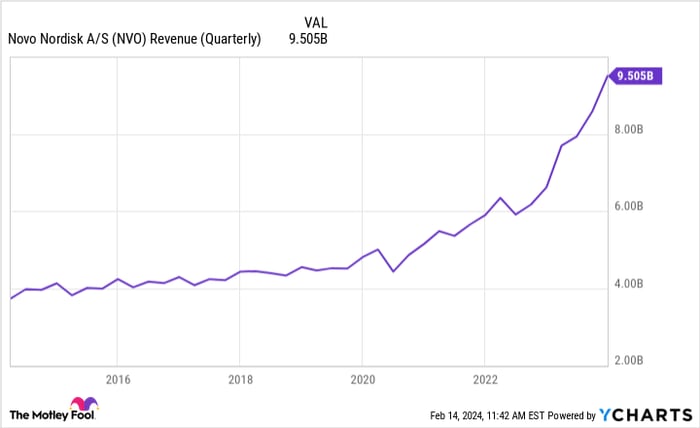
NVO revenue (quarterly) data by YCharts.
The chart above clearly shows that demand for Novo Nordisk’s diabetes and obesity treatments is high — and the estimates surrounding the market size could suggest that the party is just getting started. Even better, Novo Nordisk has another treatment that could enjoy a magical run similar to that of Ozempic.

Image Source: Getty Images
The overlooked powerhouse
During Novo Nordisk’s earnings call last month, a lot of investors and analysts were curious about the outlook on Ozempic. However, during management’s commentary, I learned that the company has a catalyst that is equally disruptive — if not more so.
The major contributors behind the 154% annual growth in obesity care were Saxenda (a daily medication) and Wegovy (which is administered weekly). While sales of Saxenda rose by 14% in 2023, Wegovy’s popularity in North America was the primary driver for obesity care’s overall stellar performance.
In North America, obesity-care sales grew 212% year over year. Taking this one step further, sales specifically from Wegovy increased 393% in the U.S. This growth comes on the heels of a commercial relaunch back in January 2023 (following an earlier launch which faltered due to supply issues).
While the demand for Wegovy is downright staggering, investors have plenty of reasons to believe even more growth could be in store. Novo Nordisk recently announced that its investment vehicle, Novo Holdings, is acquiring Catalent for $16.5 billion.
Catalent is a subcontractor that helps manufacture drugs for pharmaceutical companies. As part of the transaction, Novo Nordisk will be taking over three facilities in Belgium, Italy, and Indiana to help bolster its manufacturing output. This is an encouraging sign that Novo Nordisk sees demand for its flagship treatments rising and is trying to mitigate any supply issues by augmenting its output capabilities.
On top of all of this, Wegovy’s potential might not end with weight management. Often, pharmaceutical companies will develop a drug and attain approval for one specific purpose. Subsequently, through more research and clinical trials, these same drugs can be expanded for treating other conditions. While it’s still early days, Novo Nordisk has shed some light on Wegovy’s potential to treat heart disease.
Is it too late to buy Novo Nordisk stock?
Given the excitement surrounding Ozempic and its related medications, it’s not entirely surprising to see that Novo Nordisk stock has increased 70% over just the past year. Investors are enthusiastic about the company and have been eager to buy the stock.
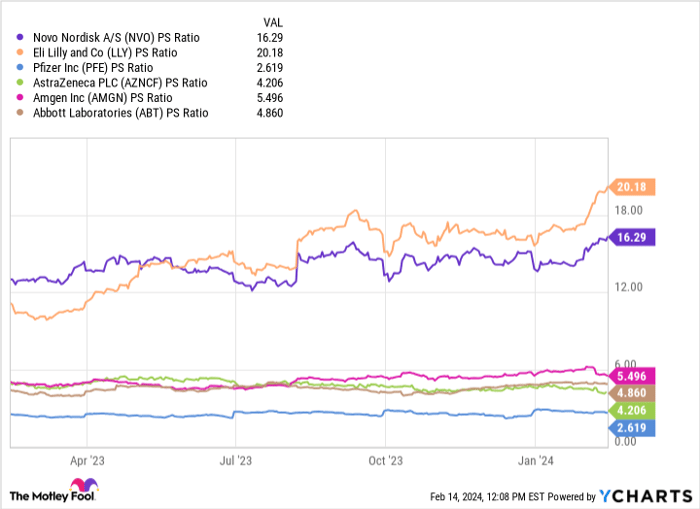
NVO PS ratio, data by YCharts.
The chart above illustrates the price-to-sales (P/S) ratio for Novo Nordisk and other pharmaceutical companies. Each of these companies is not necessarily a direct competitor to Novo Nordisk, but it’s important to understand what the markets could be implying given the graph above.
When it comes to GLP-1 medications and chronic weight management treatments, Eli Lilly is Novo Nordisk’s primary competition. Lilly is the developer of tirzepatide injections Mounjaro and Zepbound.
While Amgen, Pfizer, AstraZeneca, and Abbott Laboratories are all looking to make inroads in weight management in some capacity, it’s clear that Novo Nordisk and Eli Lilly are garnering the most attention. The disparity in trading multiples of Novo Nordisk and Lilly compared to the rest of the cohort is obvious.
It’s clear that Novo Nordisk is trading at a premium, but its P/S multiple of 16.3 is notably lower than for the primary competition. To me, it still has a lot of room to go despite the stock’s impressive run-up over the last year. The long-term prospects of Wegovy — supplemented by increased manufacturing output and potential new applications — should not be discounted.
A prudent strategy could be to use dollar-cost averaging to begin building a long-term position or augmenting an existing holding. The future looks bright — and a one-two punch from Ozempic and Wegovy could spell the beginning of a long, sustainable period of growth for one of the world’s leading pharmaceutical brands.
Should you invest $1,000 in Novo Nordisk right now?
Before you buy stock in Novo Nordisk, consider this:
The Motley Fool Stock Advisor analyst team just identified what they believe are the 10 best stocks for investors to buy now… and Novo Nordisk wasn’t one of them. The 10 stocks that made the cut could produce monster returns in the coming years.
Stock Advisor provides investors with an easy-to-follow blueprint for success, including guidance on building a portfolio, regular updates from analysts, and two new stock picks each month. The Stock Advisor service has more than tripled the return of S&P 500 since 2002*.
See the 10 stocks
*Stock Advisor returns as of February 12, 2024
JPMorgan Chase is an advertising partner of The Ascent, a Motley Fool company. Adam Spatacco has positions in Eli Lilly and Novo Nordisk. The Motley Fool has positions in and recommends Abbott Laboratories, JPMorgan Chase, and Pfizer. The Motley Fool recommends Amgen, AstraZeneca Plc, and Novo Nordisk. The Motley Fool has a disclosure policy.
The views and opinions expressed herein are the views and opinions of the author and do not necessarily reflect those of Nasdaq, Inc.
5 Stocks Our Experts Predict Could Double In the Next Year
By submitting your email, you'll also get a free pivot & flow membership. A free daily market overview. You can unsubscribe at any time.