Can Nvidia Corp.’s (NVDA) stock surge to even greater heights?
Following a remarkable earnings report, Nvidia Corp. saw its stock catapult over 15%, propelling its market value to spike by a significant $265 billion. This surge surpasses the total market capitalization of well-known American giants like McDonald’s Corp. (MCD), The Walt Disney Co. (DIS), and The Coca-Cola Co. (KO).
The momentum from Nvidia’s performance also sent the S&P 500 to a record high, which bodes well for investors.
Undoubtedly, the accomplishments achieved by Nvidia and the U.S. stock market merit commendation, perhaps even warranting a triumphant parade.
However, amidst these accolades, it’s vital to acknowledge the transient nature of glory, particularly within the realm of soaring stocks. High valuations are not perpetual.
Currently, Nvidia’s stock commands a price that is 65 times its annual earnings – roughly three times higher than the market average. This elevated valuation may be fitting for a dominant entity like Nvidia, or conceivably, it could justify trading at a multiple of 100 times earnings.
Entities like Nvidia often operate by their own set of regulations, at least for a time. Nevertheless, during these jubilant moments, investors should bear in mind the cyclical nature of markets. Elevated valuations will eventually give way to more modest figures.
Think of Nvidia as akin to a triumphant Roman commander from antiquity, parading through the streets in a grand chariot following a victorious battle. Legend has it that the commander would be accompanied by a servant, holding a golden crown above his head while whispering, “Memento mori,” a reminder that transcendence is temporary.
In the midst of celebration, it is easy to disregard lofty valuations – be it Nvidia’s or that of the broader U.S. stock market. Yet, drawing from years of historical data, the S&P 500’s current valuation rests within the upper decile of its historic range, signifying a notable high.
Though, borrowing from Shakespeare, the intent here is not to denigrate the U.S. stock market, but to exalt it.
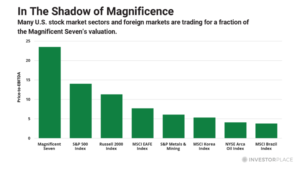
It is true that the U.S. stock market exhibits high average valuations. However, a deeper dive beyond the “Magnificent 7” stocks the likes of Nvidia – as showcased in the illustration below – unveils that the remaining 493 stocks within the S&P 500 are not as expensive. This indicates that numerous undervalued opportunities are concealed amidst the glittering allure of the premium stocks captivating investor attention.
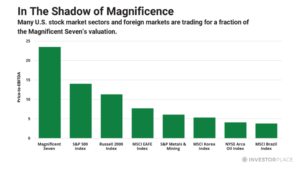
Therefore, instead of fixating on the soaring valuations prevalent in the stock market, investors should contemplate gradual shifts from high-priced stocks to undervalued counterparts. The U.S. market still harbors numerous compelling investment prospects.
Furthermore, foreign stock markets merit renewed consideration. While U.S. stock prices have surged due to increased multiples over the past decade and a half, many global markets have experienced contractions. A prime example lies in Brazilian stocks.
As showcased in the graphic below, Brazilian and U.S. stocks shared nearly identical valuations in the early 2000s. However, their trajectories diverged around a decade ago, leading to a consistent separation.
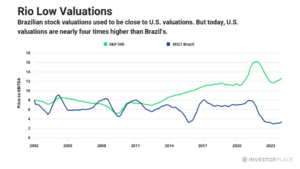
Presently, U.S. stocks stand at nearly four times the valuation of Brazilian stocks across various metrics. While this substantial variance doesn’t categorically declare Brazilian stocks as a “Buy,” it is strongly believed that they harbor significant potential for growth.
Warm Regards,
Eric Fry
5 Stocks Our Experts Predict Could Double In the Next Year
By submitting your email, you'll also get a free pivot & flow membership. A free daily market overview. You can unsubscribe at any time.