Nvidia’s Market Surge and Future Growth Amid Trade Concerns
Nvidia (NASDAQ: NVDA) has impressively increased its market capitalization by $2.5 trillion since the beginning of 2023, driven by a significant rise in sales of its superior data center chips, particularly for artificial intelligence (AI) applications. However, the stock has declined by 22% from its peak as investors cautiously assess escalating tensions between the U.S. and its trading partners.
President Donald Trump’s tariffs do not apply to semiconductors, yet investor anxiety remains high regarding potential economic slowdowns that could lead Nvidia’s clients to cut back on chip purchases.
Ongoing Investment in AI Infrastructure
Recent guidance from prominent AI companies does not indicate any imminent spending slowdown. Investors await crucial updates on May 28, when Nvidia is set to report its financial results for the first quarter of fiscal 2026 (ending April 27). This report could influence stock performance significantly.
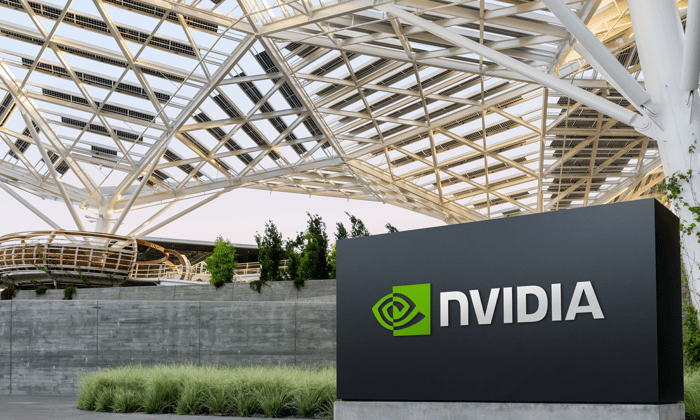
Image source: Nvidia.
Nvidia’s H100 graphics processing unit (GPU) has been the top choice for AI developers in 2023, securing a remarkable 98% market share. While it continues to dominate, there is increasing interest in Nvidia’s newer chips, based on Blackwell and Blackwell Ultra architectures. The upcoming Blackwell Ultra GB300, expected to ship in the latter half of this year, can deliver up to 50 times more performance than the H100 in certain configurations, making it suitable for advanced AI models that prioritize accuracy.
Understanding Nvidia’s Demand Drivers
CEO Jensen Huang noted that reasoning models require 100 times more computing power, raising the stakes for performance to ensure user satisfaction. This growing demand for enhanced computing capabilities bodes well for Nvidia’s long-term sales potential, regardless of global trade tensions.
Key clients including Meta Platforms, Amazon, Microsoft, and Alphabet anticipate spending around $320 billion in 2025 on AI-related infrastructure and chips. Although there are worries about potential downward pressure on their capital expenditures (capex) due to tariffs, these companies have not changed their spending plans. In fact, Meta recently increased its capex forecast from $60-65 billion to $64-72 billion.
Financial Results on the Horizon
Nvidia’s guidance indicates an expected revenue of about $43 billion for the first quarter of fiscal 2026, marking a 65% increase year-over-year. Historically, the data center segment has contributed almost 90% of Nvidia’s total revenue, driven by AI GPU sales.
Analysts project earnings per share (EPS) at $0.89 for the quarter, a 46% rise from the previous year. This figure is critical, as it directly impacts Nvidia’s stock valuation.
Looking Ahead: Q2 Guidance and Market Reaction
Investors will closely monitor Nvidia’s guidance for the second quarter of fiscal 2026, as it will clarify expectations regarding potential declines in AI spending due to economic uncertainties. Current consensus estimates suggest total revenue guidance of approximately $46.4 billion. Falling short of this forecast could trigger a sell-off in Nvidia stock.
Potential for Stock Recovery
Despite a 22% drop from its all-time high, the stock could see a resurgence post-Q1 results. Strong financial performance may quell investor fears regarding economic headwinds and provide a path for continued growth.
Valuation plays a crucial role in this outlook. With a fiscal 2025 EPS of $2.99, Nvidia’s stock trades at a price-to-earnings (P/E) ratio of nearly 40, which is significantly lower than its 10-year average of 59.7. Moreover, Wall Street projects $4.41 EPS for fiscal 2026, resulting in a forward P/E of 26.4. Thus, the stock would need to increase by 126% to align with its historical average.

NVDA PE Ratio data by YCharts
Looking forward, Huang anticipates annual data center spending could reach $1 trillion by 2028, primarily owing to the computational demands of reasoning AI models. On May 28, Nvidia may also share updates regarding its forthcoming Rubin GPU architecture, expected to enhance performance by 3.3 times compared to Blackwell Ultra, paving the way for more advanced AI applications.
Ultimately, the May 28 report could not only address short-term concerns but also reinforce Nvidia’s long-term position in the AI sector.
Expert Analysts Reveal New Stock Recommendations for Potential Growth
Do you ever feel like you missed out on buying top-performing stocks? If so, this information may interest you.
Our team of financial analysts occasionally issues a “Double Down” stock recommendation for companies they believe are poised for significant growth. If you’re concerned that you’ve already lost the chance to invest, now may be the prime opportunity to act before it’s too late. The numbers indicate strong potential:
- Nvidia: Investing $1,000 when we doubled down in 2009 would now be worth $302,503!*
- Apple: A $1,000 investment from our 2008 recommendation would be valued at $37,640!*
- Netflix: If you had invested $1,000 when we doubled down in 2004, that amount would be worth $614,911!*
Currently, we are issuing “Double Down” alerts for three exceptional companies, available to those who join our Stock Advisor service. Opportunities like this may not come around again soon.
*Stock Advisor returns as of May 12, 2025
Suzanne Frey, an executive at Alphabet, is on The Motley Fool’s board of directors. Randi Zuckerberg, former market development director at Facebook and sister of Meta Platforms CEO Mark Zuckerberg, also serves as a board member. John Mackey, former CEO of Whole Foods Market, is a board member as well. Anthony Di Pizio has no shares in any of the mentioned stocks. The Motley Fool has positions in and recommends Alphabet, Amazon, Meta Platforms, Microsoft, and Nvidia. The Motley Fool also recommends long January 2026 $395 calls on Microsoft and short January 2026 $405 calls on Microsoft. The Motley Fool has a disclosure policy.
The views and opinions expressed herein are solely those of the author and do not necessarily reflect the opinions of Nasdaq, Inc.