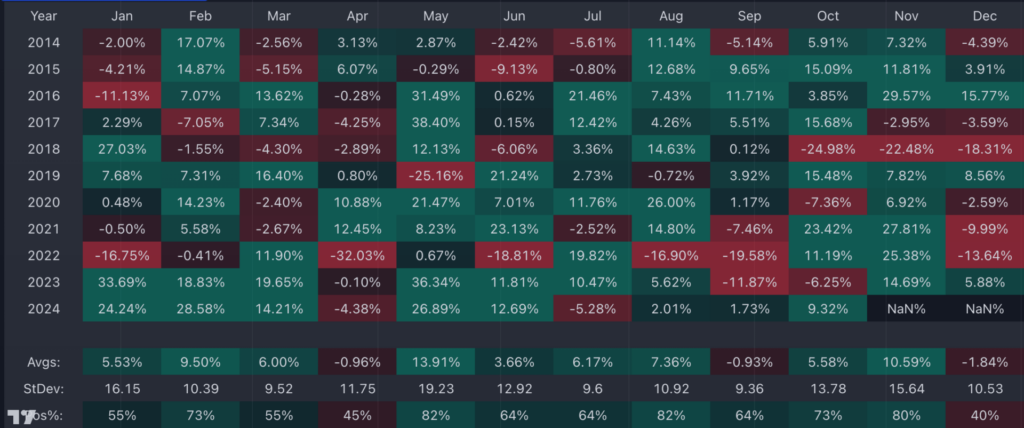
December is often a tough month for Nvidia Corp. NVDA investors. History shows that after its third-quarter earnings report, the semiconductor giant frequently experiences a temporary downturn.
Although Nvidia generally reports positive third-quarter earnings, the data indicates that December is a challenging month for its stock performance.
A Decade of December Dips for Nvidia
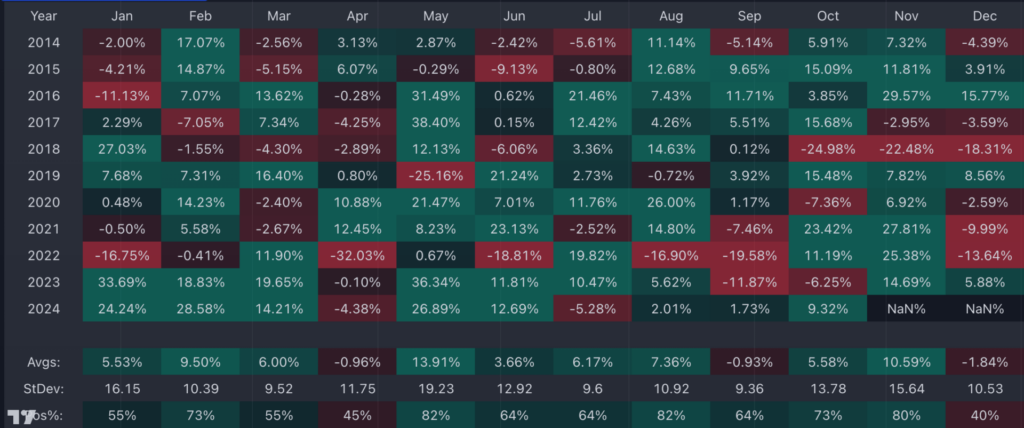
Over the past ten years, December has consistently been the weakest month for Nvidia shares. On average, the stock has dropped 1.84% during this month, marking the largest decline across all months.
In only four of the last ten years, about 40% of the time, did Nvidia manage to close December on a positive note.
The most significant drop took place in 2022, with shares plummeting 13.64%. Conversely, the best December was in 2016, which saw an impressive 15.77% gain. Despite these December challenges, Nvidia tends to rebound strongly in the first quarter of the following year.
From January to March, Nvidia has shown average gains of 5.5%, 9.5%, and 6.0%, respectively. Notably, May emerges as the standout month, averaging a return of 13.91%.
Nvidia’s December Declines Aren’t Earnings Related
At first, it might seem that Nvidia’s December struggles are linked to negative reactions from its third-quarter earnings, typically announced in mid-November. However, historical data contradicts this assumption.
In the past decade, Nvidia’s stock generally reacts positively right after earnings reports, boasting an average one-day increase of 2.57% following the announcement.
For example, shares jumped 29.81% after the 2016 earnings report and rose 13.86% in 2015. While certain years showed declines after earnings—like the 18.76% drop in 2018—the overall trend indicates that December’s difficulties are not directly correlated with earnings performance.
| Year | Q3 Earnings Date | 1-Day Reaction |
|---|---|---|
| 2023 | Nov. 21 | -2.46% |
| 2022 | Nov. 16 | -4.54% |
| 2021 | Nov. 17 | 8.25% |
| 2020 | Nov. 18 | 0.09% |
| 2019 | Nov. 14 | -2.67% |
| 2018 | Nov. 15 | -18.76% |
| 2017 | Nov. 9 | 5.27% |
| 2016 | Nov. 10 | 29.81% |
| 2015 | Nov. 5 | 13.86% |
| 2014 | Nov. 6 | -2.13% |
Profit-Taking Drives Year-End Declines
The December dip gives the impression of profit-taking rather than disappointing earnings. Nvidia has consistently provided impressive year-to-date returns, which likely encourages investors to cash out their profits before the year ends.
For example, an investor who purchased $100 worth of Nvidia stock on January 1 would have, on average, seen their investment grow to $188 by the end of November—an 88% return over eleven months. Such performance probably motivates investors to sell shares to realize gains, exerting downward pressure on the stock price.
This profit-taking trend is especially prominent in years like 2023, when Nvidia thrived amid the artificial intelligence (AI) boom, with shares surging by over 240% due to high demand for GPUs that support AI technology.
In these situations, the risks of holding onto Nvidia during December may outweigh potential rewards, prompting many investors to reduce their stock holdings.
Read Next:
Photo: Shutterstock
Market News and Data brought to you by Benzinga APIs